Hello everyone,
Today, I’d like to talk about the people who work at Japanese convenience stores.
Before we begin, one important note:
This article focuses on urban areas in Japan.
I have worked in convenience stores for about 30 years—as a part-time worker, assistant manager, store manager, and owner. Most of my experience comes from city locations, so I will only talk about what I have actually seen and experienced. If there is something I don’t know, I won’t pretend that I do. That is the basic policy of this blog.
1. About 35 Years Ago
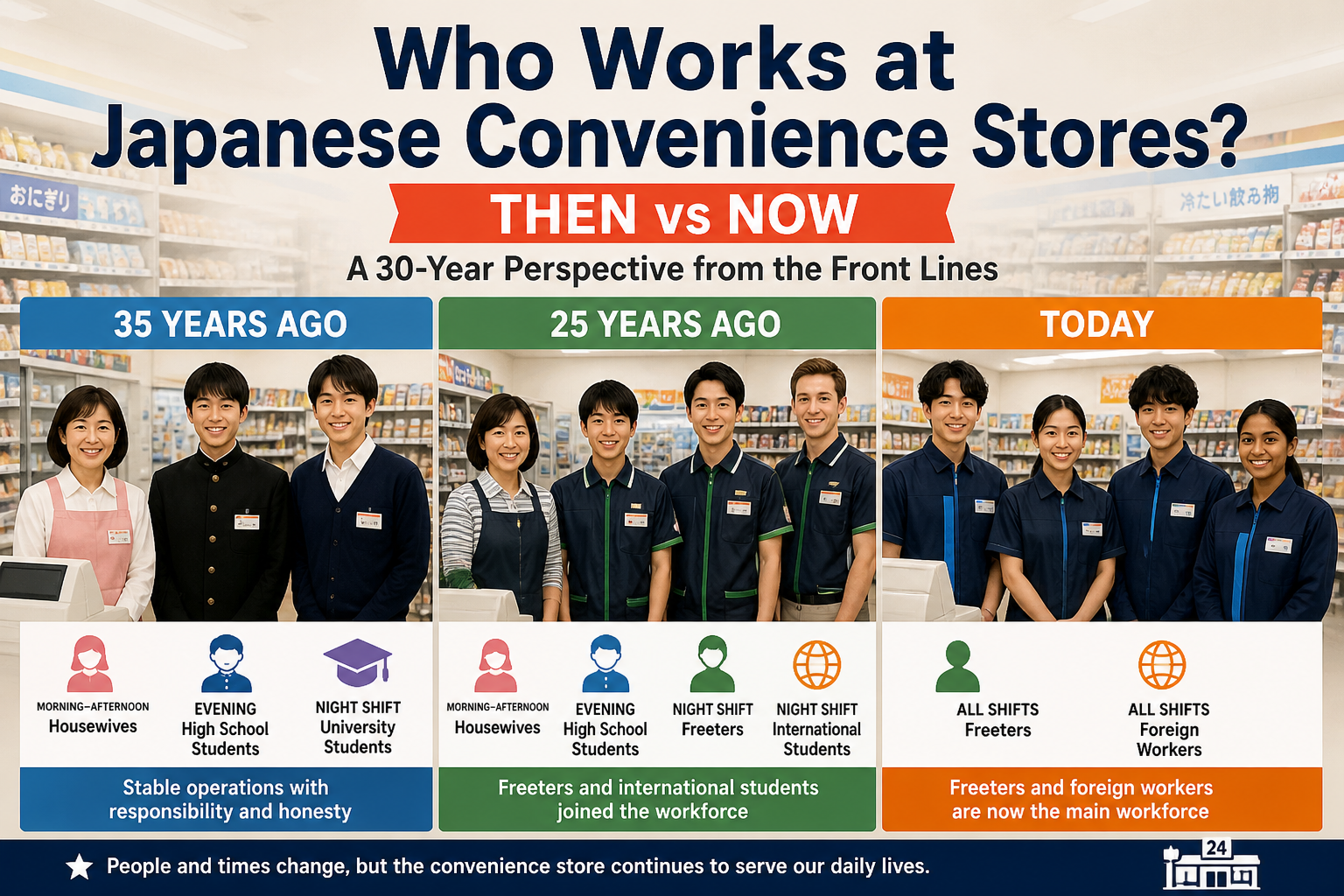
Around 35 years ago, the typical staff structure looked like this:
- Morning to afternoon: Housewives
- Evening: High school students
- Night shift: University students
At that time, what we now call “freeters” (people working part-time without full-time employment) were almost nonexistent.
Japan’s economy was strong, and it was relatively easy to find full-time jobs.
As a result, housewives worked to support household income, and students worked to earn pocket money.
You might wonder if such a workforce could run a store smoothly.
In reality, it worked very well.
There were two main reasons:
First, many housewives had prior work experience before marriage, so they had a strong sense of responsibility.
Second, students, while inexperienced, were generally honest and receptive to instructions.
Because of this, stores operated smoothly with relatively few serious problems.
2. About 25 Years Ago (The “Employment Ice Age”)
Around 25 years ago, things began to change.
The basic structure remained the same, but new groups started to appear:
- More freeters, especially on night shifts
- More international students
This was the period known as Japan’s “employment ice age,” when many people struggled to find full-time jobs.
As a result, more people worked as part-time staff.
At the same time, more international students began working in convenience stores.
Many of them were highly motivated and academically strong, even though they had to adapt to a new culture and language.
During this period, store operations were still relatively stable.
3. Today’s Convenience Stores
Today, the situation in urban areas has changed significantly.
- Fewer housewives
- Fewer students
- More freeters and foreign workers
One major reason is the rise of dual-income households.
In cities, many women continue working after marriage, leaving less availability for part-time jobs.
Another reason is Japan’s declining birthrate.
There are simply fewer young people than before.
In addition, students now have many more job options, so fewer choose to work at convenience stores.
As a result, convenience stores rely heavily on freeters and foreign staff.
4. Changes in the Workplace
From my experience, foreign staff members are still generally reliable and hardworking.
As for Japanese staff, the situation varies more from person to person.
Most people do their jobs properly, but in some cases, differences in experience can lead to misjudgment.
For example, a staff member may strictly enforce rules with good intentions, but handle a situation in a way that is not appropriate for customer service.
In many cases, this is not about ability, but rather about differences in work experience and perspective.
5. Conclusion
The people working in Japanese convenience stores have changed significantly over time:
- In the past: Housewives and students
- Then: Freeters and international students joined
- Today: Freeters and foreign workers are the main workforce
Even though the workforce has changed, convenience stores in Japan continue to function efficiently.
This is both a strength of the system—and, in some ways, a challenge for the future.
Thank you for reading.
Related Articles
- Dream Chasers Working at Japanese Convenience Stores
A look at the many people pursuing difficult dreams while working part-time at Japanese convenience stores. - Do Convenience Store Jobs Pay Well in Japan? (The Reality Explained)
How wages and economic realities influence who works at convenience stores in Japan today. - The Future of Convenience Store Owners in Japan
Why labor shortages and demographic changes are becoming major challenges for the convenience store industry.
コメント