Hello everyone.
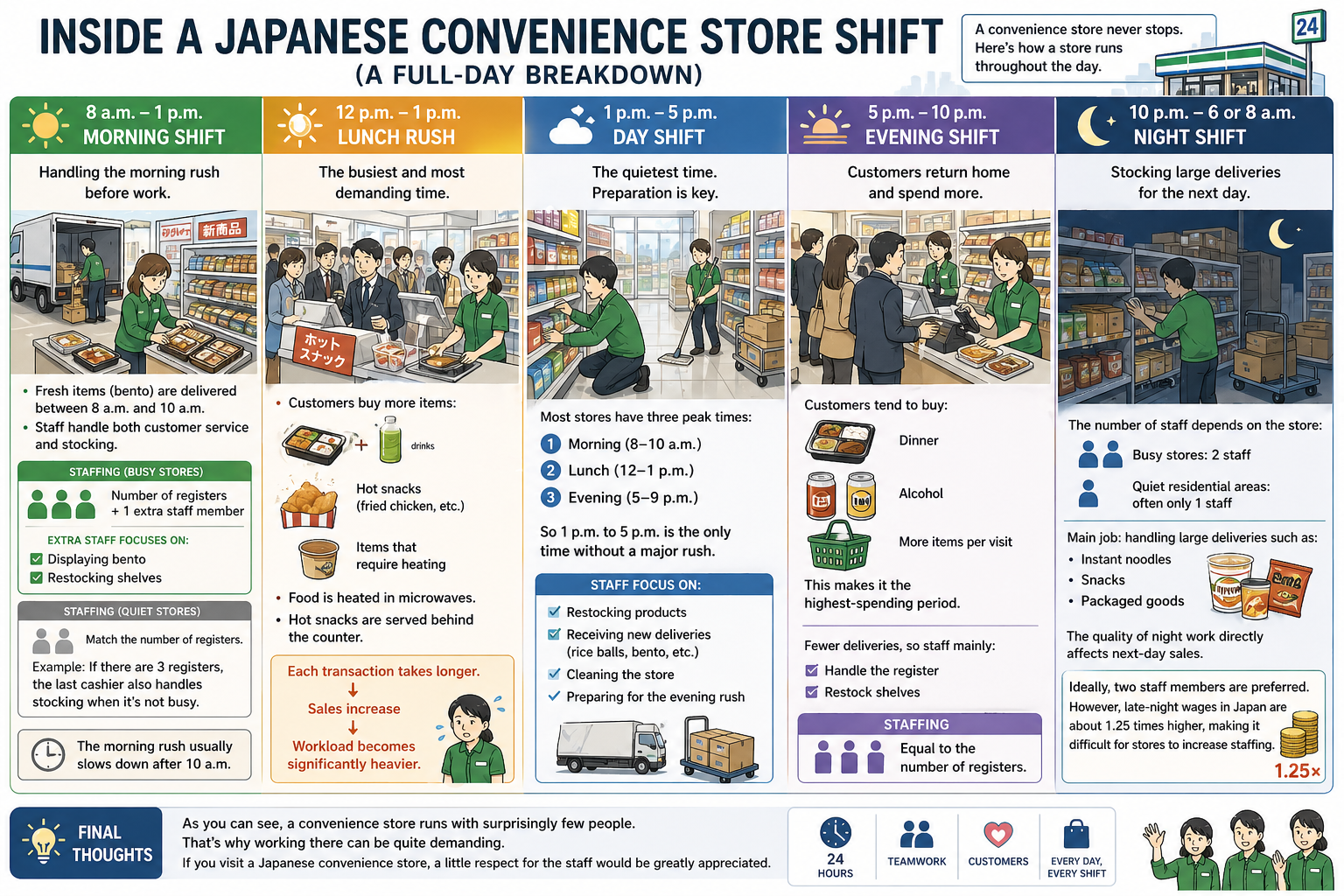
Today, I’ll walk you through a full day inside a Japanese convenience store.
This is not about a single worker’s shift, but how the entire store operates throughout the day.
Morning Shift (8 a.m. – 1 p.m.)
The main role of the morning shift is to handle the rush of customers heading to work.
In many stores, fresh items such as lunch boxes (bento) are delivered between 8 a.m. and 10 a.m.
So staff must handle both customer service and stocking at the same time.
In busy stores, staffing is typically:
number of registers + one extra staff member
That extra person focuses on:
- Displaying bento
- Restocking shelves
In quieter stores, staffing usually matches the number of registers.
For example, if there are three registers, the last cashier also handles stocking when it’s not busy.
The morning rush usually slows down after 10 a.m.
After that, staff begin preparing for the next major peak.
Lunch Rush (12 p.m. – 1 p.m.)
This is the busiest and most demanding time of the day.
Unlike the morning, customers tend to buy more items:
- Bento + drinks
- Hot snacks (fried chicken, etc.)
- Items that require heating
In Japan, convenience stores often heat food in microwaves for customers.
Staff also serve hot snacks behind the counter.
Because of this, each transaction takes longer than in the morning.
As a result:
- Sales increase
- Workload becomes significantly heavier
Day Shift (1 p.m. – 5 p.m.)
This is usually the quietest period of the day.
Most stores have three peak times:
- Morning (8–10 a.m.)
- Lunch (12–1 p.m.)
- Evening (5–9 p.m.)
So 1 p.m. to 5 p.m. is the only time without a major rush.
During this time, staff focus on:
- Restocking products
- Receiving new deliveries (rice balls, bento, etc.)
- Cleaning the store
- Preparing for the evening rush
Evening Shift (5 p.m. – 10 p.m.)
This is when customers return home from work.
They tend to buy:
- Dinner
- Alcohol
- More items per visit
This makes it the highest-spending period of the day.
Unlike earlier shifts, there are fewer deliveries, so staff mainly:
- Handle the register
- Restock shelves
Staffing is usually equal to the number of registers.
Night Shift (10 p.m. – 6 or 8 a.m.)
The number of staff depends on the store:
- Busy stores: 2 staff
- Quiet residential areas: often only 1 staff
The main job is handling large deliveries such as:
- Instant noodles
- Snacks
- Packaged goods
The quality of night work directly affects next-day sales.
Ideally, two staff members are preferred.
However, late-night wages in Japan are about 1.25 times higher, making it difficult for stores to increase staffing.
Final Thoughts
As you can see, a convenience store runs with surprisingly few people.
That’s why working there can be quite demanding.
If you visit a Japanese convenience store, a little respect for the staff would be greatly appreciated.
Related Articles
- How Deliveries Work at Japanese Convenience Stores (A Simple Guide)
How Japanese convenience stores manage constant product deliveries throughout the day. - Convenience Store Worker Breaks in Japan (The Reality Behind the Counter)
Why taking proper breaks can be surprisingly difficult for convenience store staff in Japan. - What Do Convenience Store Register Staff Actually Do?
A closer look at the many responsibilities handled by register staff during busy store operations.
コメント