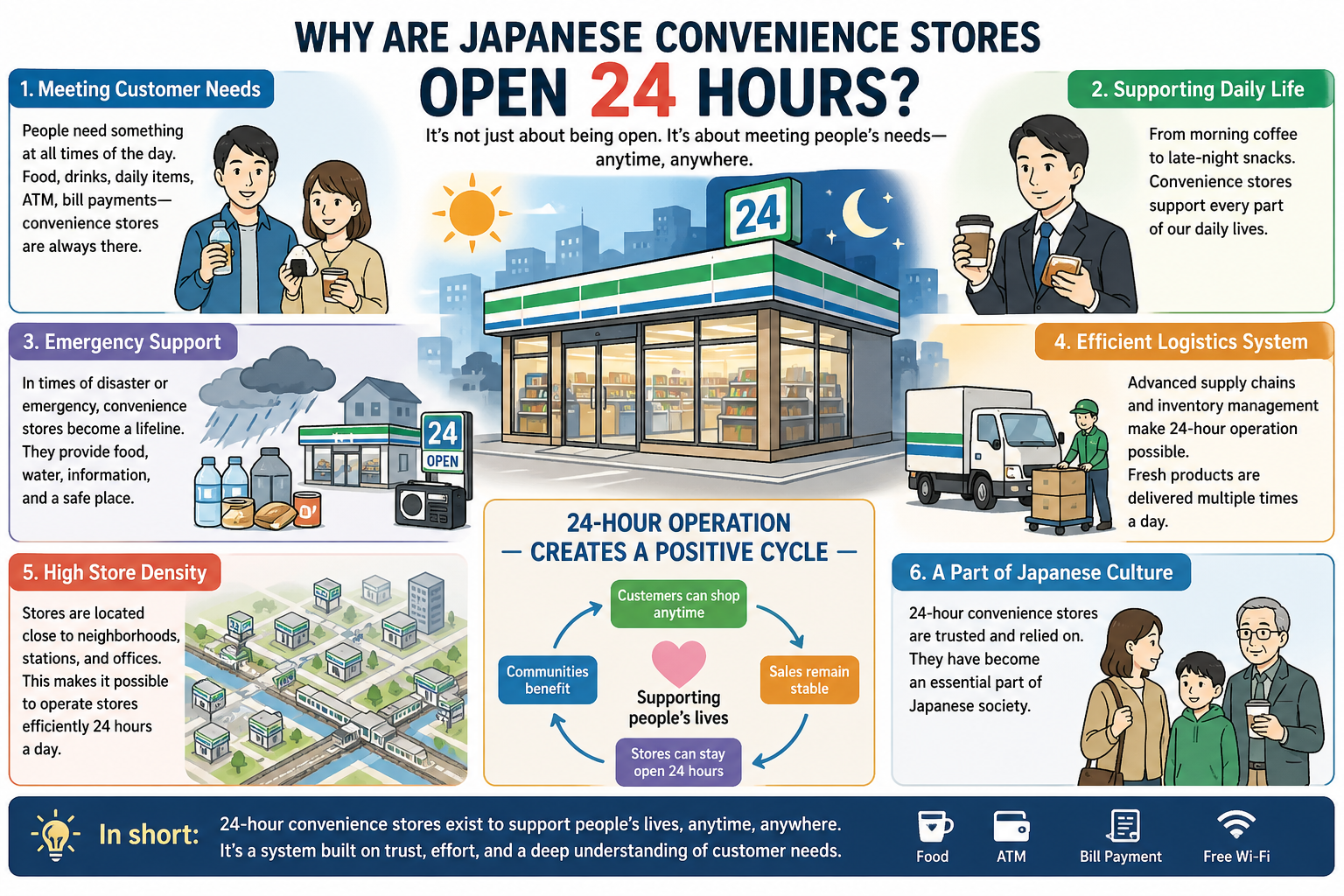
Why are convenience stores in Japan open 24 hours a day, even in areas with very few customers at night?
The answer is more complex than you might think.
Today, I’d like to explain why convenience stores in Japan operate around the clock.
How 24-Hour Operation Started
In the past, many convenience stores were open from around 7:00 a.m. to 11:00 p.m.
In fact, the name “7-Eleven” originally came from those business hours.
However, not long after convenience stores were introduced in Japan, some stores began operating 24 hours a day.
From my experience, the shift to 24-hour operation was not part of a grand strategy at first.
It likely started as an experiment. However, customer response turned out to be much better than expected, and as a result, it became difficult to go back.
Why Customers Love 24-Hour Stores
From a customer’s point of view, having a store open at any time is extremely convenient.
Even if someone only uses a convenience store once a month, they still appreciate knowing it is always available.
That sense of “you can go anytime” creates a feeling of security.
There is also an important role in crime prevention.
For example, when someone walks home late at night, especially after work, a brightly lit store with staff inside provides reassurance.
From a criminal’s perspective, areas with light and human activity are less attractive targets.
Because of these social benefits, 24-hour operation became widely accepted and expected.
The Downsides for Businesses
However, from a business perspective, the situation is more complicated.
Late-night hours are generally less profitable.
There are fewer customers, while labor costs are higher—typically 1.25 times the daytime wage due to legal requirements.
This means that, strictly speaking, operating at night is not always efficient for individual stores.
How the System Adapted
So how did the system adapt?
One major change was the development of centralized delivery systems.
In the past, different suppliers delivered products separately during the day—instant noodles, beverages, and other goods all arrived at different times.
Today, many of these deliveries are consolidated through distribution centers and scheduled during late-night hours.
This system reduces transportation costs, improves efficiency, and allows stores to focus on sales during the day and restocking and cleaning at night.
In this way, late-night operations were given a clear role within the overall system.
Is 24-Hour Operation Still Necessary?
That said, the situation is changing again.
Since the Great East Japan Earthquake in 2011, concerns about energy consumption have increased.
In addition, rising labor costs and staff shortages have led to growing debate about whether 24-hour operation is truly necessary.
As a result, some convenience store chains in Japan have started to allow shorter business hours under certain conditions—something that was previously unthinkable.
Conclusion
If you visit Japan, you will quickly realize that convenience stores are not just shops—they are part of the infrastructure of daily life.
Related Articles
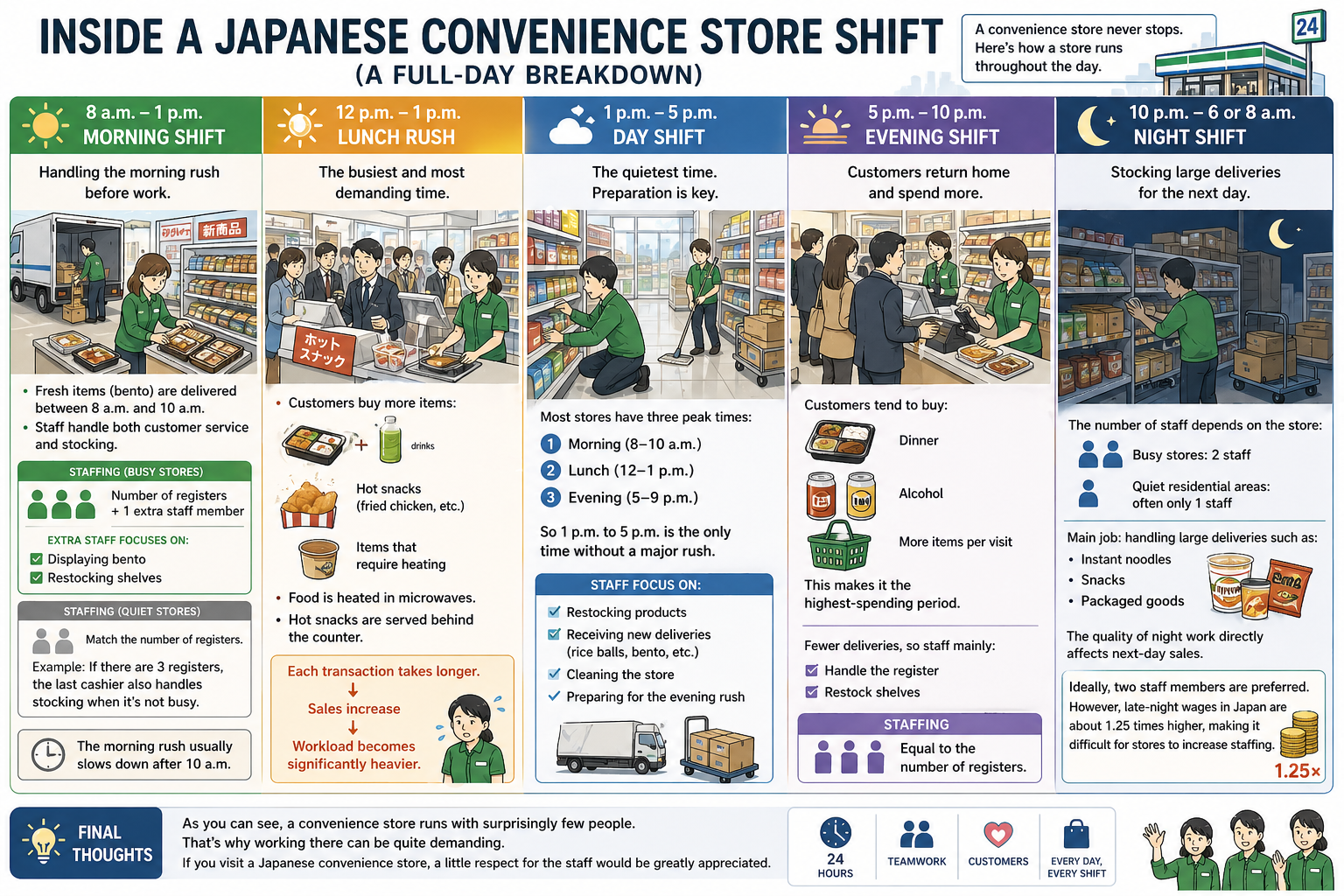
- What Is a Japanese Convenience Store Shift Like? (Full Guide)
A full behind-the-scenes look at how Japanese convenience stores operate throughout the day and night. - The Future of Convenience Store Owners in Japan
Why labor shortages and operational pressure are becoming major issues for convenience store owners. - The Limits of Japanese Convenience Stores
How changing social conditions are forcing Japanese convenience stores to rethink older systems and assumptions.
コメント