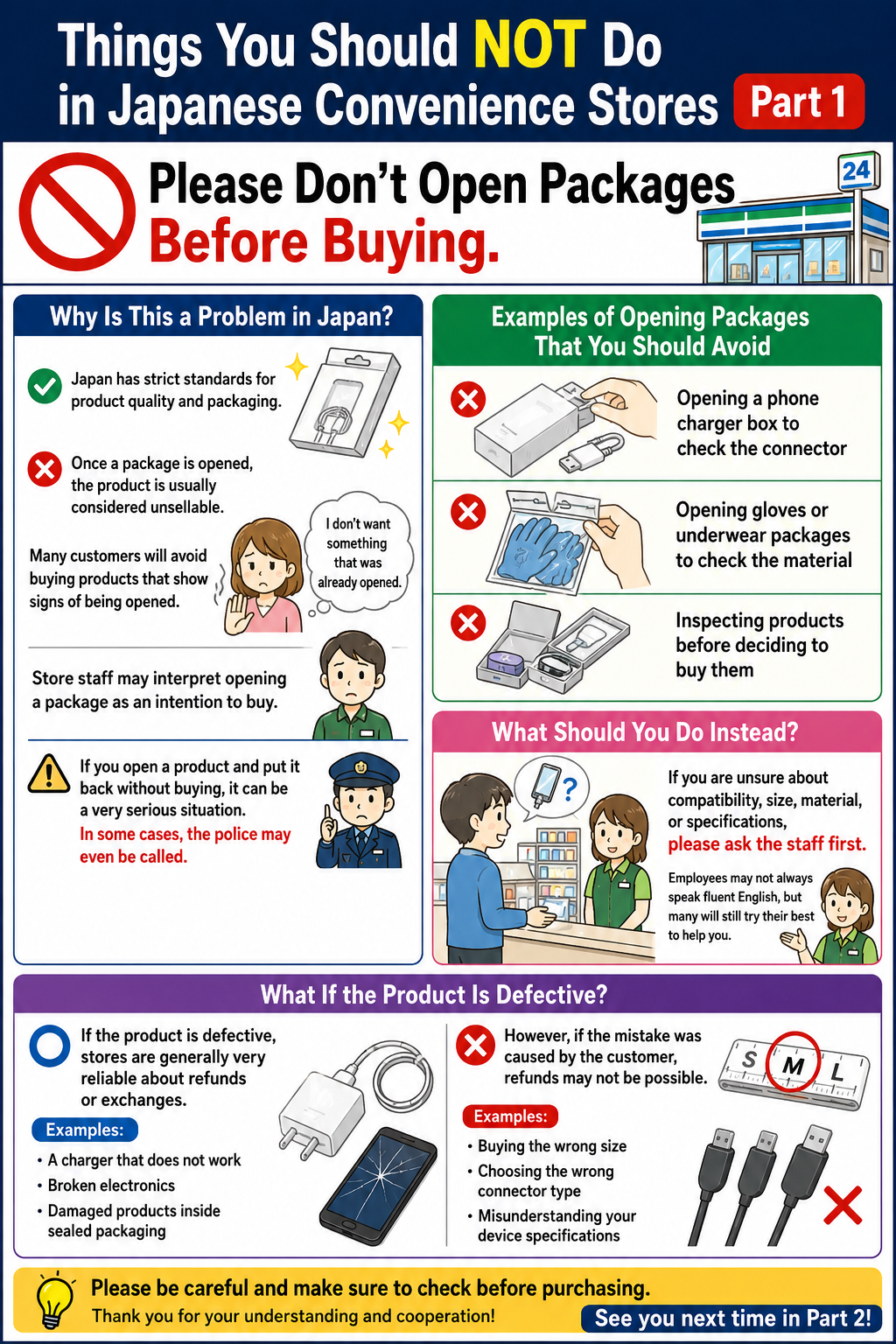
Please Don’t Open Packages Before Buying
Hello everyone.
Today, I’d like to start a new mini-series:
👉 “Things You Should NOT Do in Japanese Convenience Stores.”
Japanese convenience stores are usually very safe, convenient, and customer-friendly.
However, there are also some cultural rules and expectations that foreign visitors may not realize.
One of those is:
👉 Please do not open product packages before purchasing them.
Why Do Some Visitors Open Packages?
In some countries, it is relatively normal for customers to:
- open a charger box to check the connector,
- touch gloves or clothing material,
- or inspect products before deciding to buy them.
So many visitors do not think this behavior is a problem.
However, in Japan:
👉 opening packages inside a convenience store can create serious trouble.
Why Is This a Problem in Japan?
Japan has very strict standards regarding packaging and product condition.
Once a package has been opened:
👉 many Japanese customers no longer want to buy it.
Even if the item itself is perfectly fine, people may feel:
- “Someone already touched this.”
- “Maybe something is missing.”
- “It feels unsafe.”
As a result:
👉 stores may consider the item damaged or unsellable.
Because of this, staff may interpret opening a package as:
👉 an intention to purchase the item.
If someone opens a product and then tries to put it back on the shelf, staff may become extremely concerned.
In some situations:
👉 the police may even be called.
Convenience Stores Are Different From Large Electronics Stores
Large electronics stores sometimes provide:
- display models,
- testing areas,
- or opened sample products.
Convenience stores usually do not.
Most convenience stores operate with:
- limited shelf space,
- small inventory,
- and fast product turnover.
So once packaging is damaged:
👉 the store may have no way to sell the product.
What Should You Do Instead?
If you are unsure about:
- compatibility,
- size,
- material,
- or specifications,
please ask the staff first.
Convenience store workers may not speak perfect English, but many will still try their best to help you.
In many cases, simply showing your phone or device can make communication much easier.
What If the Product Is Defective?
If you buy a product and later discover that it is defective:
👉 do not worry.
Japanese stores are generally very reliable when dealing with genuine defects.
For example:
- chargers that do not work,
- broken electronics,
- or damaged items inside sealed packaging.
In these situations, stores will often help you with exchanges or refunds.
However:
👉 customer mistakes are usually treated differently.
For example:
- buying the wrong size,
- choosing the wrong connector,
- or misunderstanding your device specifications.
In these cases, refunds may not be possible.
So please check carefully before purchasing.
Thank you for reading.
See you next time for:
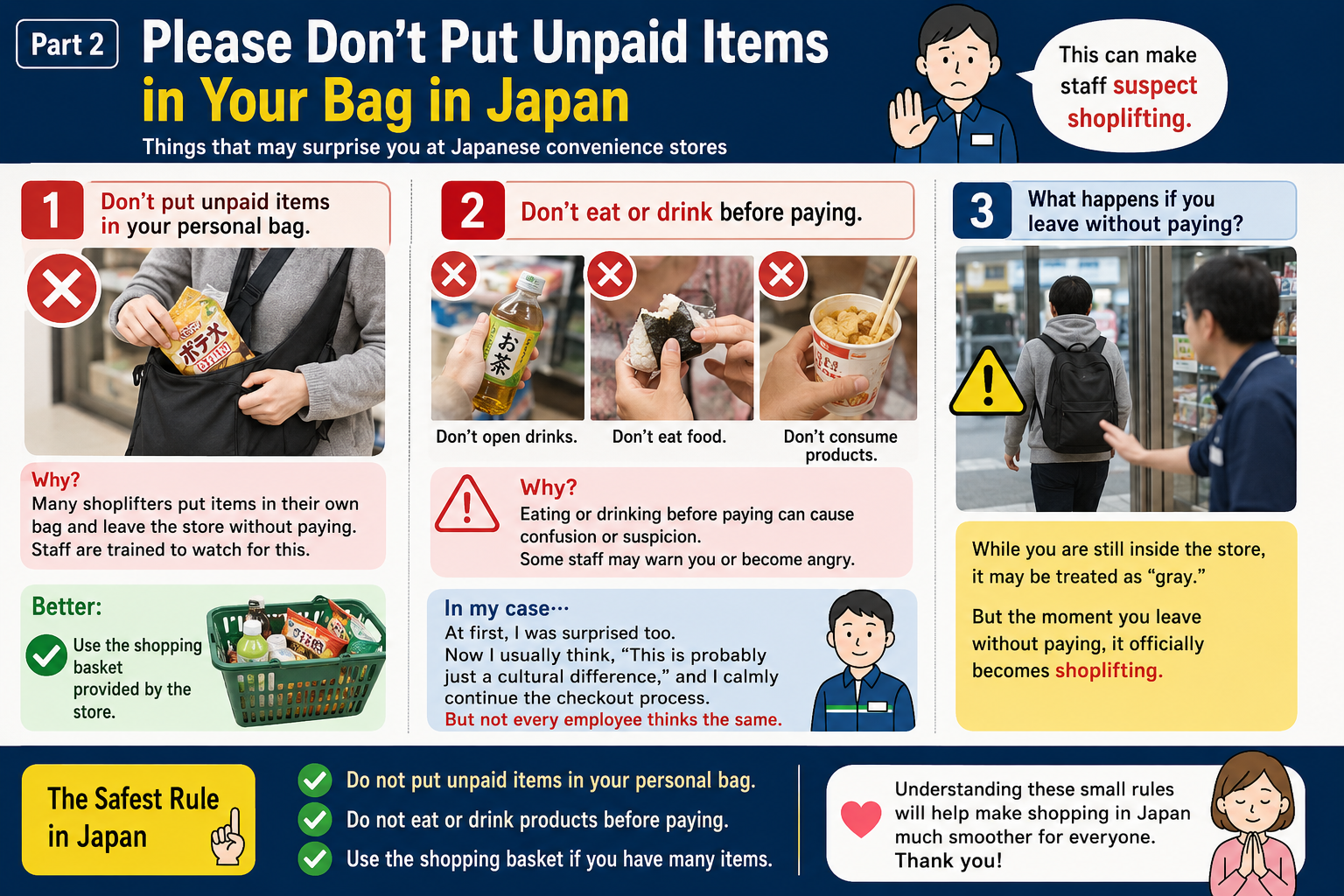
👉 Things You Should NOT Do in Japanese Convenience Stores (Part 2)
Related Articles
- Things You Should NOT Do in Japanese Convenience Stores (Part 1)
Another behavior that can easily make Japanese convenience store staff suspect shoplifting. - Are Japanese People Really Polite? — A Convenience Store Worker’s Perspective
A convenience store worker’s perspective on Japanese manners and customer behavior. - How Do Japanese Convenience Stores Prevent Crime? (Part 1)
How Japanese convenience stores handle security, theft prevention, and suspicious situations.
コメント