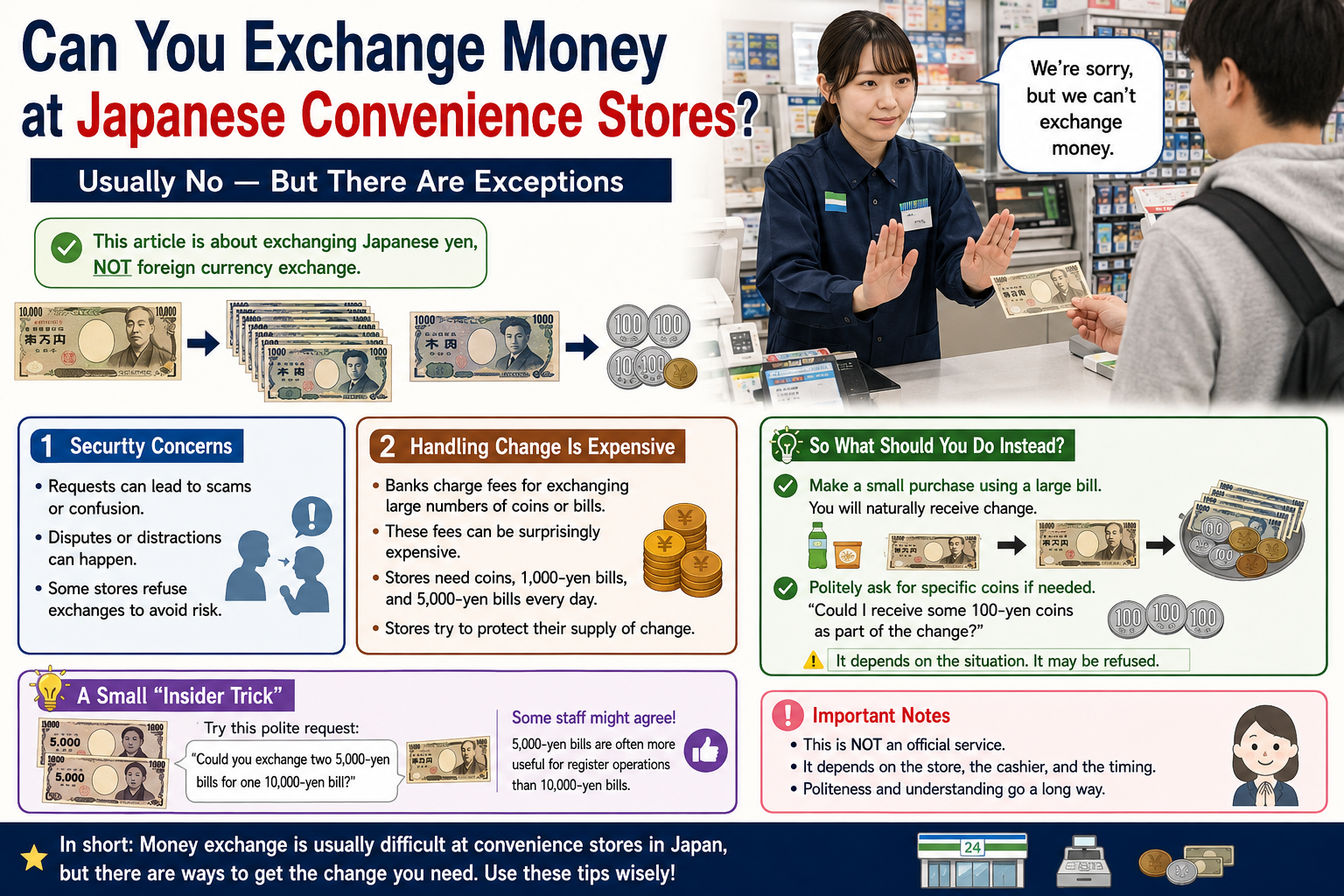
(Usually No — But There Are Exceptions)
Hello everyone.
Today, I’d like to talk about exchanging money at Japanese convenience stores.
But first, an important clarification:
👉 I am not talking about foreign currency exchange.
Some convenience stores may have currency exchange machines operated by outside companies, but that is a completely separate service.
Today’s topic is only about:
👉 exchanging Japanese yen.
For example:
- changing one 10,000-yen bill into ten 1,000-yen bills
- changing a 1,000-yen bill into 100-yen coins
Many visitors to Japan eventually try this at a convenience store.
However:
👉 there is a high chance the request will be refused.
Why?
There are two major reasons.
1. Security Concerns
One reason is security.
Unfortunately, money exchange requests can sometimes create confusion or even be connected to scams.
For example:
- someone may try to receive more money than they originally handed over
- another person may distract the cashier during the exchange
- customers may later claim they already gave money to staff
Because convenience stores are often busy environments, many stores prefer to avoid these risks entirely.
As a result:
👉 some stores simply refuse money exchange requests as a rule.
2. Handling Small Change in Japan Is Surprisingly Expensive
The second reason is surprisingly practical:
👉 coins and small bills are valuable for store operations.
Convenience stores constantly need:
- coins
- 1,000-yen bills
- 5,000-yen bills
to keep registers operating smoothly.
At the same time, many Japanese banks charge handling fees for exchanging large numbers of coins or bills.
In some cases:
👉 the fees can be surprisingly expensive.
Because of this:
👉 stores generally try to protect their supply of change whenever possible.
This is one reason many stores avoid unnecessary money exchanges.
So What Should You Do Instead?
To be honest, as a convenience store worker, I probably should not say this…
But many visitors solve the problem very simply:
👉 they make a small purchase using a large bill.
For example:
If you buy a drink or a small snack using a 10,000-yen bill, you will naturally receive change.
Compared with paying exchange fees elsewhere:
👉 this is often much easier.
Some customers also politely ask:
👉 “Could I receive some 100-yen coins as part of the change?”
Depending on the store situation, staff may agree.
However:
👉 if the store is busy or running low on coins, the request may still be refused.
A Small “Insider Trick”
Finally:
Is money exchange always impossible at Japanese convenience stores?
Actually:
👉 sometimes the answer is no.
This depends entirely on the cashier and the store situation.
For example:
Many convenience stores do not use many 10,000-yen bills during normal operations.
Stores rarely give them out as change.
So if you politely ask:
👉 “Could you exchange two 5,000-yen bills for one 10,000-yen bill?”
some staff members might agree.
Why?
Because:
👉 5,000-yen bills are often more useful for register operations than 10,000-yen bills.
Of course:
👉 this is not an official service.
Think of it more as a small convenience store insider trick — and something that depends on timing, politeness, and the situation at the store.
See you next time!
Related Articles
- The Mystery of the Disappearing 10,000-Yen Bills
Why 10,000-yen bills seem to “disappear” inside Japanese convenience store registers. - Confused by Japanese Coins? Here’s the Easiest Way to Pay at Convenience Stores
A practical guide to understanding Japanese coins and how to pay more easily. - Why You Have to Press “YES” When Buying Alcohol in Japan (And Why It Doesn’t Really Work)
Another example of a small but surprisingly confusing system many foreign visitors encounter at Japanese convenience stores.
コメント