Hello everyone.
Today, I’d like to talk about something that often confuses foreign visitors in Japanese convenience stores:
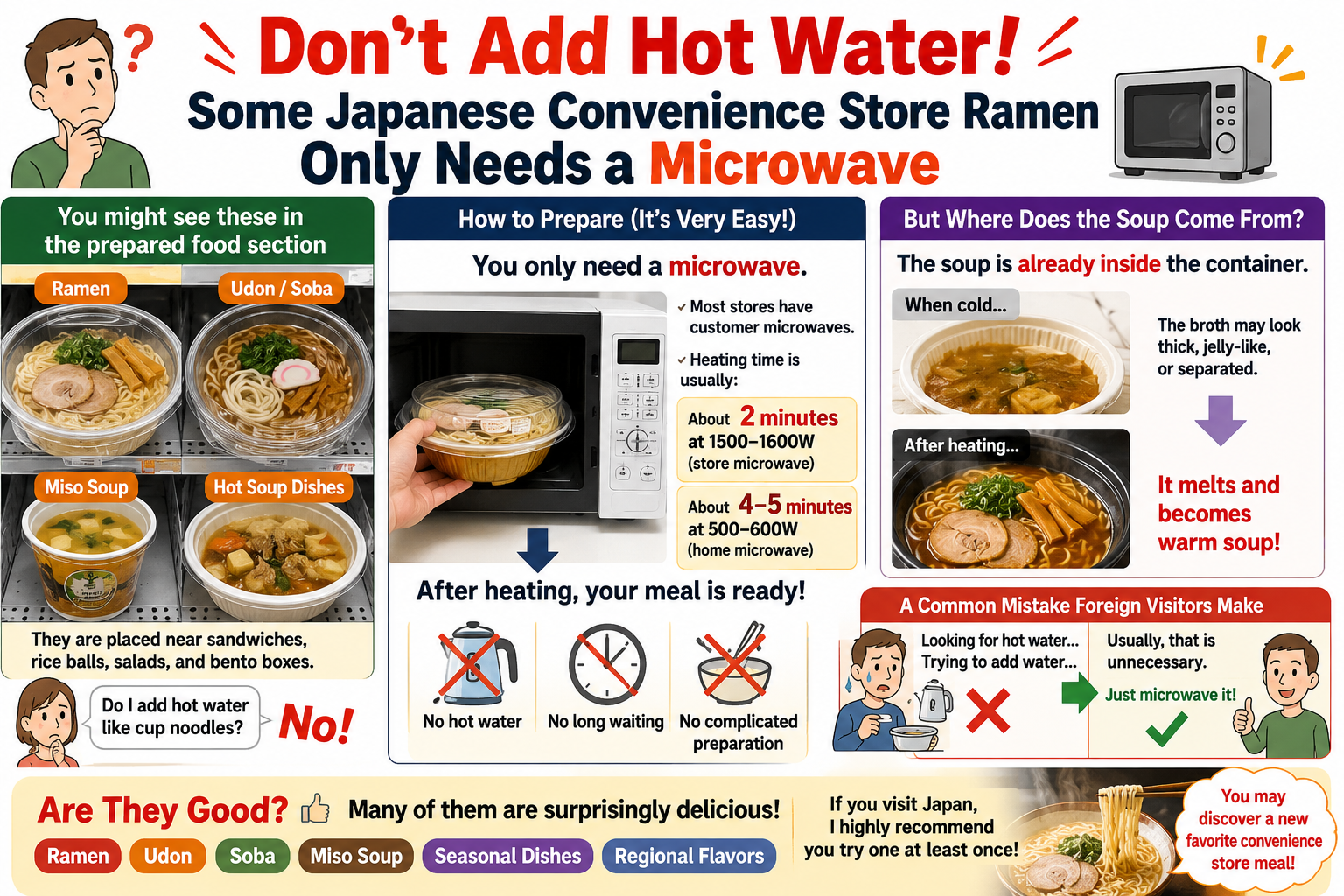
👉 ramen and soup sold in the prepared food section.
Have you ever seen:
- ramen bowls
- udon or soba noodle soups
- miso soup
- hot soup dishes
placed near:
👉 sandwiches, rice balls, salads, or boxed meals?
Many foreign visitors naturally assume:
👉 “Do I need to add hot water like cup noodles?”
Actually:
👉 most of these products do NOT need hot water at all.
And honestly:
👉 they are often much easier to prepare than instant cup noodles.
The Difference Between Cup Noodles and Prepared Meals
This is the important part:
👉 these are not instant noodles.
Japanese convenience stores sell two different kinds of noodle products:
1. Cup Noodles (Need Hot Water)
These are the familiar instant noodles.
You:
- open the lid
- add hot water
- wait a few minutes
Then:
👉 it is ready to eat.
2. Prepared Noodle Meals (Microwave Only)
These are refrigerated meals found near:
👉 rice balls, sandwiches, and bento boxes.
For these:
👉 you usually only need a microwave.
No hot water required.
How Do You Prepare Them?
The process is very simple.
Most convenience stores in Japan have customer microwaves.
Usually, heating time is:
👉 about 2 minutes in a convenience store microwave (1500–1600W)
or:
👉 about 4–5 minutes at home (500–600W)
After heating:
👉 your meal is ready.
No waiting.
No mixing.
No extra preparation.
“But Where Does the Soup Come From?”
Many visitors wonder:
👉 “If I don’t add water, how does the soup appear?”
The answer is simple:
👉 the soup is already inside.
In many products:
👉 the broth is included in the container from the beginning.
When cold:
- it may look thick
- partially frozen
- jelly-like
- or separated
But:
👉 this is completely normal.
Once heated:
👉 it melts and becomes proper soup.
That is why these meals can be prepared so quickly.
A Common Mistake Foreign Visitors Make
At my store:
👉 I sometimes see international customers searching for hot water after buying these meals.
Some people even try to:
👉 open the container and add water like instant ramen.
But usually:
👉 that is unnecessary.
In most cases:
👉 you simply microwave it.
That’s all.
Are They Actually Good?
Honestly:
👉 many of them are surprisingly delicious.
Japanese convenience stores sell:
- ramen
- udon
- soba
- miso soup
- seasonal noodle dishes
- regional flavors
And sometimes:
👉 they taste much better than visitors expect.
Especially during winter:
👉 hot noodle soup from a convenience store can feel surprisingly comforting.
If you visit Japan:
👉 I highly recommend trying one at least once.
You may discover:
👉 your new favorite convenience store meal.
Thank you for reading, and see you next time!
Related Articles
👉 Best Japanese Cup Noodles for Beginners: What Should You Try in Japan?
Learn the differences between Japanese cup noodles and find beginner-friendly recommendations.
👉 How to Make Japanese Cup Ramen (The Right Way – No Microwave!)
A simple guide to preparing Japanese instant noodles the right way.
👉 Why Are Japanese Convenience Store Microwaves So Powerful?
Why convenience store microwaves in Japan heat food so incredibly fast.
👉 How Do You Heat Convenience Store Meals in Japanese Hotels?
Useful tips for heating convenience store meals safely in hotel microwaves.
👉 What You Can Get for Free at Japanese Convenience Stores (Most Tourists Don’t Know This)
Learn about free convenience store services, including food heating.
コメント