Hello everyone.
Today, I’d like to continue my series about the work of a Japanese convenience store manager.
This time, I’d like to talk about something many foreign visitors may wonder about:
👉 Why do Japanese convenience store staff often seem so consistent?
No matter which employee you meet, the service often feels surprisingly similar.
Of course:
👉 not every store is perfect.
However, in many Japanese convenience stores:
👉 there are detailed training systems behind the scenes.
And honestly:
👉 staff training is one of the most important jobs for a store manager.
Different Stores, Different Training Styles
Training methods vary from store to store.
For example:
Some stores let experienced part-time staff train new employees.
Some leave training to assistant managers.
Others prefer to teach new staff personally.
When I was a store manager:
👉 I always trained new employees myself.
Why?
Because the first person who trains someone often shapes how they work later.
That influence can be:
👉 positive or negative.
In other words:
👉 the first teacher leaves a lasting impression.
From a manager’s perspective:
training people personally also makes it easier to build a team that fits the store’s culture and expectations.
My Personal Training Method
Here, I’d like to explain how I personally trained staff.
Whenever I hired someone:
👉 I first scheduled three to four short daytime training shifts.
Usually:
👉 around four hours or less per day.
Why?
Because trying to teach everything at once often overwhelms people.
I wanted new employees to focus on:
👉 learning, not simply surviving exhaustion.
I also explained this policy before hiring.
If someone could not attend daytime training:
👉 unfortunately, I usually had to decline the application.
Why Daytime Training?
The reason was simple:
👉 daytime is usually the safest and easiest time to train while the store is fully operating.
There are customers.
Products are arriving.
Staff are moving around.
In other words:
👉 trainees can experience a “normal working environment” without the pressure of being left alone.
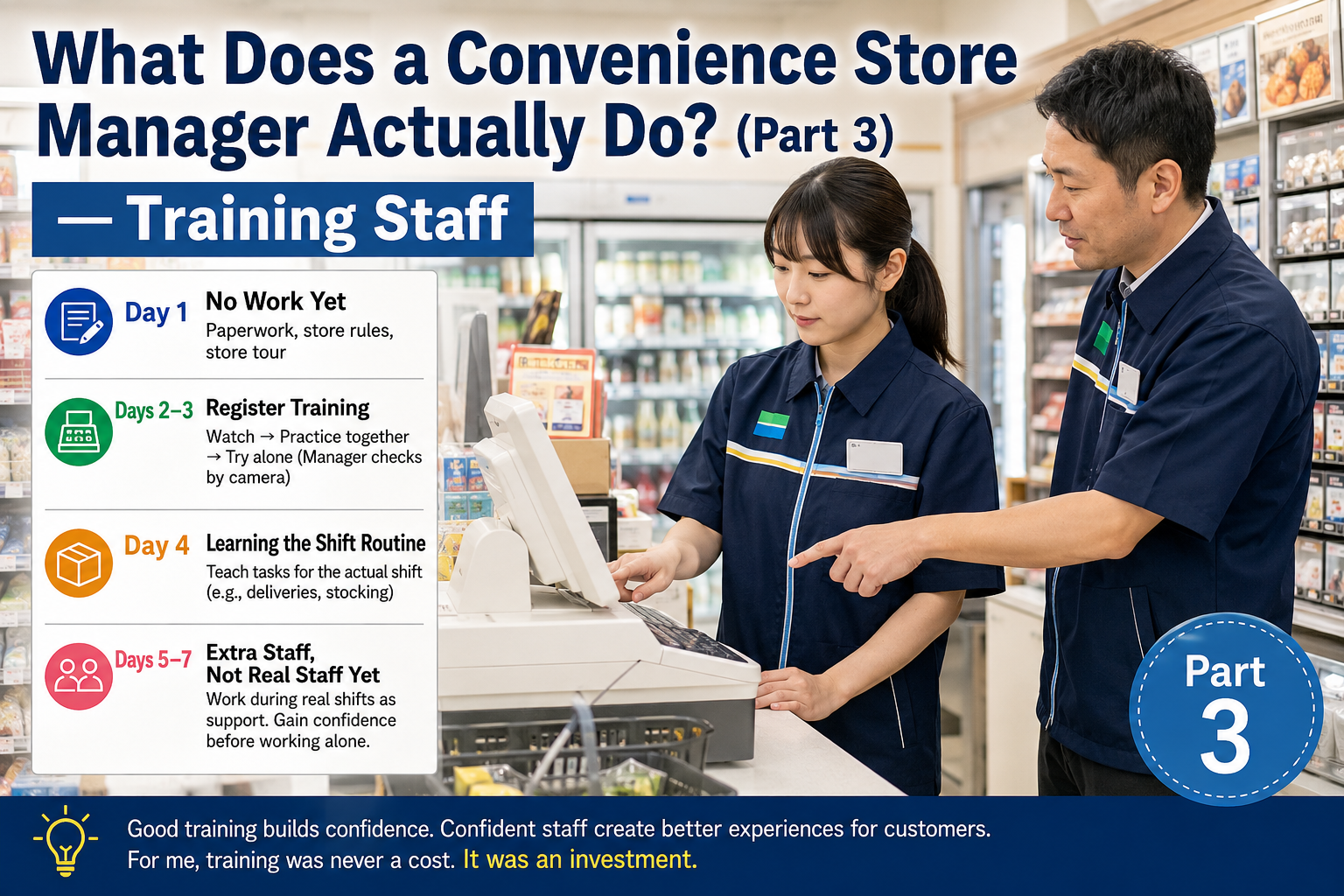
Day 1 — No Work Yet
On the first day:
👉 I did not make new staff work immediately.
Instead, we focused on:
- employment paperwork
- store rules
- staff registration
- salary registration
- prohibited behaviors inside the store
After that:
👉 I gave what I called a “store tour.”
This simply meant walking around the store together.
For example:
“This is the register.”
“This is the office.”
“This is the garbage area.”
I explained the layout and important locations.
By the end of Day 1:
👉 the goal was simply to help them understand the workplace environment.
Not skill.
Not speed.
Just familiarity.
Days 2–3 — Register Training
Days 2 and 3 focused mainly on:
👉 cash register training.
Day 2:
Basic register operations.
Day 3:
Slightly more advanced situations.
My teaching method was simple:
First:
👉 watch me.
Second:
👉 do it while I stand beside you.
Finally:
👉 try it alone.
But secretly:
👉 I still checked through the store cameras.
Not because I distrusted them.
Simply because:
👉 customers always come first.
As a manager:
I needed to confirm that the new employee could handle situations safely.
Day 4 — Learning the Shift Routine
On Day 4:
👉 I taught employees the basic tasks for their actual working hours.
For example:
If they worked during delivery times:
👉 I taught them how to receive and stock products.
If they worked another shift:
👉 training focused on the tasks common during that period.
The goal was simple:
👉 become somewhat functional — not perfect.
No one becomes fully skilled in four days.
Days 5–7 — Extra Staff, Not Real Staff Yet
From Day 5 onward:
👉 I scheduled them during their actual working hours.
However:
👉 I did not count them as normal staff yet.
Instead:
👉 I treated them as extra support staff.
In other words:
👉 during the first week, I did not expect them to be productive workers.
Only after experienced staff felt comfortable working with them:
👉 did I allow them to work independently.
Was My Method Normal?
To be honest:
👉 maybe not.
At the time, some people criticized me for spending too much on labor costs.
Their argument was simple:
“Part-time workers will improve naturally.”
“Don’t waste labor costs on training.”
And honestly:
👉 from a business perspective, they may have had a point.
So I should add one important disclaimer:
👉 my training style may have been more intensive than average.
Still, personally:
👉 I believed good training prevented bigger problems later.
In convenience stores:
👉 small mistakes can quickly become expensive mistakes.
And confident employees usually create better experiences for customers.
That is why, for me:
👉 training was never simply a cost.
It was an investment.
In the next article, I’ll explain another important part of store management:
👉 staff scheduling and labor management.
Related Articles
コメント