Hello everyone.
Today, I’d like to continue my series about the work of a Japanese convenience store manager.
This time, I’d like to talk about something many people probably never think about:
👉 labor cost management and staff scheduling.
In simple terms:
👉 this mostly means creating employee work schedules (shifts).
At first glance, this may sound simple.
After all:
“Isn’t it just deciding who works and when?”
However, from a manager’s perspective:
👉 it is much more complicated than most people imagine.
In many cases:
👉 one small scheduling mistake can directly affect sales, customer service, and profit.
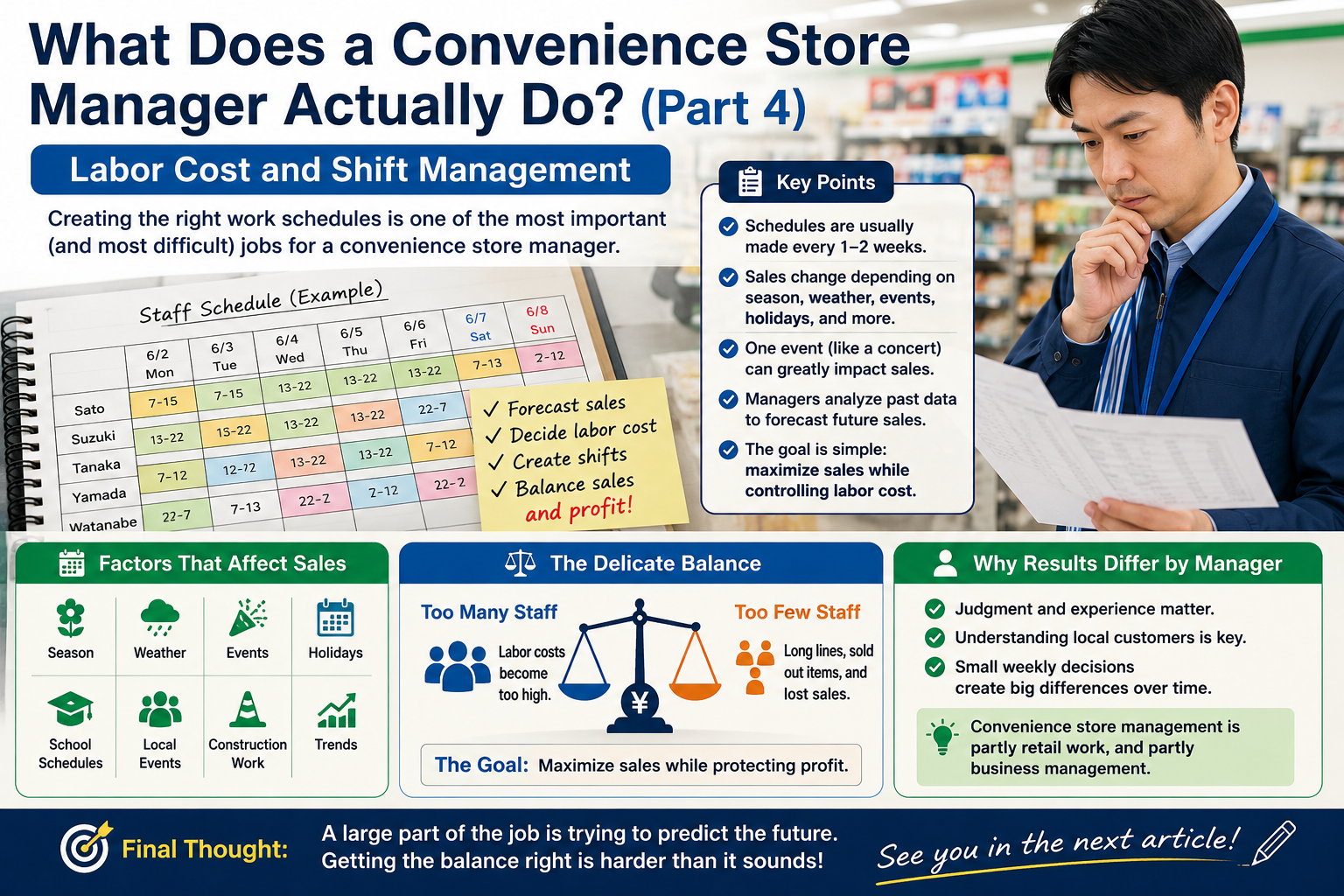
How Often Are Convenience Store Shifts Created?
In many Japanese convenience stores:
👉 work schedules are usually created every one or two weeks.
Some people may wonder:
“Why not simply use the same schedule every month?”
The reason is actually very simple:
👉 convenience store business changes constantly.
And when sales change:
👉 staffing needs also change.
Managers must think about many different factors, including:
- the season
- weather
- holidays
- school schedules
- local festivals and events
- nearby construction work
- transportation disruptions
- and sometimes even sudden social trends
In other words:
👉 convenience stores are surprisingly sensitive to what is happening nearby.
A small change in the local environment can quickly affect customer traffic.
One Event Can Completely Change Sales
Let me give you a simple example.
Imagine a convenience store located near:
👉 a concert hall or large event venue.
Sales may change dramatically depending on:
👉 who is performing.
A famous pop idol concert?
The store may suddenly become extremely busy.
Hundreds — sometimes thousands — of people may visit the area.
However:
👉 a smaller event may have little effect at all.
From a manager’s perspective:
👉 understanding local event schedules is extremely important.
Without preparation:
👉 the store may suddenly become understaffed.
And when that happens:
- long lines form
- products sell out quickly
- staff become overwhelmed
- customer service quality drops
In some cases:
👉 employees may become so busy that even basic cleaning or product restocking gets delayed.
Forecasting Sales Is Also Part of the Job
Good store managers do not simply rely on intuition.
Instead:
👉 many managers analyze past sales data carefully.
For example, managers often ask questions like:
- “How much did we sell during this season last year?”
- “Was there a nearby event?”
- “What day of the week was it?”
- “What was the weather like?”
- “Did we run a promotion?”
By looking at past patterns:
👉 managers try to predict future customer traffic.
Then comes the difficult question:
👉 How much labor cost should we spend?
This is where management becomes difficult.
Too many employees scheduled?
👉 labor costs become too high.
Too few employees?
👉 customers wait longer, shelves become messy, and sales opportunities are lost.
The goal is simple:
👉 maximize sales while protecting profit.
Why Different Managers Produce Different Results
This may surprise some people, but:
👉 the exact same convenience store can produce very different results depending on the manager.
Why?
Because judgment matters.
Some managers schedule too many employees.
Others schedule too few.
Some understand local customer behavior very well.
Others completely misread it.
And over time:
👉 small decisions repeated every week can create a surprisingly large difference in store performance.
In that sense:
👉 managing a convenience store is partly retail work —
and partly business management.
Final Thoughts
Many people imagine convenience store managers simply supervise staff.
However:
👉 a large part of the job is actually trying to predict the future.
Managers constantly ask themselves questions such as:
“How busy will next week be?”
“How many employees will we need?”
“Can we increase sales without overspending on labor?”
Honestly:
👉 finding the right balance is much harder than it sounds.
And when managers make the wrong decision:
👉 the results appear very quickly.
See you in the next article.
Related Articles
コメント