Hello everyone.
Today, I’d like to explain something that often surprises foreign customers:
Many small services at Japanese convenience stores are free.
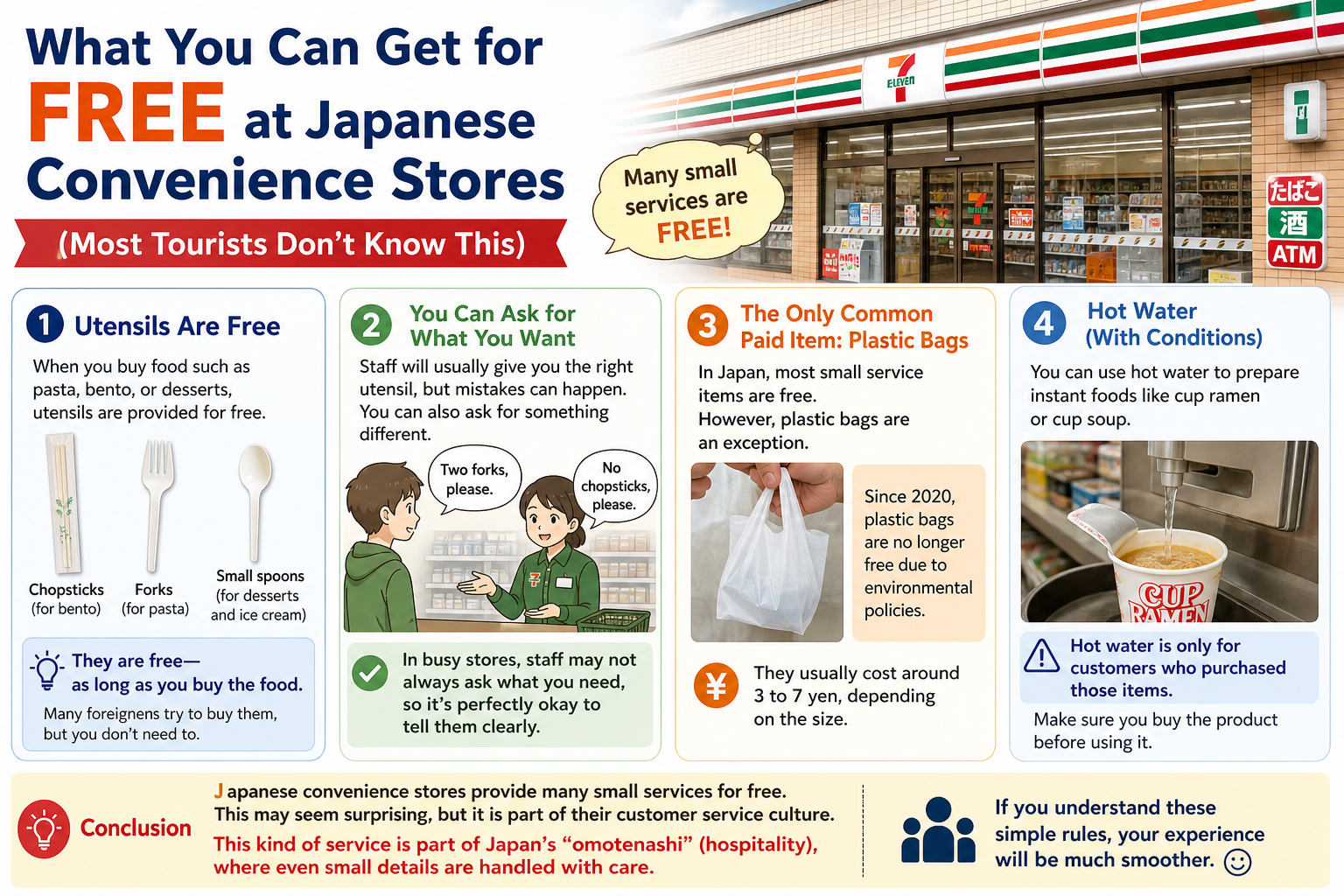
1. Utensils Are Free
When you buy food such as pasta, bento boxes, or desserts,
convenience stores usually provide utensils for free.
For example:
- Chopsticks (for bento)
- Forks (for pasta)
- Small spoons (for desserts and ice cream)
Many foreign customers are surprised by this and sometimes try to buy them separately.
However, you don’t need to.
👉 They are free—as long as you buy the food.
2. You Can Ask for What You Want
In many cases, staff will automatically give you the right utensil.
However, mistakes can happen, especially in busy stores.
Also, you may prefer something different.
For example, even if you buy a bento, you might want a fork instead of chopsticks.
In that case, simply say:
- “Two forks, please.”
- “No chopsticks, please.”
In busy stores, staff may not always ask what you need,
so it’s perfectly okay to tell them clearly.
3. The Only Common Paid Item: Plastic Bags
In Japan, most small service items are free.
However, one major exception is plastic bags.
Since 2020, plastic bags are no longer free due to environmental policies.
They usually cost around 3 to 7 yen, depending on the size.
4. Hot Water (With Conditions)
There is one more useful free service: hot water.
You can use it to prepare instant foods like cup ramen or cup soup.
However, there is an important rule:
👉 Hot water is only for customers who purchased those items.
So make sure you buy the product before using it.
Conclusion
Japanese convenience stores provide many small services for free.
This may seem surprising, but it is part of their customer service culture.
This kind of service is part of Japan’s “omotenashi” (hospitality),
where even small details are handled with care.
If you understand these simple rules, your experience will be much smoother.
Related Articles
- How to Make Japanese Cup Ramen (The Right Way – No Microwave!)
How to correctly prepare Japanese cup ramen using the free hot water service at convenience stores. - Suggested Polished Version
A simple guide to understanding customer behavior and register systems in Japanese convenience stores. - Are Japanese People Really Polite? — A Convenience Store Worker’s Perspective
A convenience store worker’s perspective on Japanese customer service culture and manners.
コメント