Hello everyone.
Today, I’ll show you how to prepare Japanese cup ramen the right way.
If you’ve just arrived in Japan, this might surprise you:
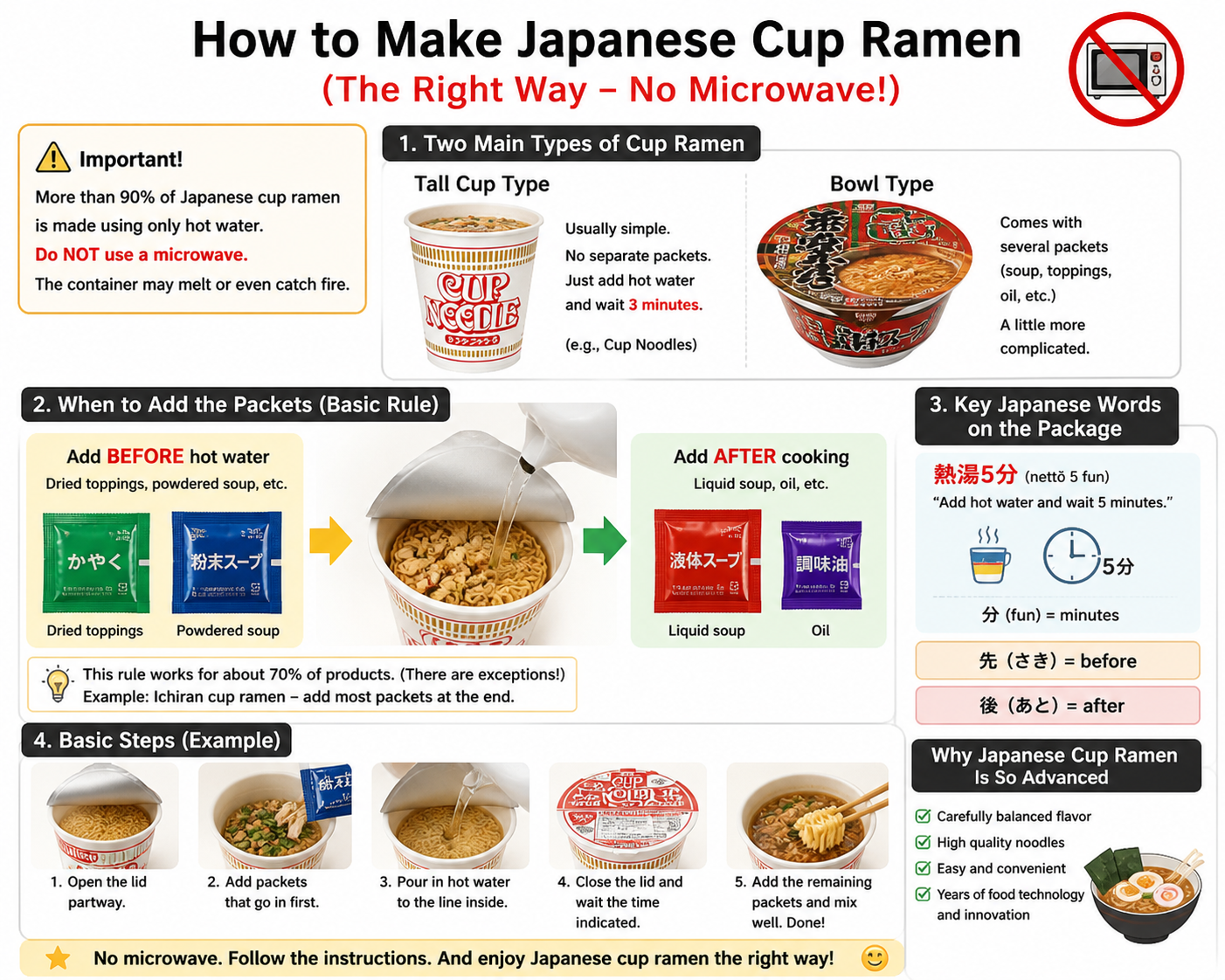
Most Japanese cup ramen is NOT made using a microwave.
Instead, you only need hot water.
In fact, more than 90% of cup ramen products in Japan are designed this way.
Using a microwave can melt the container or even cause a fire, so it’s important to avoid it.
1. Two Main Types of Cup Ramen
There are two main types of cup ramen in Japan:
- Tall cup type
- Bowl type
The tall cup type is usually very simple.
For example, Nissin’s Cup Noodles series has no separate packets.
You just pour in hot water, wait 3 minutes, and it’s ready.
The bowl type, however, is often more complex.
2. Understanding the Packets
Many bowl-type ramen products come with several small packets (such as soup and toppings).
The most important point is when to add them.
Here’s a simple rule that works in most cases:
- Dried toppings and powdered soup → add BEFORE hot water
- Liquid soup and oil → add AFTER cooking (just before eating)
This rule works for about 70% of products.
However, there are exceptions.
For example, Ichiran’s cup ramen (popular among foreign visitors) requires adding most packets at the end, which can be a bit confusing.
3. Key Japanese Words on the Package
Understanding a few Japanese words can help you avoid mistakes.
For example:
- 熱湯5分 (nettō 5 fun) → “Add hot water and wait 5 minutes”
- 分 (fun) → “minutes”
You may also see:
- 先 (saki) → before
- 後 (ato) → after
Just knowing these can make a big difference.
Why Japanese Cup Ramen Is Different
Japanese cup ramen is highly refined compared to many other countries.
The balance of flavor, texture, and preparation is carefully designed.
In a way, it represents one of the most advanced forms of everyday food in Japan.
Conclusion
Making Japanese cup ramen is simple—but only if you know the basic rules.
No microwave.
Follow the packet instructions.
And pay attention to timing.
Once you understand these points, you can enjoy it the way it was meant to be.
Related Articles
- How to Make Japanese Cup Yakisoba (Many Foreigners Make This Mistake)
Another popular Japanese instant noodle product that many foreign visitors prepare incorrectly. - What You Can Get for Free at Japanese Convenience Stores (Most Tourists Don’t Know This)
How to use free hot water services correctly at Japanese convenience stores. - Why Are Japanese Convenience Store Microwaves So Powerful?
Why Japanese convenience store microwaves are much more powerful than many home microwaves overseas.
コメント