Hello everyone.
Today, I’d like to talk about how part-time staff are hired at Japanese convenience stores.
At most convenience stores, hiring staff is one of the store manager’s responsibilities.
So what kind of people do managers prefer to hire?
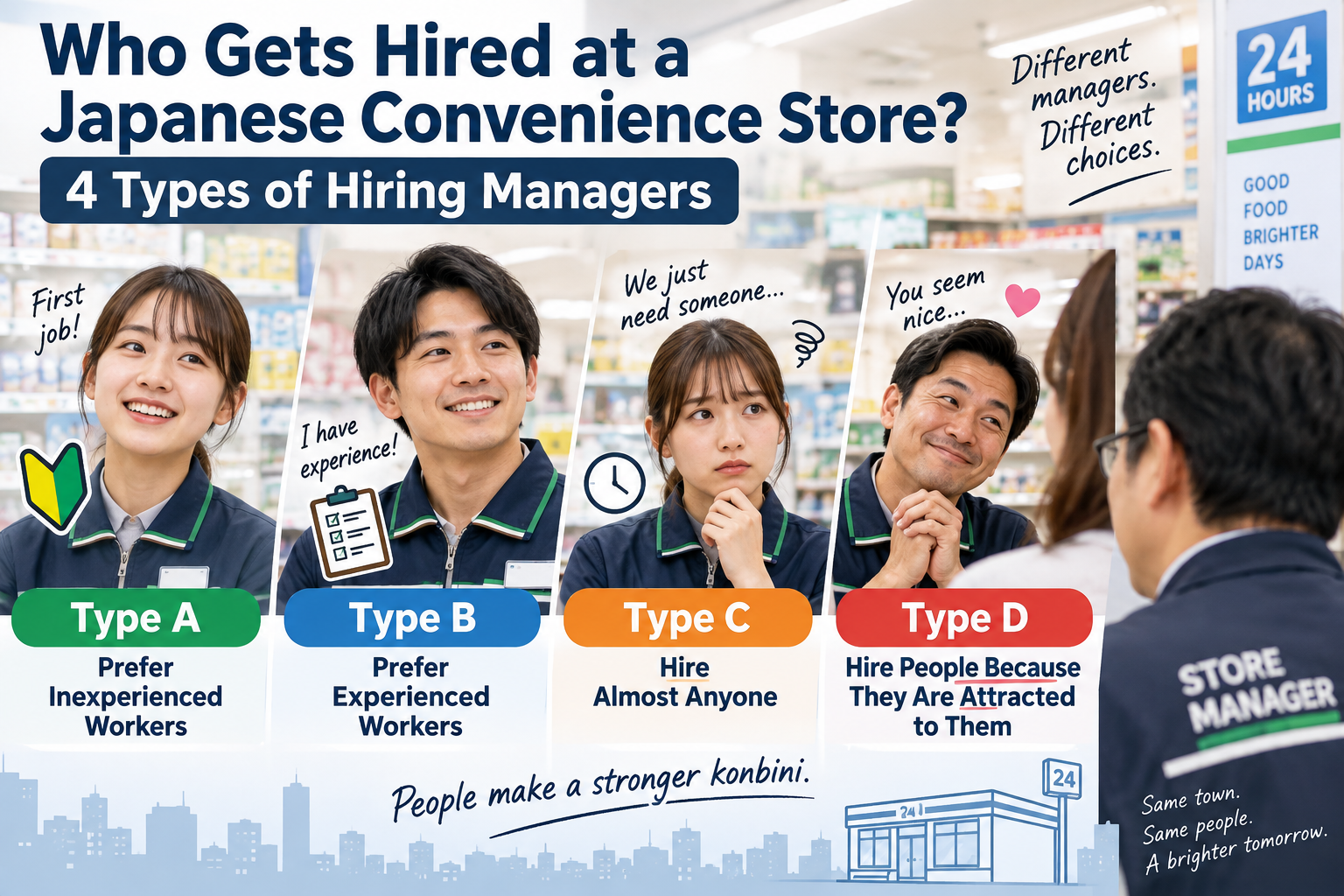
Of course, every manager has different preferences and ideas. However, based on my nearly 30 years of experience working in and managing convenience stores, I think managers’ hiring styles can be roughly divided into three main types.
And unfortunately, there is one more type that deserves a brief mention.
Type A: Managers Who Prefer Inexperienced Workers
Some managers prefer applicants who have never worked at a convenience store before.
Advantages
The biggest advantage is that new employees can learn the store’s procedures from the beginning.
Every convenience store has its own rules and atmosphere. Even stores belonging to the same chain may operate somewhat differently depending on the manager.
When inexperienced workers are trained from scratch, they can learn the manager’s preferred methods without constantly comparing them with how things were done at another store.
Training someone from the beginning can also create a stronger relationship between the manager and the employee.
In my experience, employees who were carefully trained from scratch sometimes stayed for years and eventually became some of the most reliable members of the team.
Disadvantages
The obvious disadvantage is that training takes time.
Convenience store work may look simple from the customer’s side of the counter, but new employees actually have a lot to learn.
They need to operate the register, handle different payment methods, receive deliveries, prepare food, clean the store, deal with customers, and learn many other procedures.
Some new workers may also lose confidence during training and quit before becoming fully independent.
So this hiring style requires both time and patience.
Type B: Managers Who Prefer Experienced Workers
Today, I think this approach has become quite common.
The reason is simple: experienced workers can often become productive very quickly.
Advantages
They already understand the basics of convenience store work.
They still need to learn the new store’s specific rules, but managers usually don’t have to teach everything from zero.
For a store suffering from a labor shortage, this can be extremely valuable.
Disadvantages
However, experience can sometimes create another problem.
An experienced worker may think:
“That’s not how we did it at my previous store.”
People who have worked at several convenience stores may already have strong opinions about the “correct” way to do things.
Sometimes this is useful because they bring valuable knowledge and experience.
But sometimes it makes it more difficult to create a unified team.
I sometimes compare this situation to creating a multinational army. Everyone has experience, but they were all trained differently.
And if experienced workers strongly disagree with the manager’s methods or simply don’t like the store, they may decide relatively quickly that the job isn’t for them.
Type C: Managers Who Hire Almost Anyone
Unfortunately, Japan’s current labor shortage has made this situation increasingly difficult to avoid.
This is not necessarily because the manager wants to hire without being selective.
Sometimes there simply aren’t enough applicants.
A manager may need five new workers but receive only two applications.
In that situation, the question changes from:
“Is this person suitable for my store?”
to:
“Can this person work Tuesday night?”
That is a major difference.
Advantages
From a management perspective, there aren’t many advantages beyond filling desperately needed shifts.
Disadvantages
The risks can be significant.
If managers cannot be selective, people who are poorly suited to the job may be hired.
This can lead to conflicts between staff members, customer-service problems, frequent resignations, and a generally worse atmosphere in the workplace.
Of course, hiring standards alone do not determine whether a store is good or bad.
However, in my experience, constantly hiring simply because “we need somebody” makes it much harder to build a stable team.
And Then There Is Type D…
Unfortunately, there is one more type of manager.
The manager who hires people mainly because they are attracted to them.
Advantages
None.
Disadvantages
Where should I start?
Favoritism, complaints from other employees, workplace tension, and potentially serious sexual harassment problems.
I don’t think this deserves to be called a hiring strategy, so I’ll leave it there.
Which Hiring Style Do I Prefer?
Personally, I prefer Type A.
When I first started running convenience stores, I felt that this approach was much more common than it is today.
At that time, some managers actually preferred inexperienced applicants over experienced ones.
Why?
Because stores had enough time and manpower to train people properly.
A manager could hire someone with no experience, teach them step by step, and gradually turn them into a reliable employee.
I think that kind of environment played an important role in the growth of the Japanese convenience store industry.
Stores weren’t simply filling empty shifts.
They were developing people.
Today, however, the situation has changed.
Japan is facing a serious labor shortage, and many convenience stores no longer have the luxury of spending weeks carefully training every new employee.
As a result, Type B has become more attractive because experienced workers can contribute quickly.
And when the labor shortage becomes even more serious, stores may be pushed toward Type C simply because they need someone—anyone—to cover the shift.
In other words, the change might look something like this:
In the past: Hire people and develop them.
Today: Hire people who can work immediately.
When the labor shortage becomes severe: Hire whoever is available.
That change tells us something important about Japanese convenience stores.
Hiring is not just about choosing individual employees.
It also reflects how much time, money, and organizational breathing room a store has.
Personally, I think it will be difficult for the convenience store industry to make much further progress if more and more stores are forced into Type B or Type C hiring.
A strong convenience store needs more than enough people to fill the schedule.
It needs enough stability to train those people, develop their skills, and turn them into a team.
Thank you for reading!
Related Articles
👉 What Does a Convenience Store Manager Actually Do? (Part 2) — Hiring Staff
Learn what convenience store managers actually do when recruiting part-time employees and why hiring is such an important part of store management.
👉 What Does a Convenience Store Manager Actually Do? (Part 3) — Training Staff
Hiring is only the beginning. Discover how new convenience store workers are trained after joining the team.
👉 The Reality of Part-Time Jobs for International Students in Japan
Learn about the important role international students play in Japan’s convenience store workforce.
👉 「Strange People I Met at Japanese Convenience Stores – Part 2」
What can go wrong when hiring and training new employees? Here are two unforgettable stories from my own experience.
👉 Dream Chasers Working at Japanese Convenience Stores
Meet some of the different people who work at Japanese convenience stores and discover why they choose this kind of job.
コメント