Hello everyone.
Today, I’d like to talk about something you may have noticed while visiting Japan.
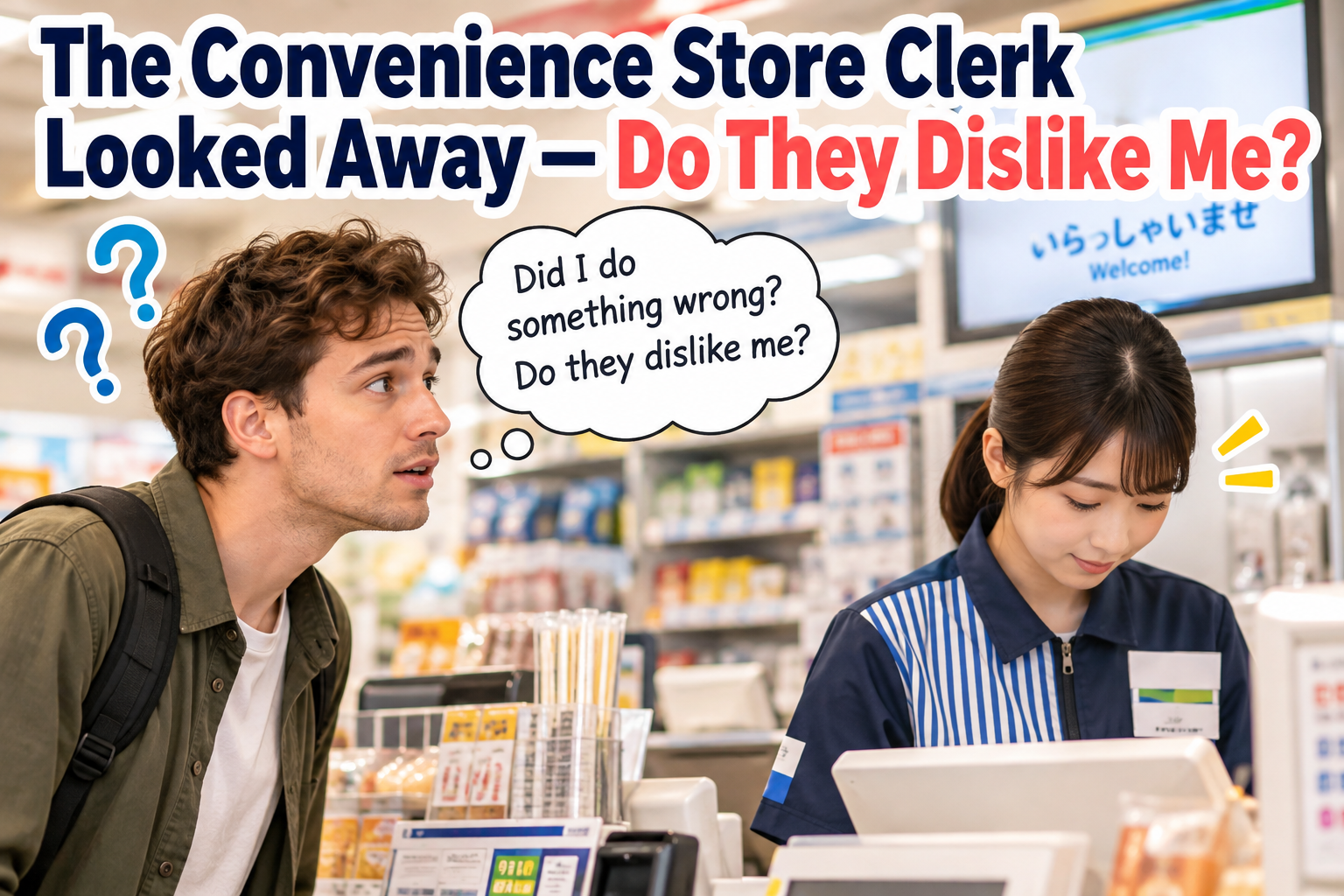
You say something to a convenience store clerk, but they avoid eye contact.
You might wonder:
“Did I do something wrong?”
“Does this person dislike me?”
In most cases, probably not.
There may be several reasons why a Japanese convenience store employee avoids eye contact, and many of them have nothing to do with you personally.
Let’s take a closer look.
Eye Contact Can Feel Different in Japan
Do you usually look people directly in the eyes when you talk to them?
From my experience working at a convenience store, I’ve noticed an interesting difference between some Japanese and international customers.
When I say “Irasshaimase” (Welcome!) to international customers, many of them look directly at me and smile.
I’m used to serving customers from many countries, so I usually make eye contact, smile back, and say, “Hello.”
But not every Japanese employee reacts in the same way.
You may have experienced this not only at convenience stores, but also at restaurants, hotels, shops, and other places in Japan.
You look at the staff member.
They look away.
Does that mean they don’t like you?
Not necessarily.
They May Simply Be Nervous
There are many possible reasons why a staff member avoids eye contact.
Some people are naturally shy.
Others may not be confident speaking English and become nervous when they see an international customer approaching them.
They may be thinking:
“What if they ask me something in English?”
“What if I can’t understand them?”
In these situations, avoiding eye contact may simply be an unconscious reaction to nervousness.
Of course, this doesn’t apply to everyone.
Some employees may be busy concentrating on their work, while others may simply have a habit of looking away during conversations.
The important point is that avoiding eye contact doesn’t automatically mean someone dislikes you.
Direct Eye Contact Isn’t Always Expected in Japan
There is also a cultural element worth understanding.
In some cultures, maintaining eye contact is an important way to show confidence, honesty, and interest in a conversation.
In Japan, however, prolonged or very direct eye contact may sometimes feel uncomfortable or overly intense.
Traditionally, depending on the situation, staring directly at someone could even be interpreted as confrontational or disrespectful.
This is particularly relevant in interactions involving differences in age or social status.
However, Japanese communication styles are not uniform.
Some Japanese people make plenty of eye contact, while others prefer to look away occasionally.
Age, personality, experience, and individual habits can all influence how someone communicates.
So it’s important not to assume that every Japanese person behaves the same way.
Still, understanding these cultural differences may help you avoid unnecessary misunderstandings during your visit.
What Should You Do?
If you need to ask a convenience store employee something, my recommendation is simple.
Use short, clear English and speak at a comfortable pace.
Long or complicated sentences can sometimes make communication more difficult, especially for employees who aren’t confident in English.
For example, you could ask:
- “Microwave?”
- “Where is the ATM?”
- “Can I use this card?”
These simple questions are often easier to understand than long explanations.
You can also point to the product or machine you’re asking about.
And remember, you don’t need perfect English to communicate successfully.
A smile, a few simple words, and a little patience can make a big difference.
Once the employee understands what you need, they may become more relaxed and comfortable speaking with you.
One More Thing: Don’t Take It Personally
Working at a convenience store can be surprisingly busy.
Employees may be operating the register, checking products, preparing food, or handling several tasks at once.
Sometimes, they may simply be focused on their work rather than making eye contact.
And sometimes, they may just be having a difficult day.
These things happen everywhere in the world, not only in Japan.
Of course, genuinely unfriendly service does exist.
But a lack of eye contact alone isn’t enough to conclude that someone is being rude or unfriendly.
Final Thoughts
If a Japanese convenience store clerk looks away while talking to you, don’t immediately assume:
“They don’t like me.”
They may simply be shy, nervous about speaking English, concentrating on their work, or communicating in a style different from the one you’re used to.
As someone who works with international customers every day, I believe small misunderstandings like these can sometimes create unnecessary distance between people.
And that’s a shame.
After all, most convenience store interactions are very simple.
You want to buy something, ask a question, or get a little help.
The employee wants to assist you and complete the transaction smoothly.
Sometimes, all it takes is a smile, a simple question, and a little patience.
You might even end up having a surprisingly friendly conversation.
So don’t worry too much if someone looks away. It doesn’t necessarily mean you’re unwelcome.
See you next time!
Related Articles
①Can Convenience Store Staff Speak English in Japan? (Part 1)
Find out how much English Japanese convenience store employees can speak and what international visitors should expect.
②Can Convenience Store Staff Speak English in Japan? (Part 2)
Explore the challenges convenience store workers face when communicating with international customers.
③Are Japanese People Really Polite? — A Convenience Store Worker’s Perspective
Take a closer look at Japanese politeness and how cultural expectations can sometimes differ from reality.
④Bad Experience at a Japanese Convenience Store? Here’s What To Do
Learn what to do if you experience genuinely unpleasant service at a Japanese convenience store.
Discover one convenience store worker’s personal approach to welcoming and serving customers from around the world.
コメント