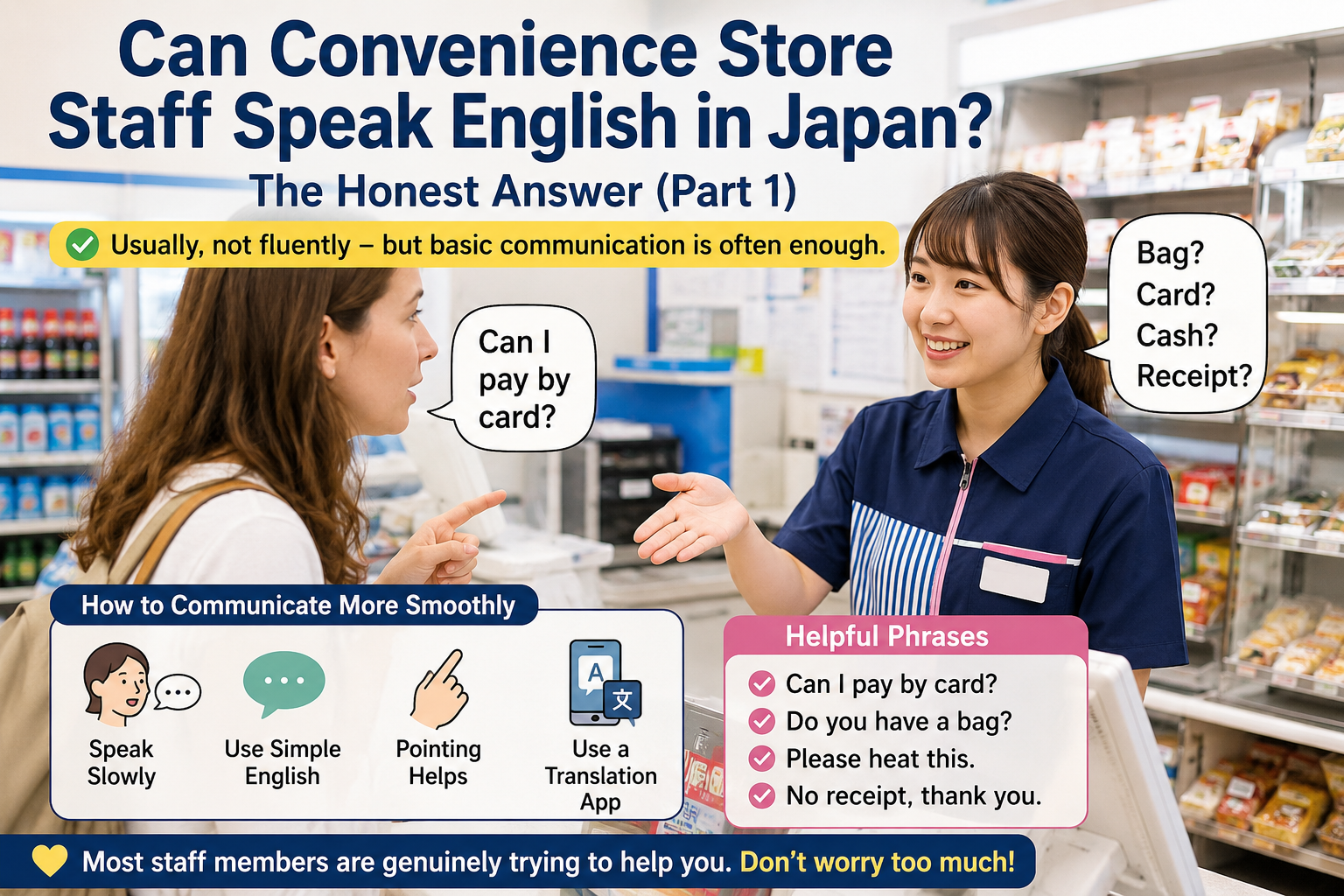
The Honest Answer
Hello everyone.
Today, I’d like to answer a question that many foreign visitors probably wonder about:
👉 Can convenience store staff speak English in Japan?
The Short Answer
The honest answer is:
👉 usually, not fluently — but basic communication is often enough.
So if you are worried about visiting a Japanese convenience store without speaking Japanese:
👉 please don’t worry too much.
Let me explain why.
Why Don’t Many Convenience Store Staff Speak English?
Many visitors are surprised by this.
After all:
👉 Japan has a reputation for having a strong education system.
Japanese students also study English for many years in school.
In fact, many people learn English from elementary school through high school — and sometimes university as well.
So naturally, some visitors think:
“If people study English for so long, they must be able to speak it.”
However:
👉 the reality is often very different.
One major reason is that traditional English education in Japan has focused heavily on:
- grammar
- reading
- written exams
- university entrance tests
In other words:
👉 many Japanese people learned “test English” rather than “conversation English.”
As a result:
some people may understand simple written English,
but still feel nervous speaking English in real-life situations.
Another reason is simple:
👉 Japan historically functioned almost entirely in Japanese.
Until recently, many people rarely needed to use English in daily life or at work.
Because of this:
even if someone studied English for years,
they may still lack confidence when speaking.
And honestly:
👉 many people are simply afraid of making mistakes.
So What Should You Expect at a Convenience Store?
If you visit a Japanese convenience store:
👉 do not expect fluent English.
However:
👉 basic communication is usually possible.
Many staff members understand simple words and common situations.
For example:
“Bag?”
“Card?”
“Cash?”
“Receipt?”
Even if the employee feels nervous speaking English:
👉 they are usually trying their best to help you.
How to Communicate More Smoothly
If communication feels difficult, a few simple tricks help a lot.
Speak Slowly
Fast English can be difficult for many people to understand.
👉 Slow and simple English works surprisingly well in Japan.
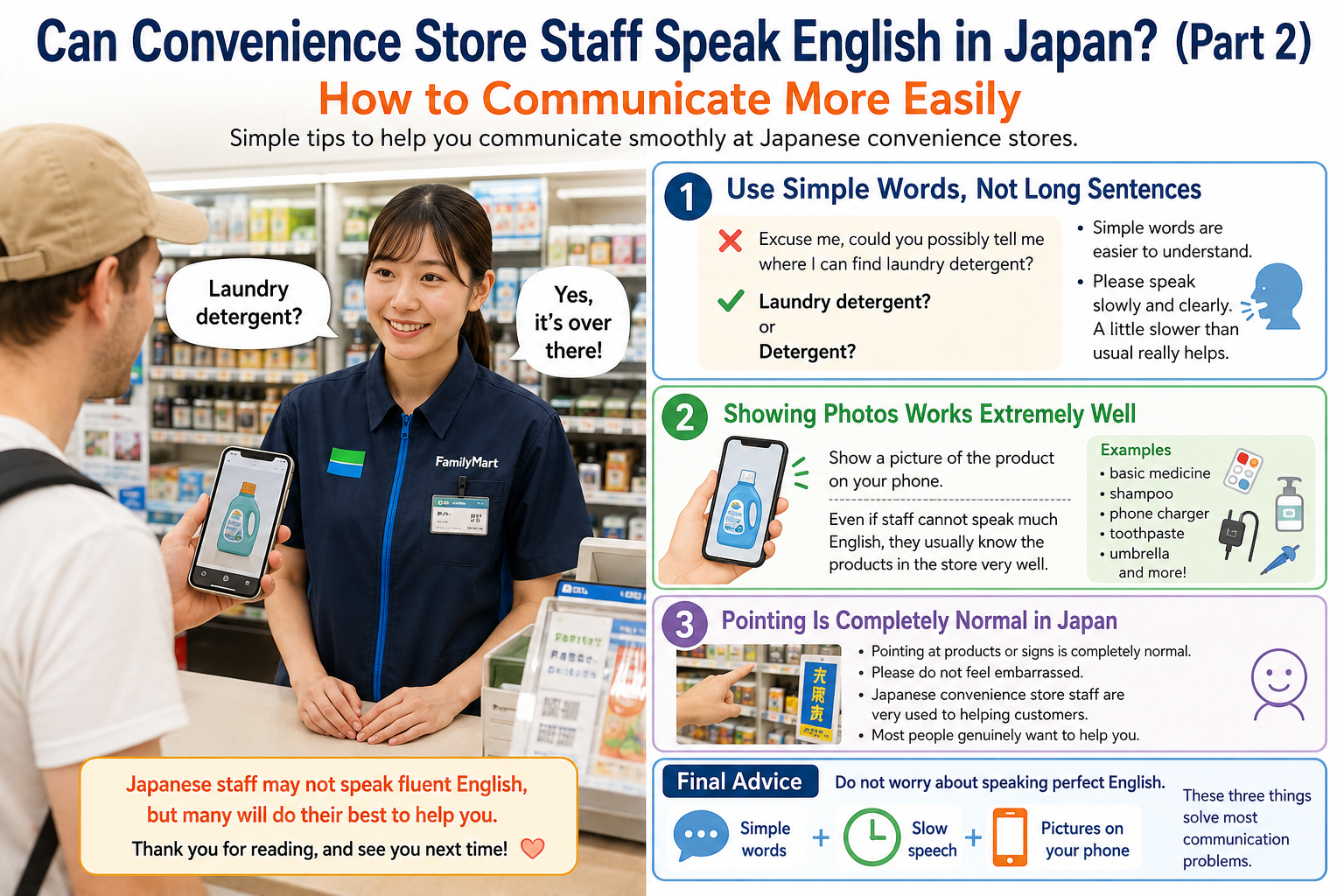
Use Simple Words
Instead of complicated sentences:
try short phrases.
For example:
❌
“Would it be possible to warm this up for me?”
⭕
“Please heat this.”
❌
“Could I possibly pay using a credit card?”
⭕
“Card okay?”
Simple English is often easier than perfect English.
Pointing Helps
Do not hesitate to:
👉 point at products, payment screens, or coffee machines.
In Japan:
👉 this is completely normal.
Translation Apps Also Help
Today, many customers and staff simply use translation apps when necessary.
No one thinks this is strange.
An Interesting Reality in Japan Today
In recent years:
many Japanese convenience stores have hired international staff members.
Depending on the store, you may meet employees from countries such as:
- Nepal
- Myanmar
- Vietnam
- the Philippines
In some cases:
👉 foreign staff members may actually feel more comfortable communicating in English than Japanese staff.
Of course:
this depends entirely on the individual person.
My Own Experience
To be honest:
👉 even I am still learning English.
I write this blog in English,
but my spoken English is still far from perfect.
However:
after using English little by little with foreign customers over many years:
👉 communication has gradually become easier.
And honestly?
Most customers are kind and understanding.
Very few expect perfect English.
Most people simply appreciate that someone is trying to help.
Final Advice
So if English communication feels awkward at a Japanese convenience store:
👉 please do not worry too much.
You do not need perfect English.
And honestly:
👉 Japanese convenience store staff do not need perfect English either.
Simple communication is usually enough.
Most staff members genuinely want to help you.
Thank you for reading, and see you next time!
Related Articles
- Can You Ask Convenience Store Staff for Directions in Japan?
Why convenience store staff may not always know the local area — especially in large cities like Tokyo. - Who Works at Japanese Convenience Stores in Japan? (Staff Types Explained)
How the workforce inside Japanese convenience stores has changed over the past few decades, including the rise of international staff. - What Customers Mean to Me
My personal perspective on helping customers and why small interactions matter in convenience store service.
コメント