Hello everyone.
Today, I’d like to share a true story from my early days working in the Japanese convenience store industry.
This happened:
👉 about 25 years ago,
when I was a young store manager working at a directly managed convenience store.
Before I begin, I should say something important:
👉 Japan was a very different country back then.
Japan Was a Different Workplace 25 Years Ago
Today, people often talk about:
- power harassment (“pawahara”)
- toxic workplaces
- mental health
- employee rights
But 25 years ago:
👉 these conversations were much less common.
In fact:
👉 the term power harassment was barely used in Japan at the time.
“Sexual harassment” had only recently started becoming widely recognized.
Meanwhile:
👉 Japan was still struggling after the collapse of the bubble economy.
Jobs were harder to find.
Companies held much stronger power over workers.
Many employees simply endured difficult situations because:
👉 quitting felt risky.
Of course:
👉 this was not unique to convenience stores.
Similar workplace culture existed in many Japanese industries at the time.
My First Store Manager Meeting
At the time:
👉 I was still in my twenties.
One day, I attended my first large meeting for convenience store managers.
Naturally:
👉 I expected to learn practical things.
I imagined discussions about:
- improving store operations
- staff management
- sales strategies
- solving problems at difficult stores
Honestly:
👉 I was excited.
After all:
👉 I genuinely cared about the work.
But the reality turned out to be very different.
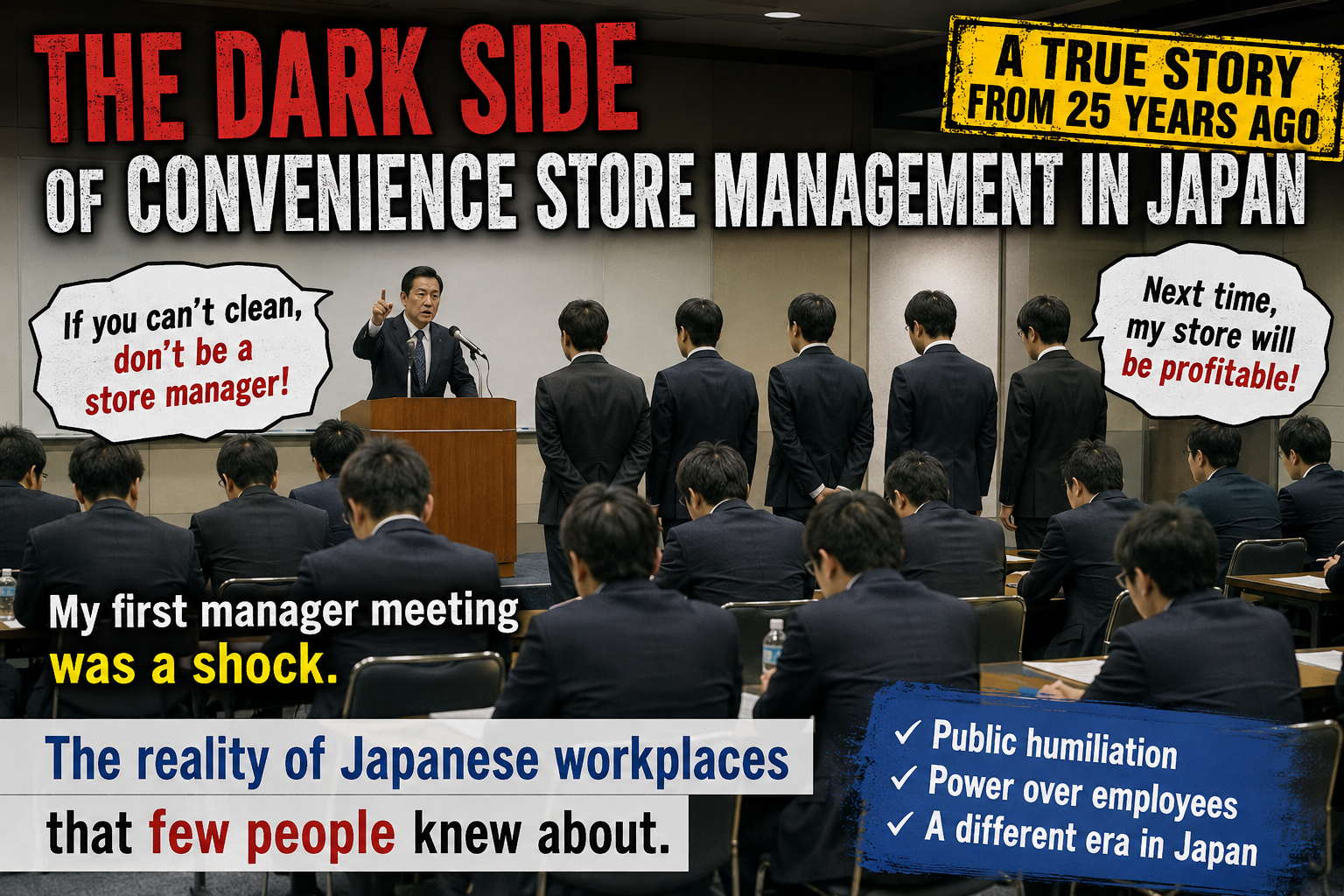
“If You Can’t Clean, Don’t Be a Manager”
The meeting began with a speech from a senior executive.
However:
👉 many executives had been transferred from completely different departments.
To be honest:
👉 many store managers often had far more real field experience than headquarters staff.
Because of this:
👉 some speeches sometimes felt disconnected from everyday store reality.
In this particular meeting:
👉 the executive started talking about cleaning.
Of course:
👉 cleaning is important in convenience stores.
No one would disagree with that.
But then, at the end of the speech, he dramatically declared:
“If you can’t clean, don’t be a store manager!”
I still remember what I thought at that moment.
Something like:
“Cleaning matters, yes… but shouldn’t we also be discussing how to create enough time to manage everything properly?”
Even in my twenties:
👉 something about the meeting felt strange.
The Moment I Saw the Dark Side
Then things became even more uncomfortable.
Managers from poorly performing stores were suddenly called to stand up:
👉 one by one.
Each manager had to loudly announce something like:
“Next time, my store will become profitable!”
in front of everyone.
Honestly:
👉 it felt humiliating.
The atmosphere felt less like professional problem-solving and more like public pressure.
At that moment:
👉 I quietly realized something.
I thought:
“Maybe this meeting isn’t really about solving problems.”
Instead:
👉 it felt more like a performance for upper management.
A way to show that headquarters was:
👉 “doing something.”
As someone who genuinely loved store operations:
👉 I wanted deeper discussions.
I wanted to talk about:
- staffing problems
- product ordering
- customer behavior
- employee training
- real operational strategy
But:
👉 that was not the kind of meeting this was.
Looking Back
To be fair:
👉 Japanese workplace culture has changed significantly since then.
Things that were once considered “normal” are often criticized today.
And:
👉 not every company was like this.
Many workplaces have improved.
Public humiliation in meetings, for example:
👉 is much less acceptable than before.
However:
👉 convenience store managers in Japan still face enormous pressure — just in different ways.
This experience showed me a side of the industry that I had never seen before.
In fact:
👉 after seeing this world, I temporarily left the convenience store industry for a while.
Looking back now:
👉 that meeting became my unforgettable store manager meeting debut.
Sometimes:
👉 reality teaches lessons faster than training manuals.
Thank you for reading, and see you in the next article!
Related Articles
What Is a Directly Managed Convenience Store in Japan?
→ Learn how directly managed convenience stores work behind the scenes in Japan.
The Real Relationship Between Japanese Convenience Store Owners and Headquarters
→ Discover the complicated relationship between convenience store managers and company headquarters.
What Does a Convenience Store Manager Actually Do? (Part 5)
→ Explore one of the most stressful parts of convenience store management.
コメント