Hello everyone.
Today, I’d like to explain something many people outside Japan probably do not know about Japanese convenience stores:
👉 directly managed stores
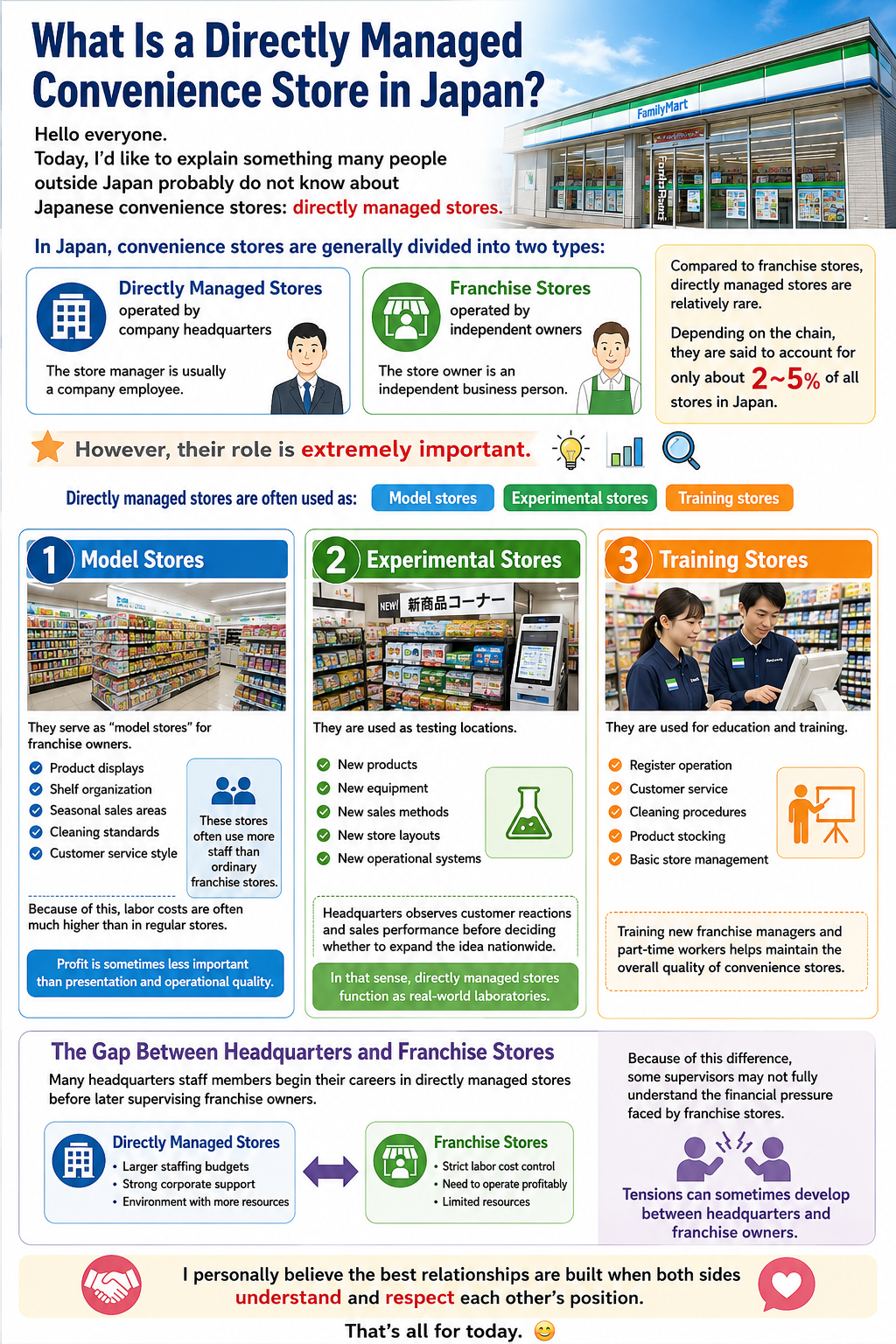
In Japan, convenience stores are generally divided into two types:
- Directly managed stores operated by company headquarters
- Franchise stores operated by independent owners
The store I used to run was a franchise store.
What Is a Directly Managed Store?
A directly managed store is a convenience store operated directly by the company itself.
The store manager is usually a company employee rather than an independent business owner.
Compared to franchise stores, directly managed stores are relatively rare.
Depending on the chain, they are said to account for only about 2–5% of all convenience stores in Japan.
However, despite their small numbers, they play a very important role.
Directly managed stores are often used as:
- Model stores
- Experimental stores
- Training stores
1. Model Stores
One major role of directly managed stores is serving as a “model” for franchise owners.
For example, headquarters may use these stores to demonstrate:
- Product displays
- Shelf organization
- Seasonal promotional areas
- Cleaning standards
- Customer service style
These stores are often designed to look as ideal and polished as possible.
In many cases, they also use more staff than ordinary franchise stores.
Because of this:
👉 labor costs are often much higher than in regular franchise stores.
In other words, profit is sometimes considered less important than presentation quality and operational standards.
2. Experimental Stores
Directly managed stores are also used as testing locations.
When convenience store companies want to try something new, they often begin with directly managed stores first.
Examples include:
- New products
- New equipment
- New sales methods
- New store layouts
- New operational systems
Headquarters then studies:
- Customer reactions
- Sales performance
- Operational problems
before deciding whether to expand the idea nationwide.
In that sense:
👉 directly managed stores function as real-world laboratories.
3. Training Stores
Another very important role is education and staff training.
When new franchise managers or part-time workers receive training, they are often sent to directly managed stores.
There, experienced trainers teach them inside a real store environment.
Training may include:
- Register operation
- Customer service
- Cleaning procedures
- Product stocking
- Basic store management
Because of this, directly managed stores play a major role in maintaining the overall quality of Japanese convenience stores.
The Gap Between Headquarters and Franchise Stores
However, there can also be challenges.
Many headquarters employees begin their careers working in directly managed stores before later becoming supervisors for franchise owners.
The problem is that directly managed stores often have larger staffing budgets and stronger corporate support.
As a result, some supervisors may not fully understand the financial pressure faced by franchise stores.
Most franchise stores operate under very strict labor cost control in order to remain profitable.
Because of this difference in environment:
👉 tensions can sometimes develop between headquarters and franchise owners.
Personally, I believe the best relationships are built when both sides understand and respect each other’s position.
That’s all for today.
Related Articles
- The Future of Convenience Store Owners in Japan
Why Japan’s convenience store industry is struggling to secure the next generation of franchise owners. - What Is a Japanese Convenience Store Shift Like? (Full Guide)
A behind-the-scenes look at how Japanese convenience stores operate throughout the day. - Is Japan Really a “Manual-Based Society”? — A Convenience Store Perspective
How training and workplace culture actually function inside Japanese convenience stores.
コメント