Hello everyone.
People around the world often say that Japanese people are very polite.
And in many situations, that is certainly true.
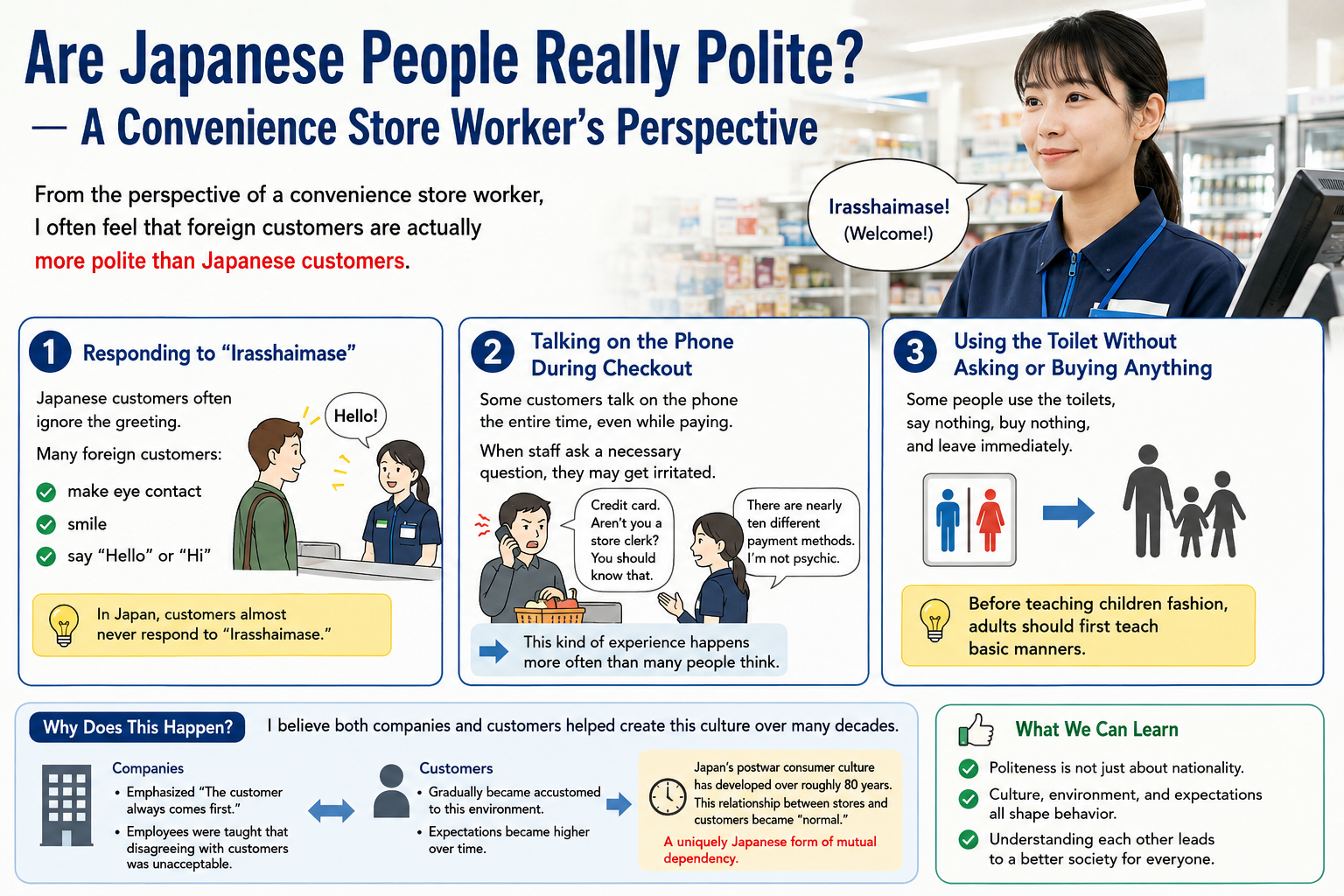
However, from the perspective of someone who has worked in Japanese convenience stores for many years, I sometimes feel that foreign customers can actually be more polite than Japanese customers.
Today, I’d like to explain why.
1. Responding to “Irasshaimase”
In Japanese convenience stores, staff greet customers with:
👉 “Irasshaimase” (“Welcome”)
For Japanese customers, this greeting is so common that most people simply continue shopping without responding.
Usually, they do not make eye contact or reply verbally.
To be fair, “ignoring” may sound too negative.
In Japan, this greeting is often treated more like background communication than a real conversation.
However, many foreign customers react very differently.
They often:
- make eye contact
- smile
- say “Hello” or “Hi”
Ironically, this sometimes surprises Japanese staff.
Many visitors to Japan may have experienced this:
👉 You say “Hello” back to a store clerk, and the clerk looks slightly shocked for a moment.
Why?
Because in Japan:
👉 customers almost never respond to “Irasshaimase.”
2. Customers Talking on the Phone During Checkout
This is surprisingly common in Japan.
Some customers continue talking on the phone throughout the entire checkout process.
Occasionally, when staff ask a necessary question, the customer becomes irritated.
I once experienced something similar involving earphones.
A customer came to the register while listening to music and silently held out a smartphone.
So I asked:
👉 “How would you like to pay?”
The customer replied angrily:
👉 “Credit card. Aren’t you a store clerk? You should know that.”
I answered:
👉 “Japanese convenience stores have nearly ten different payment methods. I don’t think any clerk is psychic.”
The customer turned red and quickly left.
3. Using the Toilet Without Asking or Buying Anything
This is another behavior I rarely see from foreign customers.
In many countries, people are surprised that Japanese convenience stores even allow public toilet use because of security concerns.
One experience left a particularly strong impression on me.
A children’s fashion event was being held nearby.
Many parents and children dressed in expensive clothes entered the store all at once.
They:
- used the toilets
- said nothing
- bought nothing
- left immediately
Watching this, I felt uncomfortable.
Personally, I thought:
👉 Before teaching children fashion, adults should first teach basic manners.
Why Does This Happen?
Interestingly, most Japanese people would never behave this way in ordinary social situations.
If someone ignored people, talked over others, or acted selfishly in daily life, it could easily create tension.
So why does it happen in stores?
I believe both companies and customers helped create this culture over many decades.
For a long time, Japanese customer service culture strongly emphasized the idea that:
👉 “The customer always comes first.”
Employees were often taught that disagreeing with customers was unacceptable.
Companies believed this attitude would improve customer satisfaction and increase business.
At the same time, customers gradually became accustomed to this environment.
Japan’s postwar consumer culture developed over roughly 80 years, and over time, this relationship between stores and customers became normalized.
In some ways, this may be a uniquely Japanese form of mutual dependency created through modern consumer culture.
That’s all for today.
Related Articles
- What Do Convenience Store Register Staff Actually Do?
How customer behavior and unspoken rules work around Japanese convenience store registers. - What Customers Mean to Me
My personal thoughts about customer service after more than 30 years working in convenience stores. - Is Japan Really a “Manual-Based Society”? — A Convenience Store Perspective
A look at Japanese workplace culture and how customer service is actually learned in convenience stores.
コメント