Hello everyone.
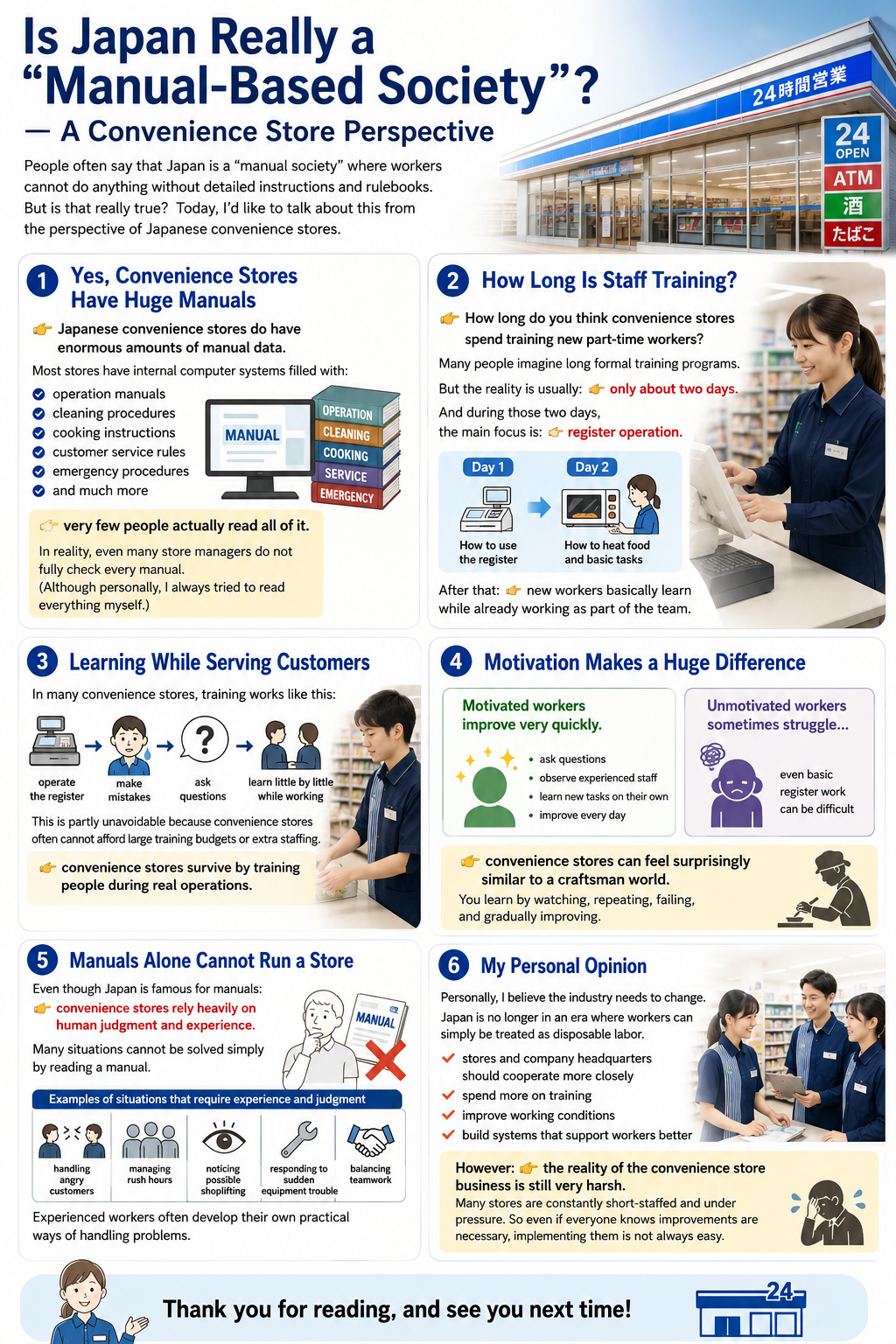
People often say that Japan is a “manual-based society” where workers cannot do anything without detailed instructions and rulebooks.
But is that really true?
Today, I’d like to talk about this from the perspective of Japanese convenience stores.
Yes, Convenience Stores Have Huge Manuals
To begin with:
👉 Japanese convenience stores do have enormous amounts of manuals.
Most stores have internal computer systems filled with:
- operation manuals
- cleaning procedures
- cooking instructions
- customer service rules
- emergency procedures
- equipment troubleshooting
- campaign instructions
- and much more
However:
👉 very few people actually read all of it.
In reality, even many store managers never fully check every manual.
(Although personally, I always tried to read everything myself.)
The amount of information is simply too large for most busy stores to study in detail every day.
How Long Is Staff Training?
Now let me ask you a question:
👉 How long do you think convenience stores spend training new part-time workers?
Many people imagine long formal training programs.
But the reality is often:
👉 only about two days.
And during those two days, the main focus is usually:
👉 register operation.
How to scan products.
How to handle payments.
How to use cigarettes numbers.
How to process cashless payments.
How to heat food in the microwave.
That alone already takes time.
After that:
👉 new workers basically learn while already working as part of the team.
Learning While Serving Customers
In many convenience stores, training works like this:
- operate the register
- make mistakes
- ask questions
- get corrected by senior staff
- slowly learn through experience
This is partly unavoidable because convenience stores often cannot afford large training budgets or extra staffing.
Many stores are already operating with very limited manpower.
In other words:
👉 convenience stores survive by training people during real operations.
From the outside, Japanese stores may look perfectly organized.
But behind the scenes:
👉 many workers are learning while struggling in real time.
Motivation Makes a Huge Difference
Because of this system:
👉 motivated workers improve very quickly.
They actively:
- ask questions
- observe experienced staff
- memorize procedures
- notice how senior workers move
- and learn new tasks voluntarily
Meanwhile:
👉 unmotivated workers sometimes struggle even with basic register work.
Some people improve dramatically within a few weeks.
Others never fully adapt.
In that sense:
👉 convenience stores can sometimes feel surprisingly similar to a craftsman world.
You learn by watching, repeating, failing, and gradually improving.
Manuals Alone Cannot Run a Store
This is the important point.
Even though Japan is famous for manuals:
👉 convenience stores actually rely heavily on human judgment and experience.
For example:
- how to handle angry customers
- how to manage rush hours
- how to balance teamwork
- how to notice possible shoplifting
- how to respond to sudden equipment trouble
Many situations cannot be solved simply by reading a manual.
Experienced workers often develop their own practical ways of handling problems.
My Personal Opinion
Personally, I believe the industry needs to change.
Japan is no longer in an era where workers can simply be treated as disposable labor.
I think:
👉 stores and company headquarters should cooperate more closely
👉 spend more on training
👉 improve working conditions
👉 and build systems that support workers better
However:
👉 the reality of the convenience store business is still very harsh.
Many stores are constantly short-staffed and under pressure.
So even if everyone knows improvements are necessary, implementing them is not always easy.
Thank you for reading, and see you next time!
Related Articles
- Dream Chasers Working at Japanese Convenience Stores
Why many young Japanese workers choose part-time convenience store jobs while pursuing their dreams. - What Customers Mean to Me
My personal perspective after more than 30 years in customer service.
コメント