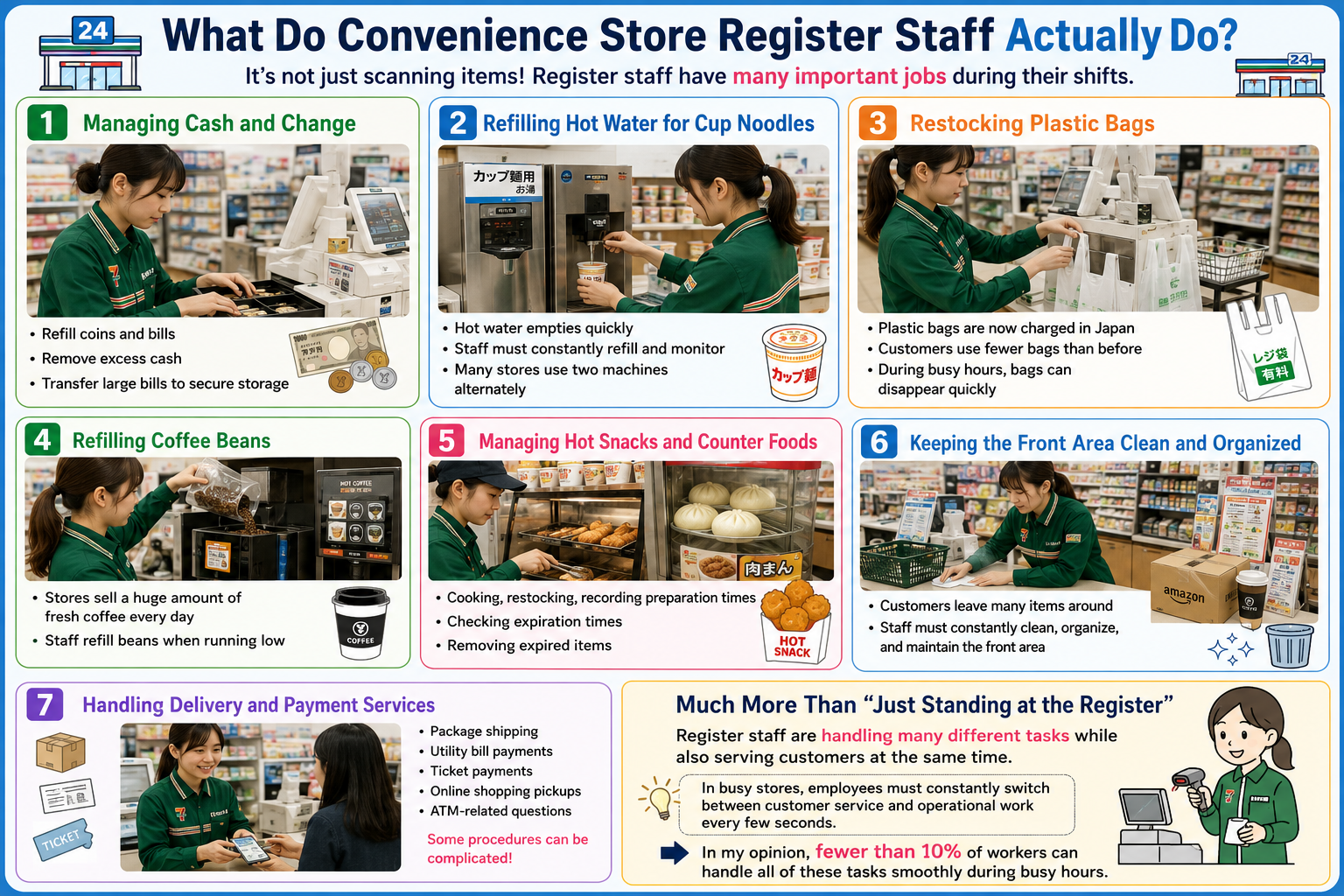
Hello everyone.
Today, I’d like to talk about the work of convenience store register staff in Japan.
From the customer side, it may look like employees are simply standing at the register and scanning products.
But in reality:
👉 convenience store register staff usually handle far more tasks than most people imagine.
Let’s look at some of the typical jobs they do during a shift.
1. Managing Cash and Change
While operating the register, staff constantly need to manage the balance of:
- coins
- small bills
- large bills
Sometimes there is too much cash in the register. Sometimes there is not enough change.
Employees must:
- refill coins and bills
- remove excess cash
- transfer large bills to secure storage boxes
This also includes handling 10,000-yen bills, which I explained in a previous article.
2. Refilling Hot Water for Cup Noodles
The hot water pot used for cup noodles empties surprisingly quickly.
Because of this:
👉 staff must constantly refill and monitor it.
Many stores use two hot water machines alternately so customers can continue using hot water even while one machine is being refilled.
3. Restocking Plastic Bags
Convenience stores constantly need to restock plastic shopping bags at the register.
Since plastic bags became charged in Japan, customers use fewer of them than before.
However:
👉 during busy hours, bags can still disappear surprisingly fast.
If staff forget to refill them, the register area can become chaotic very quickly.
4. Refilling Coffee Beans
Japanese convenience stores sell an enormous amount of fresh coffee every day.
When the coffee machine starts running low on beans:
👉 register staff refill them.
It sounds simple, but during rush hours, even small delays can create long customer lines.
5. Managing Hot Snacks and Counter Foods
This includes products such as:
- fried chicken
- hot snacks
- steamed buns (nikuman)
- other counter foods
In many stores:
👉 register staff are responsible for managing these items.
Their work includes:
- cooking
- restocking
- recording preparation times
- checking expiration times
- removing expired products
A well-organized hot snack case often depends heavily on the skill of the register staff.
6. Keeping the Front Area Clean and Organized
The area near the register becomes messy very easily.
Customers leave:
- shopping baskets
- delivery packages
- receipts
- empty coffee cups
- various small items
around the counter area.
Because of this, register staff must constantly:
👉 clean,
👉 organize,
👉 and maintain the appearance of the front area.
7. Handling Delivery and Payment Services
Japanese convenience stores also function as mini service centers.
Register staff often handle:
- package shipping
- utility bill payments
- ticket payments
- online shopping pickups
- ATM-related customer questions
Some of these procedures can be surprisingly complicated, especially for new staff members.
Much More Than “Just Standing at the Register”
As you can see:
👉 register staff are handling many different tasks while also serving customers at the same time.
In busy stores, employees must constantly switch between customer service and operational work every few seconds.
It can actually be a surprisingly demanding job.
And speaking honestly:
👉 in my opinion, fewer than 10% of workers can handle all of these tasks smoothly during busy hours.
Thank you for reading, and see you next time!
Related Articles
- The Mystery of the Disappearing 10,000 Yen Bills
A behind-the-scenes look at how Japanese convenience stores manage large amounts of cash safely. - Is Japan Really a “Manual-Based Society”? — A Convenience Store Perspective
Why convenience store workers often learn through real operations rather than manuals alone. - Why Are Japanese Convenience Stores Open 24 Hours? (Real Reason Explained)
What actually happens behind the scenes during a typical day at a Japanese convenience store. - How Cleaning Works at Japanese Convenience Stores
Why cleanliness and constant maintenance are far more important than many customers realize. - How Do Japanese Convenience Stores Prevent Crime? (Part 1)
How stores protect cash, staff, and customers through security systems and operational rules.
コメント