Hello everyone.
Today, I’d like to continue my series about the work of a Japanese convenience store manager.
This time, I’d like to talk about something many customers never see:
👉 the relationship between store managers and company headquarters.
Many people imagine convenience store managers simply running their stores freely.
However:
👉 in reality, many managers spend a surprising amount of time communicating with headquarters.
And honestly:
👉 this relationship is far more important than most people realize.
Most Japanese Convenience Stores Are Part of Franchise Systems
Many people probably imagine convenience stores operating independently.
However:
👉 most Japanese convenience stores are part of franchise systems.
This means store managers regularly communicate with representatives from headquarters.
Depending on the company, these representatives may be called:
supervisors,
field consultants,
area managers,
or operation advisors.
Their job is simple in theory:
👉 help stores improve performance.
But in reality:
👉 things are often more complicated.
Meetings With Headquarters
At many stores:
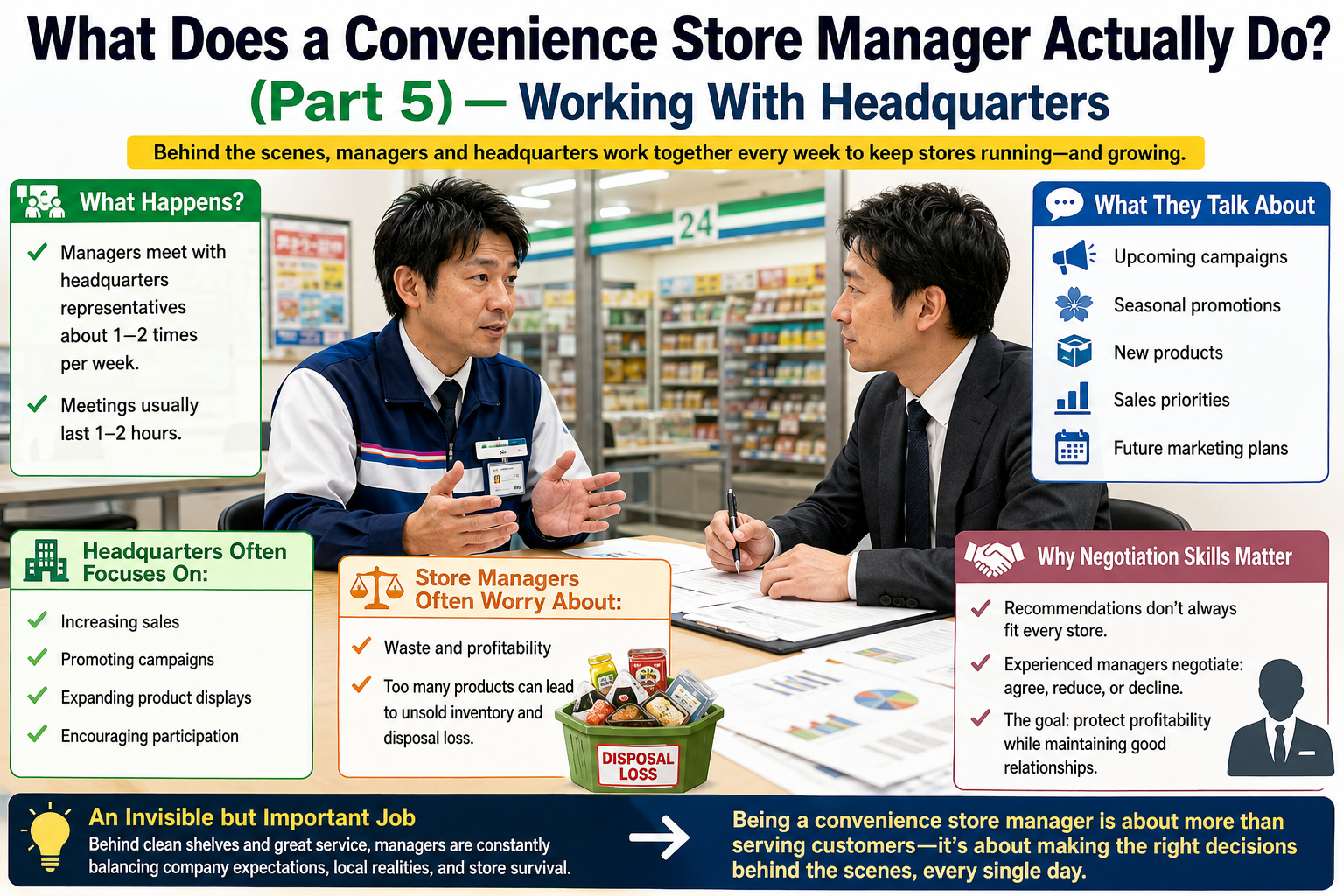
👉 managers meet with company representatives about once or twice per week.
In my experience:
👉 these meetings often last one to two hours.
The discussions usually focus on topics such as:
upcoming campaigns,
seasonal promotions,
new products,
sales priorities,
and future marketing plans.
For example:
👉 headquarters may discuss campaigns planned for next week — or even one month later.
From headquarters’ perspective:
👉 company-wide campaigns are naturally very important.
After all:
👉 they want stores to actively participate so promotions succeed nationwide.
Headquarters and Stores Often See Things Differently
In reality:
👉 headquarters and stores sometimes see the same situation very differently.
This is where things can become complicated.
Generally speaking:
Headquarters often focuses on:
increasing sales,
promoting campaigns,
expanding product displays,
and encouraging store participation.
Meanwhile:
Store managers often worry about:
👉 waste and profitability.
For example:
If too many campaign products are ordered:
👉 unsold food or seasonal products may eventually become disposal loss.
A campaign may look successful on paper.
But from a manager’s perspective:
👉 too much unsold inventory can quickly become expensive.
So managers constantly ask themselves questions like:
“How much should we follow headquarters’ recommendation?”
“How much risk is reasonable?”
Why Negotiation Skills Matter
To be fair:
👉 headquarters representatives are not simply “forcing” stores to do things.
Their role is to support sales and share company strategy.
At the same time:
👉 store managers understand their own customers better than anyone else.
For example:
A recommendation that works in central Tokyo may not work in a quieter residential neighborhood.
A tourist-heavy location may need completely different products than a suburban store.
Because of this:
👉 experienced managers gradually learn how to negotiate.
Sometimes they agree.
Sometimes they reduce the order size.
Sometimes they politely decline certain suggestions.
In my personal experience:
👉 finding this balance was one of the most important skills of being a manager.
You must protect profitability while still maintaining a good relationship with headquarters.
And honestly:
👉 that can be harder than people think.
An Invisible but Important Part of the Job
To customers:
👉 these meetings are completely invisible.
Most people only see:
clean shelves,
campaign products,
seasonal displays,
and organized stores.
But behind the scenes:
👉 managers are constantly balancing:
company expectations,
local customer realities,
profitability,
and waste risks.
In many ways:
👉 being a convenience store manager is not only about serving customers.
It is also about making difficult decisions behind the scenes.
And honestly:
👉 that balancing act never really ends.
See you in the next article.
Related Articles
コメント