Hello everyone.
Today is the final article in my series about the work of a Japanese convenience store manager.
This time, I’d like to talk about something customers almost never see:
👉 manager meetings.
Many people imagine that convenience store managers only communicate with company headquarters.
However:
👉 in companies that operate multiple stores, managers often attend internal meetings as well.
For example:
If a company operates:
five stores,
ten stores,
or even more,
👉 store managers may regularly gather to discuss how their stores are running.
So:
What actually happens at these meetings?
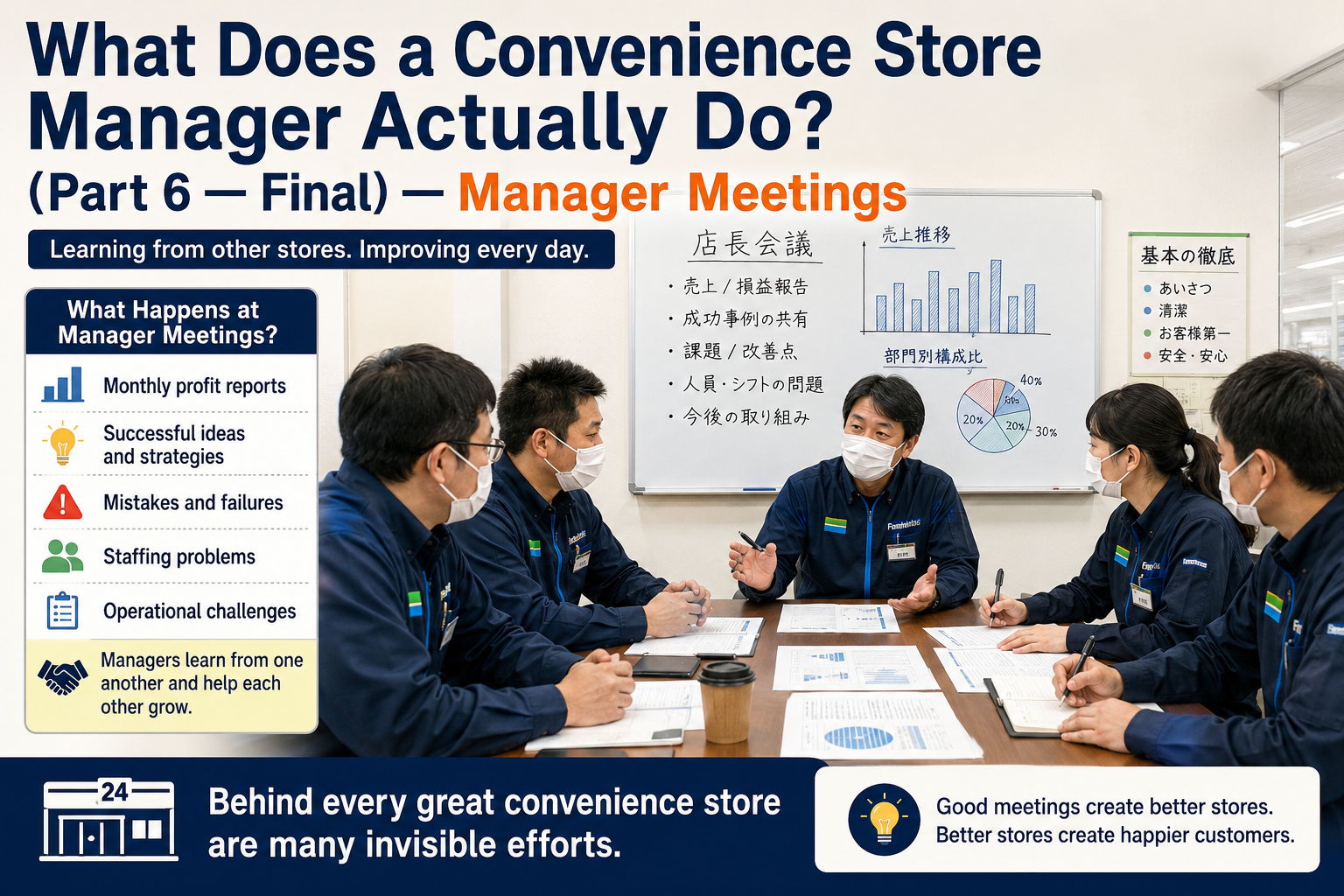
What Happens at Manager Meetings?
In my experience, manager meetings often include topics such as:
monthly profit reports,
successful ideas and strategies,
mistakes and failures,
staffing problems,
sales performance,
and operational challenges.
In other words:
👉 managers learn from one another.
This is especially important because convenience store managers vary widely in experience.
Some are:
👉 completely new managers.
Others have:
👉 decades of experience.
Because of this:
👉 experienced managers often help newer managers improve.
For example:
👉 one store may discover a better way to reduce food waste,
improve staffing efficiency,
or handle busy periods more smoothly.
And:
👉 other managers can immediately learn from that experience.
In this sense:
👉 manager meetings are also training opportunities.
Even Managers Need Training
Some people imagine managers already know everything.
Honestly:
👉 that is rarely true.
Even experienced managers constantly face new problems.
And for new managers:
👉 the learning curve can be extremely steep.
After all:
👉 they are suddenly responsible for an entire store.
And remember:
👉 the manager is usually the highest-ranking person inside the store.
This means:
👉 many managers must learn through trial and error.
However, daily operations can quickly become overwhelming.
Staff shortages,
deliveries,
paperwork,
customer complaints,
equipment trouble,
unexpected emergencies—
sometimes managers become so busy that:
👉 they barely have time to stop and improve.
That is why:
👉 learning from other managers can be extremely valuable.
Sometimes:
👉 one simple idea from another store can immediately improve operations.
What Makes a Good Manager Meeting?
Personally:
👉 I believe one thing is very important.
A manager meeting should not become a place where:
poor performers are publicly criticized,
or top performers are simply praised.
Why?
Because:
👉 results alone do not explain everything.
Instead:
👉 people should calmly analyze what happened.
Questions such as:
Why did something succeed?
Why did something fail?
are much more important.
Sometimes poor results happen because of:
location differences,
staff shortages,
unexpected local events,
or difficult circumstances.
And sometimes success comes from:
good preparation,
strong leadership,
smart teamwork,
or simply good timing.
Without honest analysis:
👉 meetings become stressful rather than educational.
And when that happens:
👉 people stop learning.
Final Thoughts
To many customers:
👉 convenience store managers may seem almost invisible.
But behind the scenes:
they hire staff,
train employees,
manage labor costs,
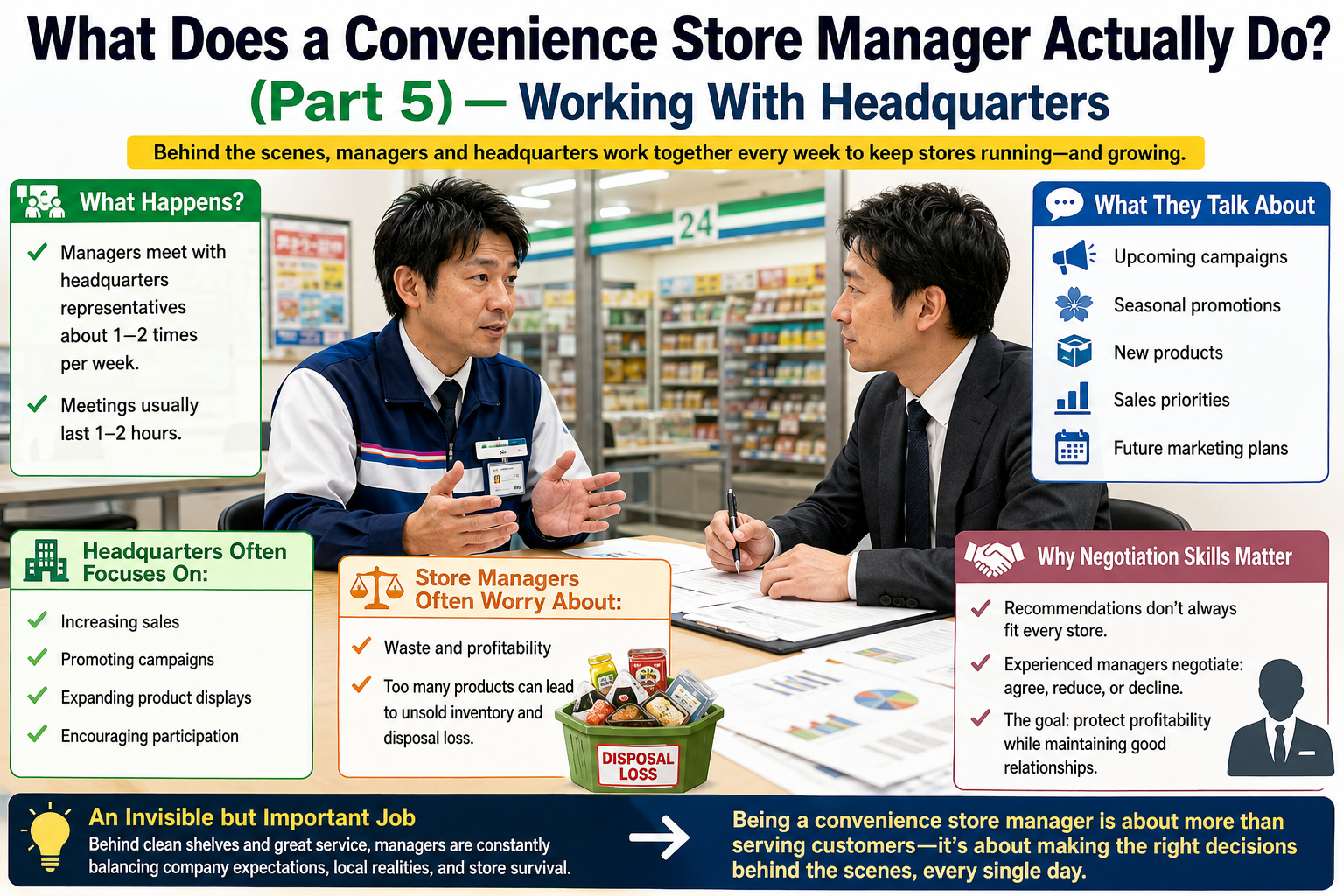
communicate with headquarters,
predict sales,
solve problems,
and continue learning themselves.
Honestly:
👉 it can be a very demanding job.
But for people who enjoy:
problem-solving,
leadership,
and teamwork,
👉 it can also be deeply rewarding.
After more than 30 years working in convenience stores:
👉 I can honestly say that no two days are ever the same.
Behind every clean and efficient convenience store in Japan:
👉 there are many invisible efforts happening every single day.
Thank you very much for following this series.
I hope this helped you better understand what happens behind the scenes of Japanese convenience stores.
See you next time.
コメント