Hello everyone.
Today, I’d like to talk about something most customers rarely think about:
👉 cleaning at Japanese convenience stores.
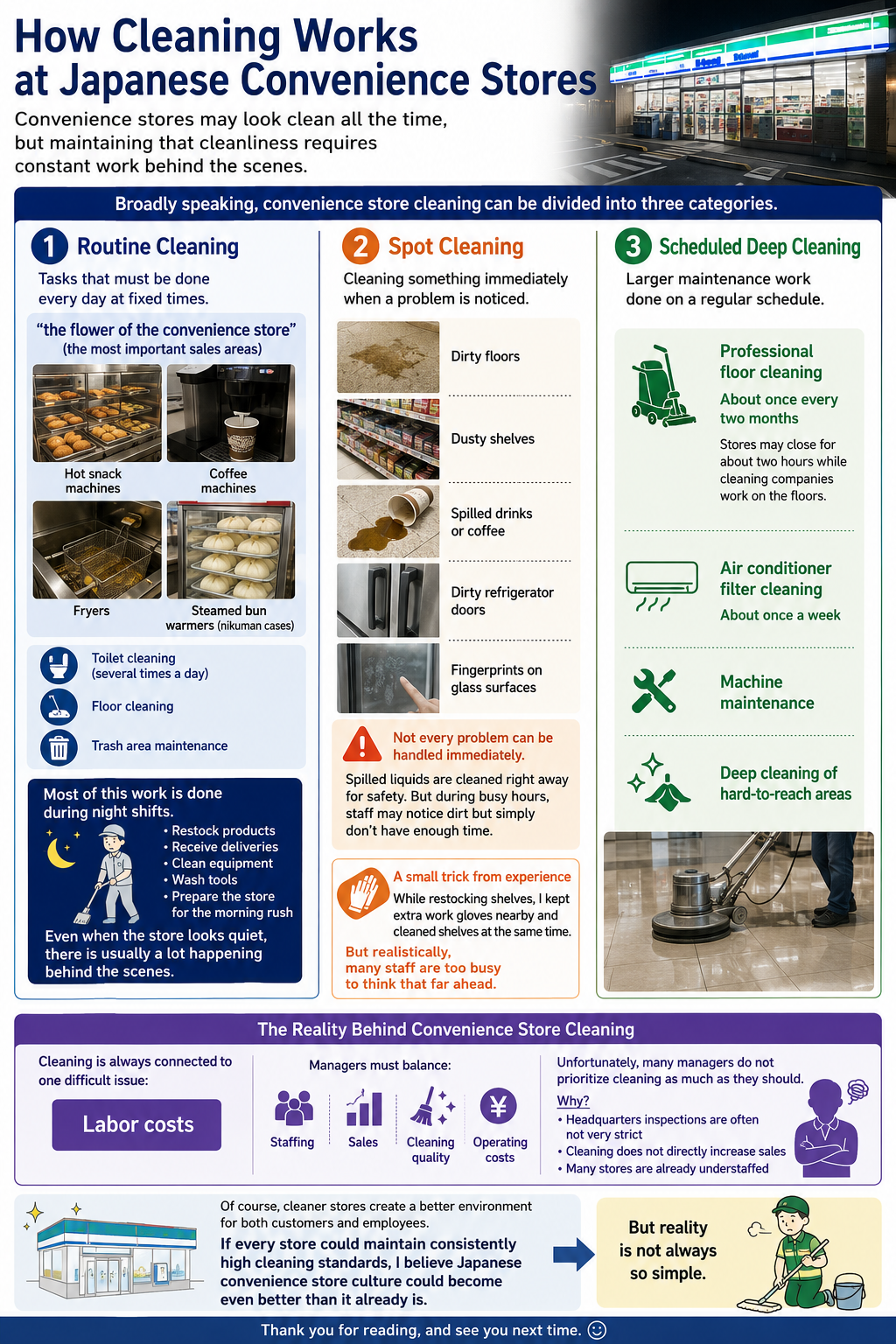
Convenience stores may look clean all the time, but maintaining that cleanliness actually requires constant effort behind the scenes.
In most stores, a large amount of cleaning work is done during quieter hours, especially late at night.
Broadly speaking, convenience store cleaning can be divided into three categories:
- Routine cleaning
- Spot cleaning
- Scheduled deep cleaning
1. Routine Cleaning
Routine cleaning refers to tasks that must be performed every single day at fixed times.
This usually includes equipment related to what many workers informally call:
👉 “the flower of the convenience store”
In other words:
the most important sales areas in the store.
Examples include:
- Hot snack machines
- Coffee machines
- Fryers
- Steamed bun warmers (nikuman cases)
These areas directly affect both food safety and customer impressions, so they are cleaned very frequently.
Much of this work is handled during night shifts.
Other routine tasks include:
- Toilet cleaning (often several times a day)
- Floor cleaning
- Trash area maintenance
Many people imagine that convenience store night shifts are easy because there are fewer customers.
But in reality:
👉 night staff often carry enormous workloads.
They must:
- Restock products
- Receive deliveries
- Clean equipment
- Wash tools
- Prepare the store for the morning rush
Even when the store appears quiet, there is usually a great deal happening behind the scenes.
2. Spot Cleaning
Spot cleaning means dealing with dirt or problems immediately after they are noticed.
For example:
- Dirty floors
- Dusty shelves
- Spilled drinks or coffee
- Dirty refrigerator doors
- Fingerprints on glass surfaces
However, to be honest:
👉 not every problem can be handled immediately.
The one thing that is almost always cleaned right away is spilled liquids inside the store.
For example:
- Coffee
- Juice
- Soft drinks
This is mainly because of safety concerns.
A wet floor can easily cause customers to slip and fall.
However, during busy daytime hours, stores are often operating with the minimum number of staff possible.
As a result:
👉 employees sometimes notice dirt but simply do not have enough time to clean it properly.
When I worked in stores, I sometimes used a small trick.
While restocking shelves, I kept extra work gloves nearby and cleaned shelves at the same time.
But realistically speaking:
👉 many employees are simply too busy to think that far ahead.
3. Scheduled Deep Cleaning
The final category is scheduled deep cleaning.
This includes larger maintenance work such as:
- Professional floor cleaning
- Air conditioner filter cleaning
- Machine maintenance
- Deep cleaning of hard-to-reach areas
For example, professional floor cleaning is often performed:
👉 about once every two months.
In some cases, stores temporarily close for around two hours while professional cleaning companies work on the floors.
Air conditioner filters are also cleaned regularly, often about once a week.
The Reality Behind Convenience Store Cleaning
Convenience store cleaning is always connected to one difficult issue:
👉 labor costs.
Managers must constantly balance:
- Staffing
- Sales
- Cleaning quality
- Operating costs
And unfortunately, the reality is this:
👉 many store managers do not prioritize cleaning as much as they should.
Why?
Because:
- Headquarters inspections are often not very strict
- Cleaning does not directly increase sales
- Many stores are already understaffed
Of course, cleaner stores create a better environment for both customers and employees.
If every store could maintain consistently high cleaning standards, I believe Japanese convenience store culture could become even better than it already is.
But reality is not always so simple.
Thank you for reading, and see you next time.
Related Articles
- What Is a Japanese Convenience Store Shift Like? (Full Guide)
A look at how convenience stores operate throughout an entire day behind the scenes. - What Do Convenience Store Register Staff Actually Do?
The many hidden responsibilities convenience store register staff handle during a normal shift. - Is Japan Really a “Manual-Based Society”? — A Convenience Store Perspective
Why convenience store workers often learn through real operations rather than manuals alone.
コメント