Hello everyone.
Today, I’d like to talk about alcohol sold at Japanese convenience stores.
Most people probably expect articles about famous Japanese beer, but in this blog, I’d first like to explain some Japanese alcoholic drinks that often confuse foreign visitors.
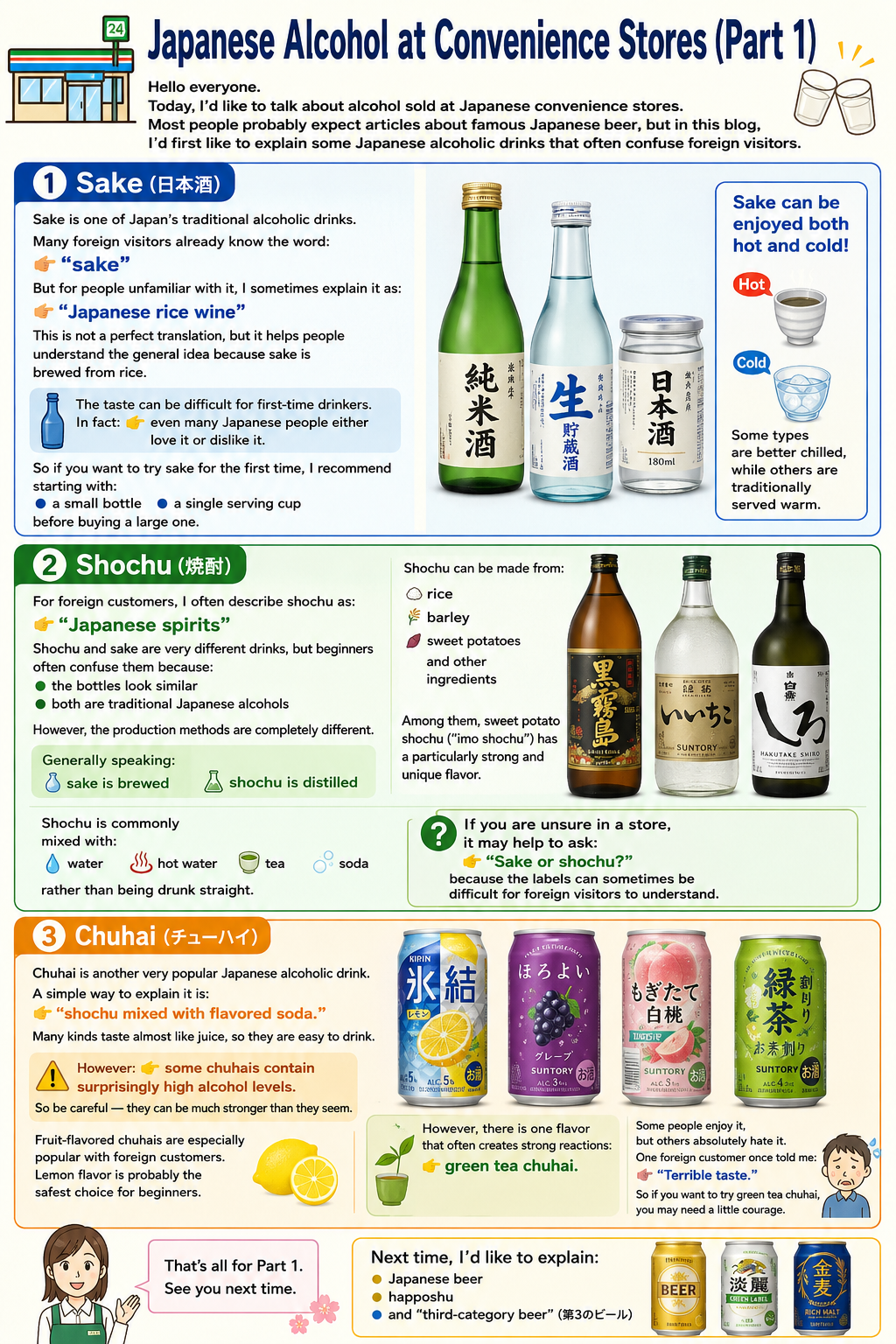
1. Sake (日本酒)
Sake is one of Japan’s traditional alcoholic drinks.
Many foreign visitors already know the word:
👉 “sake”
But for people unfamiliar with it, I sometimes explain it as:
👉 “Japanese rice wine”
This is not a perfect translation, but it helps people understand the general idea because sake is brewed from rice.
The taste can be difficult for first-time drinkers.
In fact:
👉 even many Japanese people either love it or dislike it.
So if you want to try sake for the first time, I recommend starting with:
- a small bottle
- or a single-serving cup
before buying a large one.
Another thing that surprises many visitors is this:
👉 sake can be enjoyed both hot and cold.
Some types are better chilled, while others are traditionally served warm.
2. Shochu (焼酎)
For foreign customers, I often describe shochu as:
👉 “Japanese spirits”
Shochu and sake are very different drinks, but beginners often confuse them because:
- the bottles look similar
- both are traditional Japanese alcohols
However, the production methods are completely different.
Generally speaking:
- sake is brewed
- shochu is distilled
Shochu can be made from:
- rice
- barley
- sweet potatoes
- and other ingredients
Among them, sweet potato shochu (“imo shochu”) has a particularly strong and unique flavor.
Some people love it immediately.
Others feel it smells surprisingly strong.
Shochu is also commonly mixed with:
- water
- hot water
- tea
- soda
rather than being drunk straight.
If you are unsure in a store, it may help to ask:
👉 “Sake or shochu?”
because the labels can sometimes be difficult for foreign visitors to understand.
3. Chuhai (チューハイ)
Chuhai is another very popular Japanese alcoholic drink.
A simple way to explain it is:
👉 “shochu mixed with flavored soda.”
Many kinds taste almost like juice, so they are easy to drink.
However:
👉 some chuhais contain surprisingly high alcohol levels.
So be careful — they can be much stronger than they seem.
Fruit-flavored chuhais are especially popular with foreign customers.
Lemon flavor is probably the safest choice for beginners.
However, there is one flavor that often creates strong reactions:
👉 green tea chuhai.
Some people enjoy it, but others absolutely hate it.
One foreign customer once told me:
👉 “Terrible taste.”
So if you want to try green tea chuhai, you may need a little courage.
That’s all for Part 1.
Next time, I’d like to explain:
- Japanese beer
- happoshu
- and “third-category beer” (第3のビール)
See you next time.
Related Articles
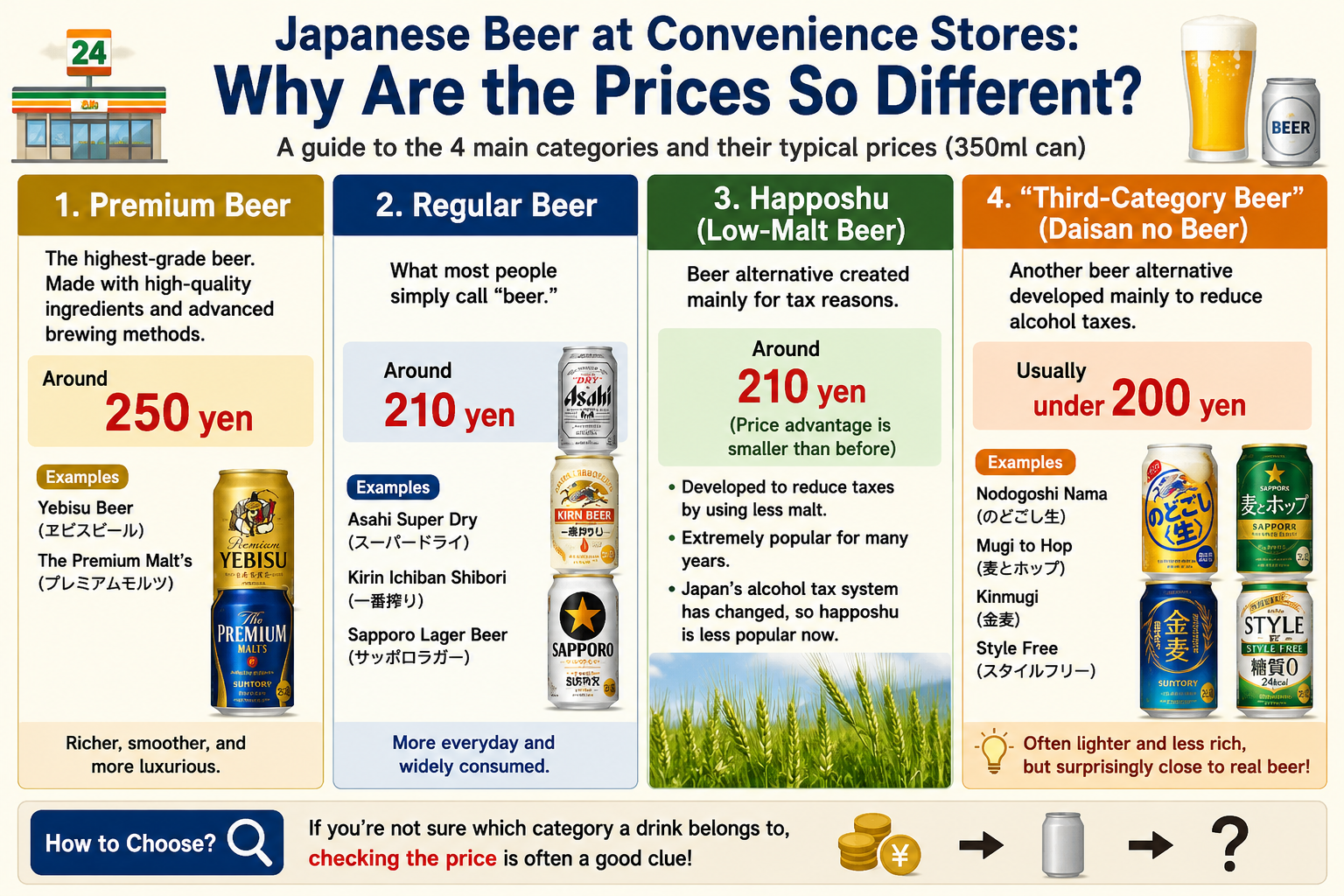
- Japanese Beer at Convenience Stores: Why Are the Prices So Different?
A guide to Japanese beer categories, including happoshu and “third-category beer.” - Types of Green Tea at Japanese Convenience Stores (With Real Product Names)
Why green tea products are everywhere in Japanese convenience stores and how foreigners react to them. - What You Can Get for Free at Japanese Convenience Stores (Most Tourists Don’t Know This)
Small convenience store services and items in Japan that often surprise foreign visitors.
コメント