Hello everyone.
As I mentioned in my previous article, today I’d like to introduce a successful example of a company creating its own “special day” in Japan.
In Japan:
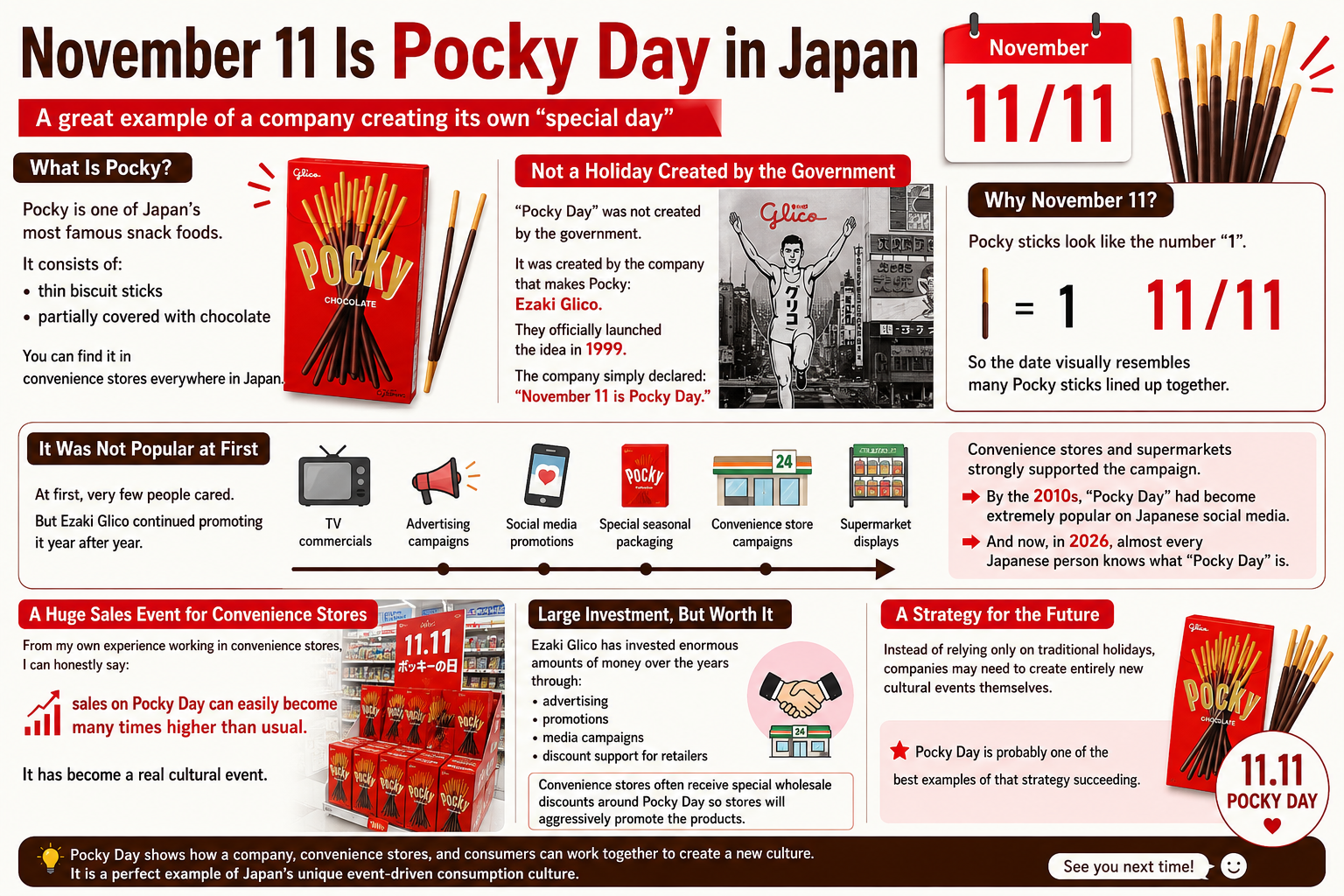
👉 November 11 is known as “Pocky Day.”
What Is Pocky?
Pocky is one of Japan’s most famous snack foods.
It consists of:
- thin biscuit sticks
- partially covered with chocolate
If you have visited Japan, you have probably seen it in convenience stores everywhere.
But here is the interesting part:
👉 “Pocky Day” was not created by the government.
It was created by the company that makes Pocky:
👉 Ezaki Glico.
They officially launched the idea in 1999.
Of course, this was not a real national holiday.
The government did not announce it.
There was no legal authority behind it.
The company simply declared:
👉 “November 11 is Pocky Day.”
Why November 11?
The reason is very simple.
Pocky sticks look like the number:
👉 “1”
And November 11 is:
👉 11/11
So the date visually resembles many Pocky sticks lined up together.
It Was Not Popular at First
At first, very few people cared.
Many consumers had never even heard of “Pocky Day,” and it had almost no cultural presence.
However, Ezaki Glico continued promoting it year after year through:
- TV commercials
- advertising campaigns
- social media promotions
- special seasonal packaging
- convenience store campaigns
- supermarket displays
Convenience stores and supermarkets also strongly supported the campaign.
By the 2010s, “Pocky Day” had become extremely popular on Japanese social media.
And now, in 2026:
👉 almost every Japanese person knows what “Pocky Day” is.
A Huge Sales Event for Convenience Stores
From my own experience working in convenience stores, I can honestly say:
👉 sales on Pocky Day can easily become many times higher than usual.
At this point, it is no longer just a marketing campaign.
It has become a real cultural event.
Of course, creating this kind of movement was not cheap.
Ezaki Glico probably invested enormous amounts of money over the years through:
- advertising
- promotions
- media campaigns
- discount support for retailers
For example, convenience stores often receive special wholesale discounts around Pocky Day so stores will aggressively promote the products.
But considering that the campaign became highly successful around 2010 — and continues generating huge sales every year even now in 2026 — the company has almost certainly earned far more than it originally invested.
A Strategy That May Become More Important in Japan
Personally, I think this kind of strategy may become increasingly important for Japanese convenience stores in the future.
Instead of relying only on traditional holidays, companies may need to create entirely new cultural events themselves.
And Pocky Day is probably one of the best examples of that strategy succeeding.
See you next time!
Related Articles
- Why Every Japanese Convenience Store Suddenly Sells the Same Product
How manufacturers and convenience store chains cooperate to create large nationwide sales campaigns. - Convenience Store Events in Japan: Setsubun
Another example of how seasonal traditions become major convenience store events in Japan. - A Special Convenience Store Event in Japan: Unagi Day
How Japanese convenience stores aggressively promote traditional seasonal foods during special periods of the year.
コメント