Hello everyone.
Today, I’d like to talk about one of the biggest seasonal events at Japanese convenience stores.
Japan has many seasonal events connected to food and shopping, such as:
- Christmas
- Valentine’s Day
- New Year
However, today I’d like to introduce something that many people outside Japan may not know:
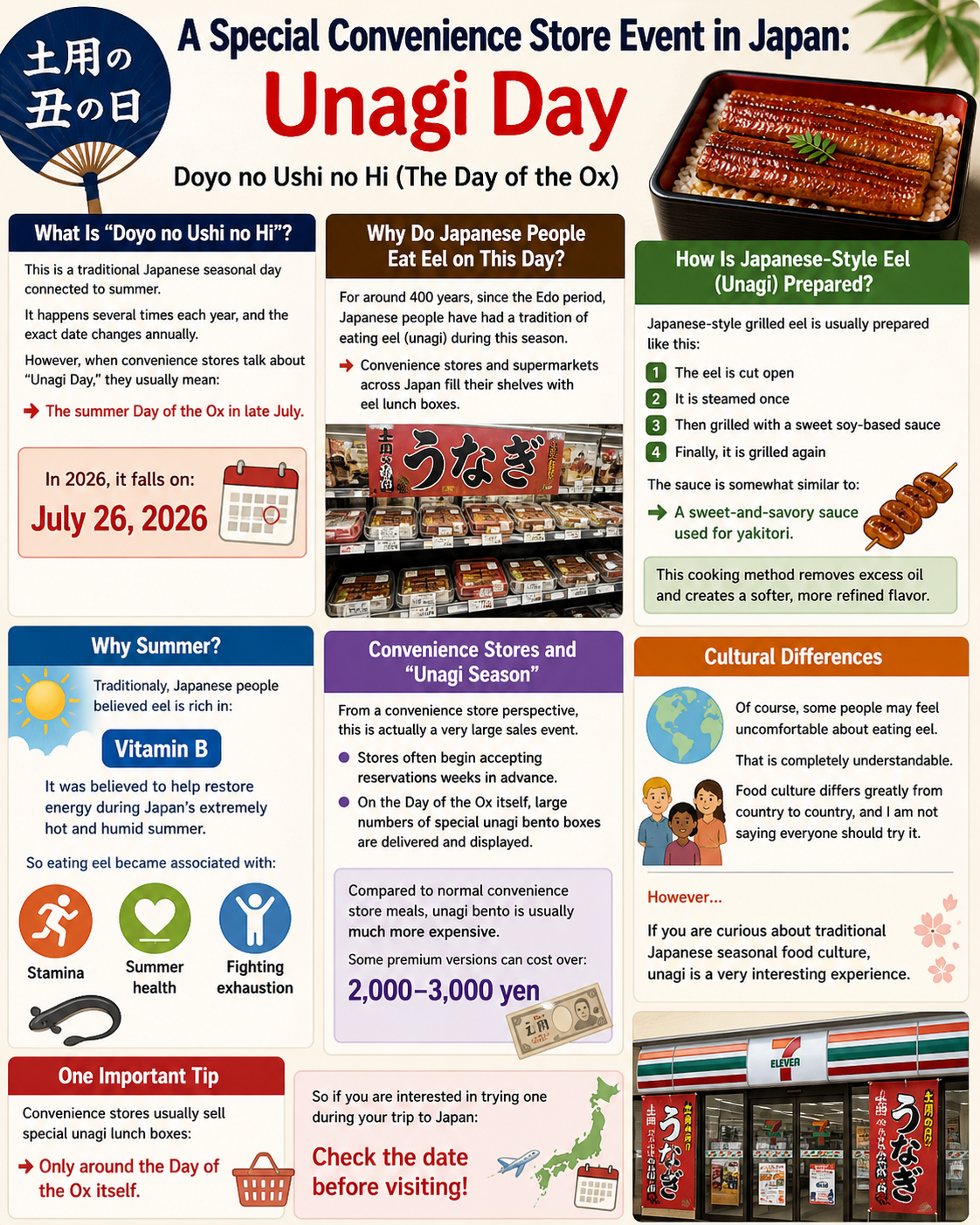
👉 Doyo no Ushi no Hi (The Day of the Ox)
What Is “Doyo no Ushi no Hi”?
This is a traditional seasonal day connected to summer in Japan.
Technically, “Day of the Ox” occurs several times each year, and the exact dates change annually.
However, when Japanese convenience stores talk about this event, they are usually referring to:
👉 The summer Day of the Ox in late July
In 2026, it falls on:
👉 July 26, 2026
Around this time, convenience stores across Japan begin heavily promoting eel products.
Why Do Japanese People Eat Eel on This Day?
For roughly 400 years, dating back to the Edo period, Japanese people have had a tradition of eating eel (unagi) during the hottest part of summer.
During this season:
👉 Convenience stores and supermarkets fill their shelves with special eel lunch boxes.
Many foreign visitors know what eel is, but have never actually tried Japanese-style unagi.
Japanese grilled eel is usually prepared like this:
- The eel is cut open
- It is steamed once
- Then grilled with a sweet soy-based sauce
- Finally, it is grilled again
The sauce is somewhat similar to:
👉 The sweet-and-savory sauce used for yakitori.
This cooking method removes excess oil and creates:
- A soft texture
- A rich aroma
- A refined flavor
Why in Summer?
Traditionally, Japanese people believed eel helped restore energy during Japan’s extremely hot and humid summers.
Eel is rich in nutrients such as:
👉 Vitamin B
Because of this, eel became associated with:
- Stamina
- Summer health
- Fighting exhaustion
Even today, many Japanese people still eat unagi during this season as a kind of summer tradition.
Convenience Stores and “Unagi Season”
From a convenience store perspective, this is actually a very large sales event.
Stores often begin accepting reservations weeks in advance.
On the Day of the Ox itself:
👉 Large numbers of special unagi bento boxes are delivered and displayed.
Compared to normal convenience store meals:
👉 Unagi bento is usually much more expensive.
Some premium versions can cost over:
👉 2,000–3,000 yen
Because of this, convenience stores promote these products very aggressively during the season.
Cultural Differences
Of course, some people may feel uncomfortable about eating eel.
That is completely understandable.
Food culture differs greatly from country to country, and I am not saying everyone should try it.
However:
👉 If you are interested in traditional Japanese seasonal food culture, unagi is a very interesting experience.
One Important Tip
Convenience stores usually sell special unagi lunch boxes:
👉 Only around the Day of the Ox itself.
So if you are interested in trying one during your trip to Japan:
👉 It is a good idea to check the date before visiting.
That’s all for today!
Related Articles
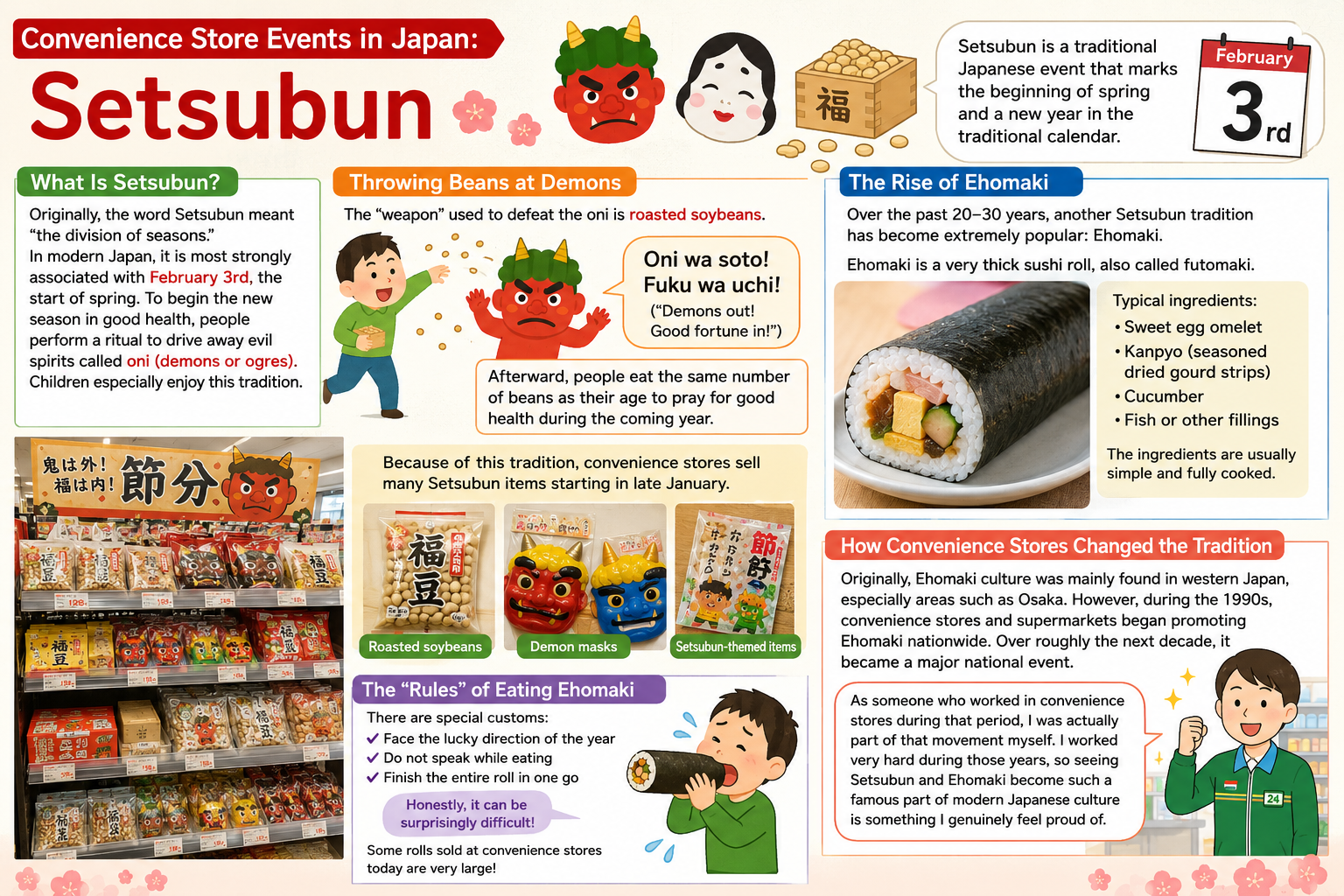
- Convenience Store Events in Japan: Setsubun
Another uniquely Japanese seasonal tradition heavily promoted by convenience stores every year. - Why Every Japanese Convenience Store Suddenly Sells the Same Product
How Japanese convenience stores use seasonal events and limited-time products to drive sales. - Convenience Store vs Supermarket in Japan — Which Should You Use?
Why convenience stores specialize in seasonal and individually packaged products that supermarkets often handle differently.
コメント