Hello everyone.
Today is Part 3 of my series about food disposal in Japanese convenience stores.
This time, I’d like to talk about something many people are curious about:
👉 Can convenience store employees eat unsold food?
Many people are surprised when they hear this:
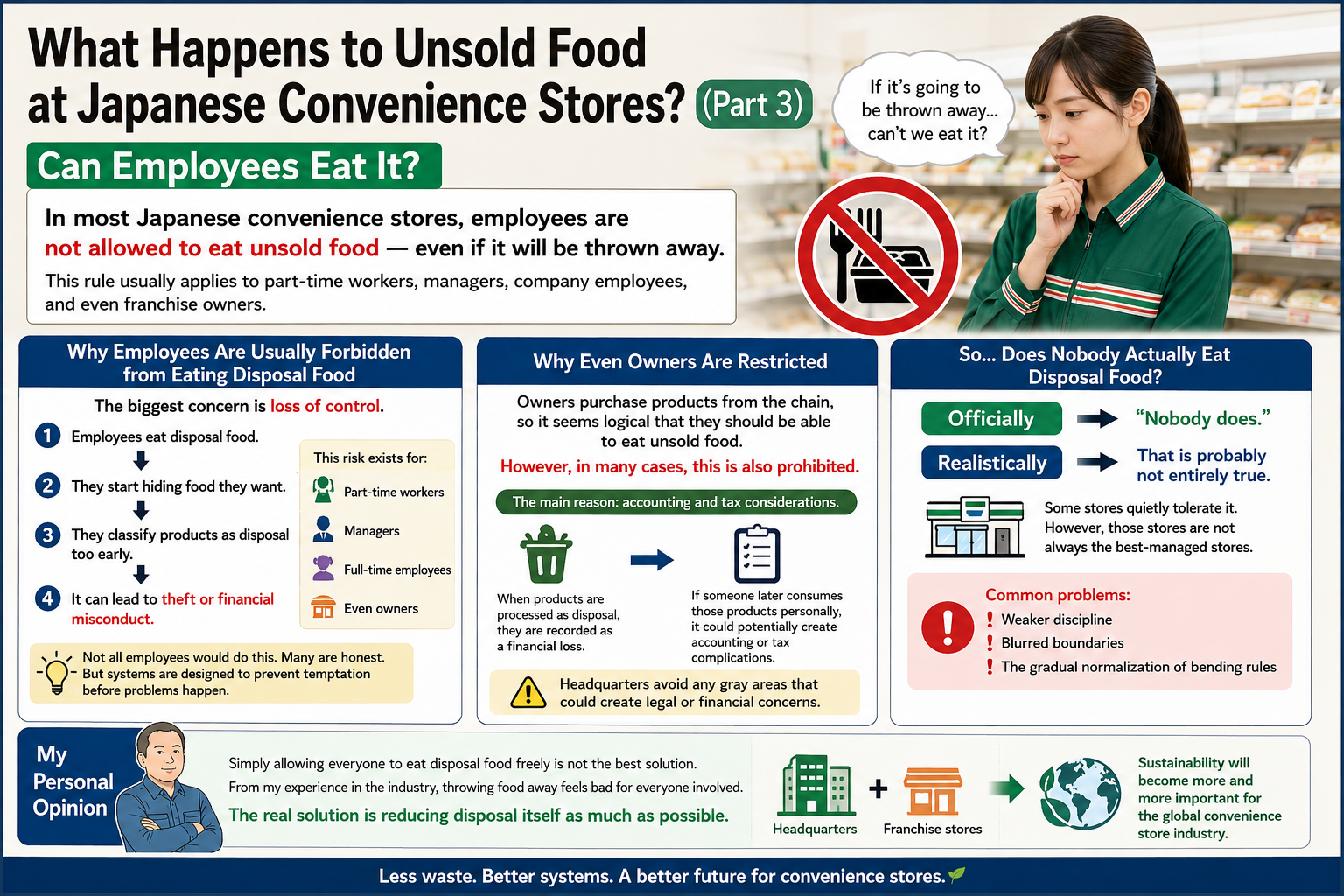
👉 in most Japanese convenience stores, employees are not allowed to eat unsold food — even if it will be thrown away.
And in many cases, this rule applies not only to part-time workers, but also to:
- store managers
- company employees
- and even franchise owners
For many people outside Japan:
👉 this probably sounds very strange.
After all, throwing away perfectly edible food feels extremely wasteful.
So why are convenience stores so strict about this?
Why Employees Are Usually Forbidden from Eating Disposal Food
Let’s start with part-time staff.
The biggest concern is:
👉 preventing temptation before problems begin.
Once employees become used to receiving free food regularly, their attitude toward products and money can gradually change.
For example, management worries about situations like this:
first, employees simply eat disposal food,
then they begin setting aside food they personally want,
later, they may intentionally classify products as disposal too early,
and in the worst cases, this can eventually lead to theft or financial misconduct.
Of course:
👉 this does not mean most employees would behave this way.
Many workers are honest.
However, convenience store systems are generally designed to reduce opportunities for trouble before it starts.
And honestly:
👉 this concern does not apply only to part-time workers.
The same temptation can exist for:
- managers
- full-time employees
- and sometimes even owners
Because rules are usually easier to maintain when they apply equally to everyone.
Why Even Franchise Owners Are Often Restricted
This part surprises many people.
A franchise owner technically purchases products from the convenience store chain.
So logically:
👉 many people assume owners should be free to eat unsold food.
However, in many cases:
👉 this is also discouraged or prohibited.
Why?
One reason involves accounting and tax considerations.
When products are processed as disposal:
👉 they are usually recorded as a financial loss.
If someone later consumes those products personally, depending on how the products are recorded, it could potentially create accounting or tax complications.
Even if such situations may be difficult to prove in practice, convenience store headquarters generally prefer to avoid any gray areas that could create legal or financial concerns.
So… Does Nobody Actually Eat Disposal Food?
Officially?
👉 “Nobody does.”
Realistically?
👉 That is probably not entirely true.
I personally know stores where disposal food is quietly tolerated.
However:
👉 those stores are not always the best-managed stores.
In my experience, the problem is not really the food itself.
The bigger issue is often:
- weaker discipline
- blurred boundaries
- and the gradual normalization of bending rules
Once standards begin slipping in one area, other problems sometimes follow.
My Personal Opinion
Personally:
👉 I do not think the answer is simply letting everyone eat disposal food freely.
From my experience in the convenience store industry:
👉 throwing food away feels bad for everyone involved.
That is exactly why I believe the real solution is:
👉 reducing food disposal itself as much as possible.
Both:
- convenience store headquarters
- and franchise stores
need to keep improving systems that reduce unnecessary waste.
Because in the future:
👉 sustainability will become more and more important for the global convenience store industry.
Thank you for reading.
Related Articles
- What Happens to Unsold Food at Japanese Convenience Stores? (Part 1)
Why convenience stores remove food early and how the disposal system works behind the scenes. - What Happens to Unsold Food at Japanese Convenience Stores? (Part 2)
The hidden financial burden of food disposal and why stores often struggle to balance waste and sales. - The Worst Convenience Store Workers I’ve Ever Seen (Part 1)
Why workplace discipline and employee behavior matter more than many people realize in convenience store operations.
コメント