Hello everyone.
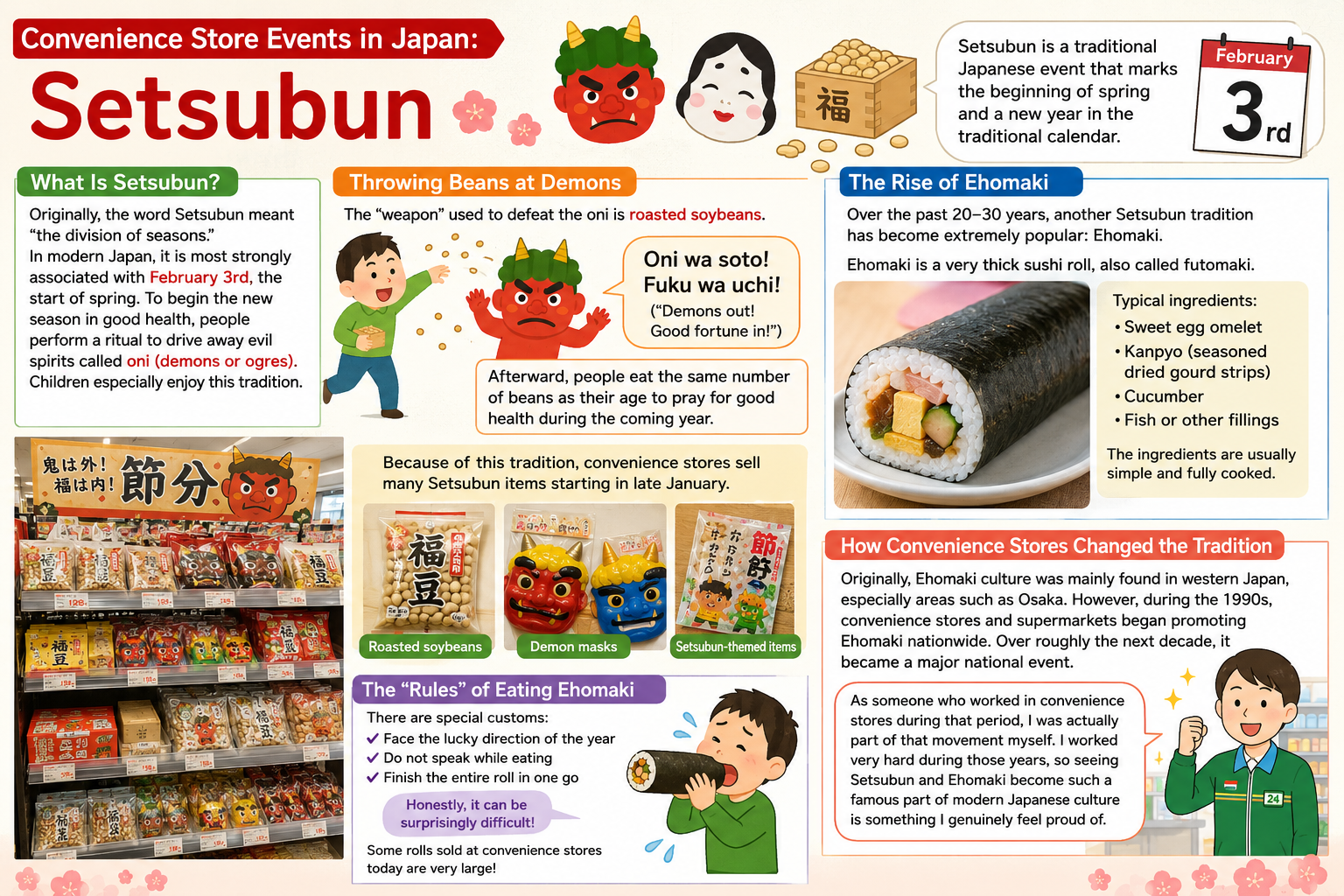
Today, I’d like to explain another uniquely Japanese seasonal event from the perspective of convenience stores: Setsubun.
What Is Setsubun?
Originally, the word Setsubun meant “the division of seasons.”
However, in modern Japan, it is most strongly associated with February 3rd, which marks the beginning of spring according to the traditional Japanese calendar.
In Japanese culture, spring has long been viewed as the beginning of a new year or a fresh stage of life.
To welcome the new season in good health, people traditionally perform rituals to drive away evil spirits known as oni (demons or ogres).
For many Japanese children, this is one of the most memorable seasonal events of the year.
Throwing Beans at Demons
The “weapon” used against the oni is:
👉 Roasted soybeans
People throw the beans while shouting:
“Oni wa soto! Fuku wa uchi!”
(“Demons out! Good fortune in!”)
After the ritual, people traditionally eat the same number of beans as their age to pray for good health during the coming year.
Because of this custom, Japanese convenience stores begin selling seasonal Setsubun items around late January, including:
- Roasted soybeans
- Demon masks
- Small Setsubun-themed products
During this season, these items are displayed prominently near store entrances and seasonal event sections.
The Rise of Ehomaki
Over the past 20–30 years, another Setsubun tradition has become extremely popular:
👉 Ehomaki
Ehomaki is a very thick sushi roll, also called futomaki.
Typical ingredients include:
- Sweet egg omelet
- Kanpyo (seasoned dried gourd strips)
- Cucumber
- Fish or other fillings
Compared to ordinary sushi, the ingredients are usually simple and fully cooked, making it approachable even for people who are not used to raw fish.
The “Rules” of Eating Ehomaki
There are several traditional rules associated with Ehomaki:
- Face the lucky direction of the year
- Do not speak while eating
- Finish the entire roll without cutting it
Honestly:
👉 It can be surprisingly difficult.
Some convenience store Ehomaki today are extremely large, and finishing one silently can become a real challenge.
How Convenience Stores Changed the Tradition
Originally, Ehomaki culture was mainly found in western Japan, especially in areas such as Osaka.
However, during the 1990s, convenience stores and supermarkets began promoting Ehomaki nationwide as a seasonal event product.
Over roughly the next decade, it grew into a major national tradition recognized across Japan.
As someone who worked in convenience stores during that period, I was actually part of that movement myself.
I worked very hard during those years, so seeing Setsubun and Ehomaki become such a famous part of modern Japanese culture is something I genuinely feel proud of.
That’s all for today.
Related Articles
- Why Every Japanese Convenience Store Suddenly Sells the Same Product
How Japanese convenience stores use seasonal events and limited-time promotions to increase sales. - A Special Convenience Store Event in Japan: Unagi Day
Another seasonal product heavily promoted by Japanese convenience stores during specific times of the year. - What Is a Japanese Convenience Store Shift Like? (Full Guide)
A look at the busy behind-the-scenes operations that support seasonal sales events in Japanese convenience stores.
コメント