Hello everyone.
Today, I’d like to talk about the relationship between Japanese convenience store owners and company headquarters.
Many people outside Japan probably imagine convenience stores as simple retail shops.
However, behind the scenes, Japanese convenience stores operate through a very complex franchise system.
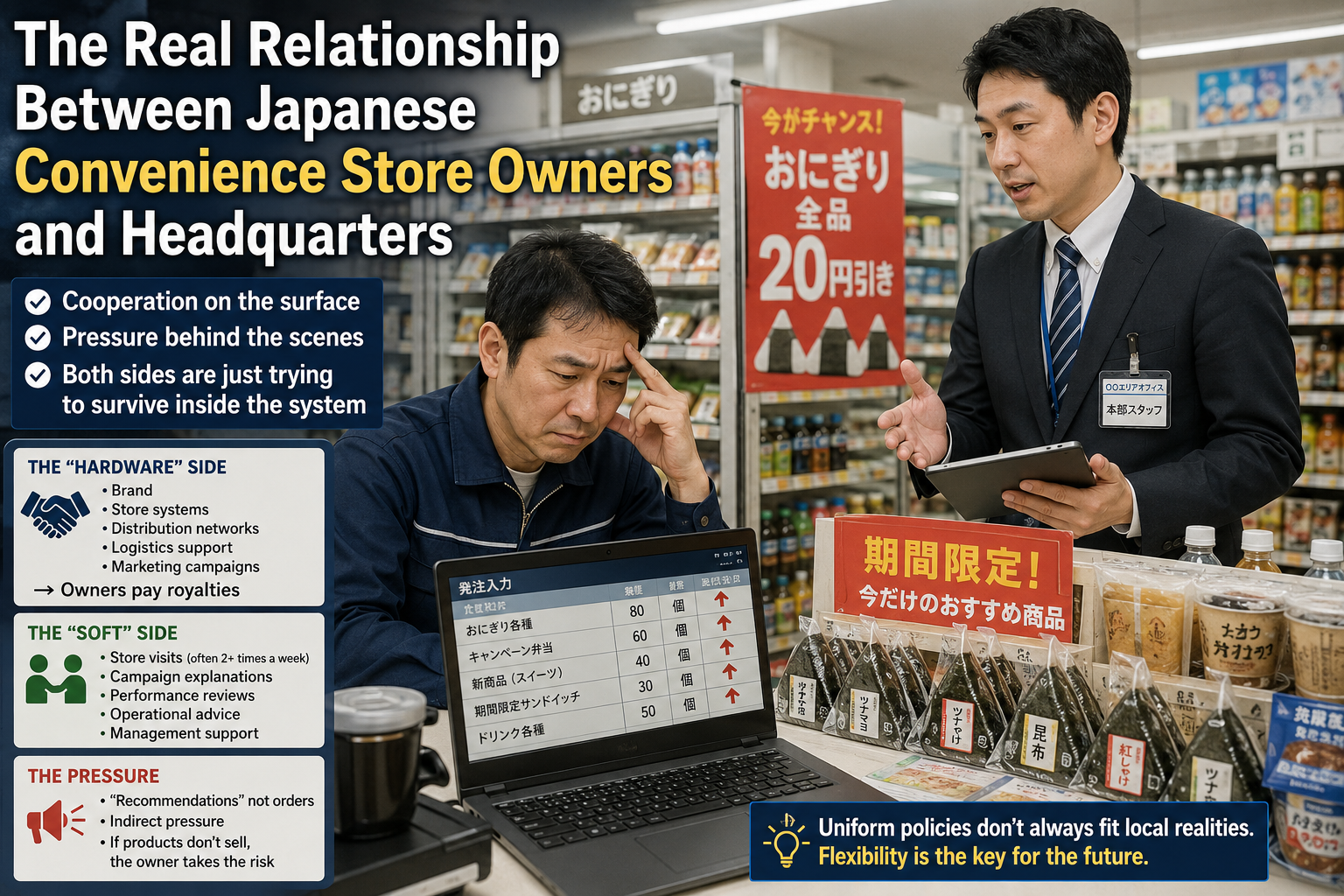
The “Hardware” Side of the Relationship
First, let’s look at the basic business structure.
Convenience store owners sign franchise contracts with headquarters.
In exchange, they gain access to things such as:
- the brand name
- store systems
- product distribution networks
- logistics support
- nationwide marketing campaigns
And in return:
👉 franchise owners pay royalties to headquarters every month according to their contracts.
This is the visible, business side of the relationship.
But what about the human side?
The “Soft” Side of the Relationship
Each franchise store belongs to a regional office operated by headquarters.
For example:
- Kawasaki Office
- Shinjuku Office
- Yokohama Office
Employees from headquarters regularly visit stores — often at least twice a week.
Their role is to:
- explain upcoming campaigns
- discuss company priorities
- review store performance
- provide operational advice
- support store management
Officially, the relationship is presented as a cooperative partnership.
The store and headquarters are supposed to work together to solve problems and improve business.
And sometimes, that is genuinely true.
But reality is often more complicated.
The Pressure Behind the Scenes
Headquarters frequently encourages stores to increase orders for specific products.
For example:
- campaign items
- seasonal products
- promotional goods
- limited-time foods
Officially, these are usually described as “recommendations,” not mandatory orders.
However, many franchise owners still feel strong pressure.
Sometimes the pressure is not direct.
Instead, it may appear through indirect comments such as:
👉 “Stores that actively participate tend to receive stronger support.”
Or:
👉 “Most nearby stores are increasing their orders.”
In Japan, this kind of indirect pressure can sometimes feel stronger than explicit orders.
Of course, if a campaign succeeds, stores can earn good profits.
But if the products do not sell:
👉 the financial burden often falls on the franchise owner.
Why Does Headquarters Push So Hard?
To be fair, the employees visiting stores are also workers inside a large organization.
Their own evaluations and career advancement are often connected to:
- campaign performance
- sales numbers
- store participation rates
So from their perspective, encouraging stores to order more products is also part of their job.
In many cases:
👉 both sides are simply trying to survive inside the system.
Personally, I do not think the situation is as simple as “good versus bad.”
The system itself creates pressure for everyone involved.
The Problem With Uniform Policies
Personally, I think one major issue is that headquarters policies are sometimes too inflexible.
For example:
Imagine a store located in an area with many foreign customers and relatively few Japanese customers.
In that kind of location, products like rice balls (onigiri) may not sell very well.
And yet:
👉 during large nationwide onigiri campaigns, stores may still be encouraged to order large quantities anyway.
Even when local staff already know demand will probably be weak.
I understand why headquarters creates nationwide campaigns.
Standardization is one reason Japanese convenience stores became so successful in the first place.
However, modern Japan is changing rapidly.
Customer demographics are changing.
Tourism is increasing.
And the needs of each area are becoming more different than before.
Because of this:
👉 I sometimes feel convenience stores now need more flexibility based on local conditions and customer demographics.
My Personal Perspective
As a former convenience store owner, I was always cautious about my relationship with headquarters.
There was often tension between:
- field reality
and - company policy
Of course, not every headquarters employee was bad.
Some genuinely tried to help stores succeed.
In fact, I met several people who were intelligent, sincere, and highly professional.
But from my experience:
👉 convenience store management in Japan often involves balancing cooperation and pressure at the same time.
And maintaining that balance can sometimes become very difficult.
Japanese convenience stores are famous around the world for their efficiency and consistency.
But behind that system, there are also many invisible human relationships and pressures that customers never see.
See you next time!
Related Articles
- What Is a Directly Managed Convenience Store in Japan?
How directly managed stores operate and why they are important for headquarters strategy and staff training. - Why Every Japanese Convenience Store Suddenly Sells the Same Product
A behind-the-scenes look at nationwide manufacturer campaigns and how stores are pressured to promote certain products. - The Future of Convenience Store Owners in Japan
Why more convenience store owners in Japan are becoming cautious about the future of the franchise system.
コメント