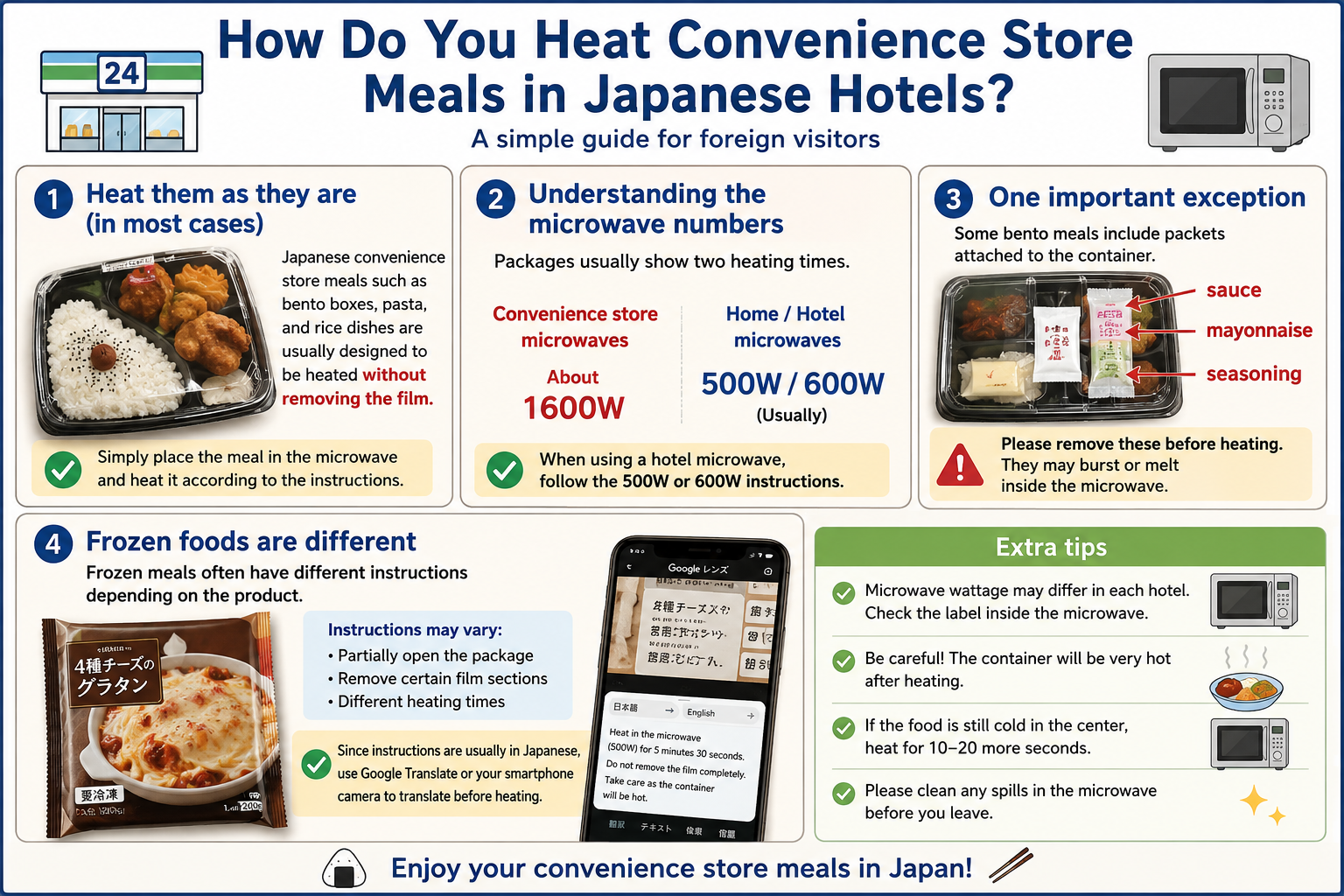
Hello everyone.
Today, I’d like to explain something that surprisingly confuses many foreign visitors to Japan:
👉 How do you heat convenience store meals in hotel microwaves?
The answer is actually very simple:
👉 In most cases, you should heat them exactly as they are.
However, if you are unfamiliar with Japanese convenience store food, this may feel a little confusing at first.
A Common Mistake Foreign Visitors Make
One mistake I sometimes see is this:
Some people completely remove the plastic film or open the lid before heating the food.
However:
👉 this can cause the food to splatter inside the microwave.
Most Japanese convenience store meals such as:
- bento boxes
- pasta
- rice dishes
are designed to be heated without removing the film or lid.
In most cases:
👉 simply place the meal in the microwave and heat it according to the instructions on the package.
Understanding the Microwave Numbers
Japanese convenience store meals usually show multiple heating times on the package.
Typically, you will see:
- heating time for convenience store microwaves
- heating time for home microwaves (500W / 600W)
Japanese convenience store microwaves are extremely powerful.
Many operate at around:
👉 1600 watts
Meanwhile, hotel or home microwaves are usually:
👉 500–600 watts
So when using a hotel microwave:
👉 follow the 500W or 600W instructions printed on the package.
Otherwise, the food may become too hot or unevenly heated.
One Important Exception
Earlier, I said you can heat the food “as it is.”
However, there is one important exception.
Some bento meals include:
- sauce packets
- mayonnaise packets
- seasoning packets
attached to the container.
Please remove these before heating.
Otherwise:
👉 they may burst or melt inside the microwave.
Frozen Foods Are Different
One more important point:
Fresh convenience store meals such as bento and pasta are usually simple to heat.
However:
👉 frozen foods often have completely different instructions depending on the product.
Some require:
- partially opening the package
- removing certain film sections
- different heating times
Since the instructions are usually written in Japanese, I strongly recommend using:
- Google Translate
- a translation app
- your smartphone camera translation feature
before heating frozen foods.
This can help prevent overheating, cold spots, or cooking mistakes.
See you next time!
Related Articles
- Why Are Japanese Convenience Store Microwaves So Powerful?
Why convenience store microwaves in Japan are so powerful and how they help stores operate efficiently. - How to Make Japanese Cup Ramen (The Right Way – No Microwave!)
A simple guide to preparing Japanese cup ramen the right way. - How to Make Japanese Cup Yakisoba (Many Foreigners Make This Mistake)
One of the most confusing convenience store foods for foreign visitors — and how to avoid common mistakes.
コメント