Hello everyone.
Today, I’d like to answer a question that many visitors to Japan may have:
Can you return something you bought at a Japanese convenience store?
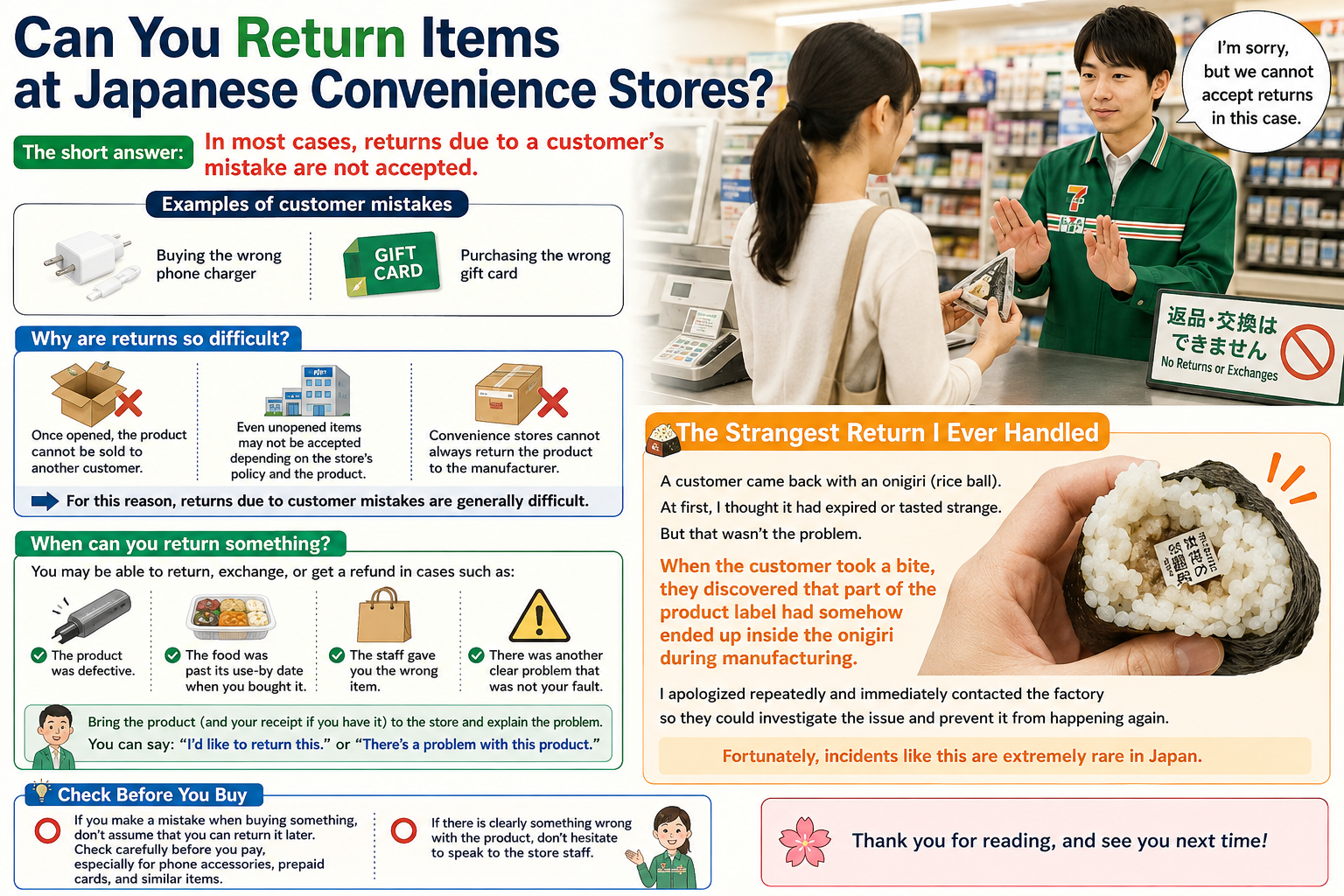
The short answer is:
In most cases, returns due to a customer’s mistake are not accepted.
For example, imagine that you buy the wrong phone charger because you didn’t check the connector carefully. Or perhaps you accidentally purchase the wrong gift card.
In cases like these, the store will usually not accept a return.
Why Are Returns So Difficult?
There are several reasons.
Once certain products have been opened, they can no longer be sold to another customer. Even if the product is still unopened, the store may not accept it depending on its return policy and the type of product.
Convenience stores also cannot necessarily return unwanted products to their suppliers or manufacturers.
This means that if a store accepts a return simply because a customer changed their mind or bought the wrong item, the store may have to absorb the loss.
For this reason, returns due to customer mistakes are generally difficult at Japanese convenience stores.
This is especially important when buying products such as phone accessories or prepaid cards. Make sure you have the correct product before paying.
When Can You Return Something?
Of course, there are situations where a return, exchange, or refund may be appropriate.
For example:
- The product was defective.
- The food was already past its use-by date when you bought it.
- The staff gave you the wrong item.
- There was another clear problem with the product or transaction that was not your fault.
If something like this happens, bring the product and, if possible, your receipt back to the store and explain the problem to the staff.
You can simply say:
“I’d like to return this.”
or:
“There’s a problem with this product.”
The Strangest Return I Ever Handled
Before I finish, I’d like to share the most memorable return request I’ve ever handled during my years working in convenience stores.
One day, a customer came back to the store with an onigiri—a Japanese rice ball.
At first, I assumed that it had expired or that there was something wrong with the taste.
But that wasn’t the problem.
The customer had taken a bite and discovered something very unusual inside the rice ball.
Part of the product label had somehow ended up inside the onigiri during the manufacturing process.
Naturally, I apologized repeatedly.
I then contacted the factory immediately so that they could investigate what had happened and take steps to prevent the same problem from happening again.
Fortunately, incidents like this are extremely rare in Japan.
Check Before You Buy
The important thing to remember is simple:
If you make a mistake when buying something, don’t assume that you can return it later.
Before paying, especially for phone accessories, prepaid products, or other items that are difficult to return, take a moment to make sure you are buying the correct product.
On the other hand, if there is clearly something wrong with the product itself, don’t hesitate to speak to the store staff.
Thank you for reading, and see you next time!
Related Articles
👉Things You Can’t Buy at Japanese Convenience Stores
Learn about products and services that visitors may expect to find at Japanese convenience stores—but often cannot.
👉 Why Didn’t My Credit Card Work in Japan?
Find out what to do when your credit card unexpectedly fails at a Japanese convenience store.
👉 Bad Experience at a Japanese Convenience Store? Here’s What To Do
Learn what you can do if you experience a serious problem or poor service at a Japanese convenience store.
👉 Paper Cups Behind Japanese Convenience Store Registers Are Not Free
Discover another common misunderstanding that can occur when shopping at Japanese convenience stores.
👉 Is Japan Really a “Manual-Based Society”? — A Convenience Store Perspective
Learn why Japanese stores often follow clearly defined rules and procedures when dealing with customers.
コメント