Hello everyone.
Today, I’d like to share Part 2 of my series about some of the most unforgettable people I’ve met while working in Japanese convenience stores.
This time, both stories are about hiring and training.
And yes, these really happened.
A: The Five-Second Job Interview
The first person never actually became an employee.
In fact, his job interview lasted about five seconds.
He came to the store for an interview and handed me his résumé.
I looked at it.
And almost immediately said:
“I’m sorry, but we can’t continue with the interview.”
Why?
His résumé had a photo attached to it.
But it wasn’t a normal ID-style photo.
It was a purikura photo.
Purikura are Japanese photo-booth pictures that were especially popular among young people at the time. People often took them with friends, making funny poses and decorating the pictures.
And that was exactly what he had attached to his résumé.
It wasn’t even a picture of him alone.
He was posing with a friend.
For a formal job application.
To me, this suggested that he hadn’t understood even the basic expectations of a job interview, so I decided not to continue.
But the story didn’t end there.
Later, I received a phone call from one of his parents.
The parent was angry.
“How can you reject someone without even properly interviewing him?”
So I explained what had happened.
I told the parent about the purikura photo on the résumé.
There was a pause.
Then the parent’s attitude completely changed.
They apologized repeatedly and told me they would teach him how to prepare properly for a job interview.
I remember feeling relieved.
At least the parent understood why I had made the decision.
B: The Mysterious Barcode
The second person actually passed the interview.
He seemed serious and polite, so I hired him.
However, during his training period, I gradually realized that convenience-store work might not be the right job for him.
Let me give you one example.
At a Japanese convenience store, employees usually scan the barcode on each product at the register.
Simple enough.
However, not every item has a barcode.
When an item doesn’t have one, the cashier has to enter it using the appropriate function on the register.
I explained this to him several times.
But whenever he encountered an item without a barcode, he simply couldn’t accept that there wasn’t one.
He kept looking for it.
And looking.
And looking.
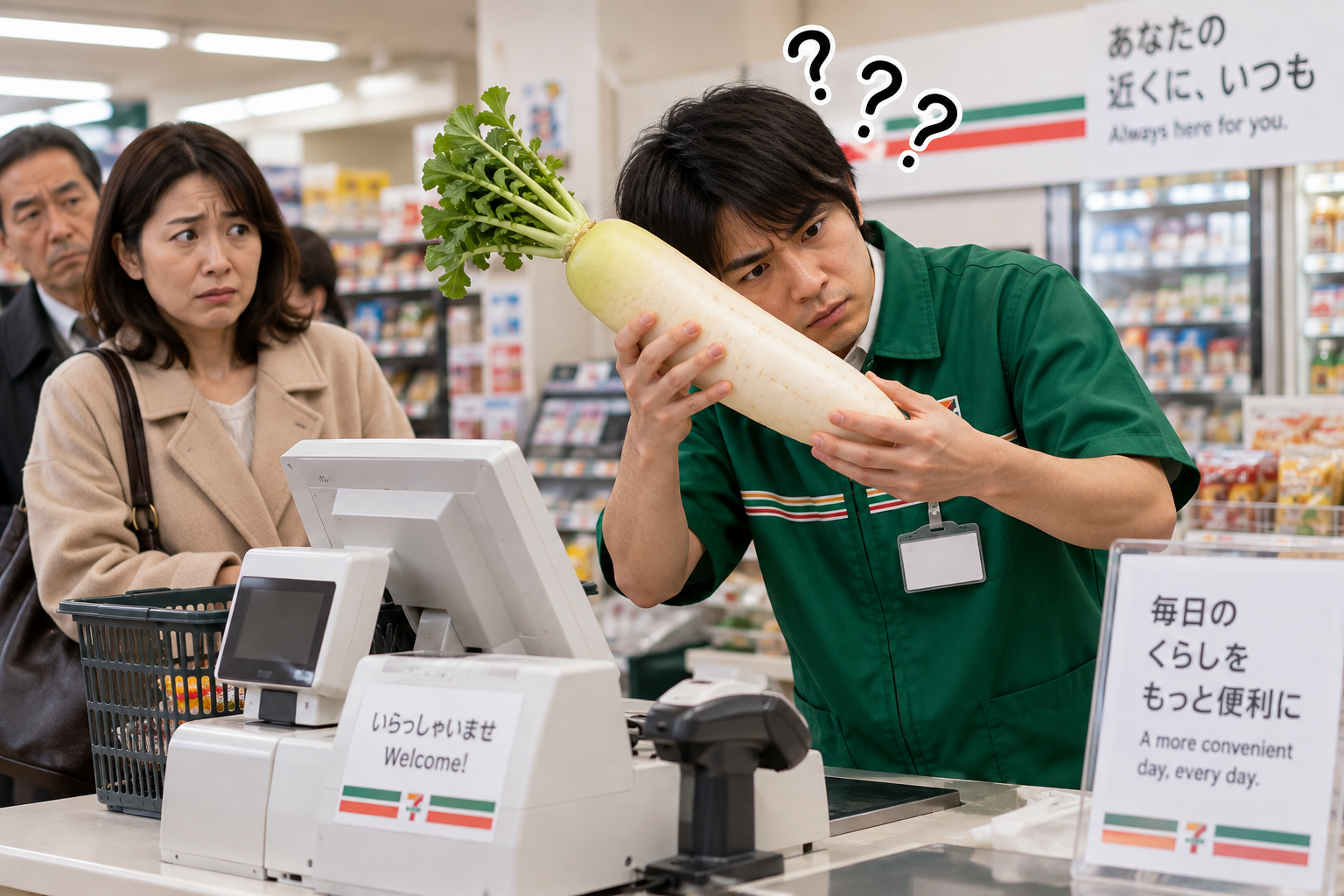
Imagine that a customer brings a daikon, a large Japanese white radish, to the register.
There is no barcode attached to it.
He picks up the daikon.
He turns it around.
And around.
And around.
Still looking for the barcode.
I tell him:
“There isn’t a barcode on that.”
But he keeps searching.
One minute passes.
Then two.
Sometimes almost three minutes.
Meanwhile, the customer is standing there watching an employee slowly rotate a giant white radish in his hands, desperately searching for a barcode that does not exist.
Eventually, he gives up.
Then he calls me over and announces:
“There is no barcode.”
Yes.
That was what I had told him from the beginning.
As you can imagine, some customers became angry.
Others simply looked uncomfortable and wanted to leave as quickly as possible.
And this didn’t happen just once.
No matter how many times I explained the procedure, the same problem continued.
Eventually, I told him:
“I don’t think this job is right for you.”
He thought about it.
Then he said:
“I think so too.”
And that was the end of his convenience-store career.
Looking Back
Managing convenience stores introduced me to an incredible variety of people.
Some were excellent workers.
Some surprised me in good ways.
And occasionally, I met someone who left me with a story that I would still remember many years later.
The important thing is that not every person is suited to every kind of job.
Convenience-store work may look simple from the outside, but employees constantly have to make small decisions, respond to unexpected situations, and keep customers moving through the register quickly.
These experiences taught me that it can be surprisingly difficult to judge whether someone is suited to convenience-store work based on a short interview.
And they also taught me something else:
If someone tells you that a daikon doesn’t have a barcode, sometimes you just have to believe them.
Thanks for reading!
If I remember another unforgettable convenience-store story, there may be a Part 3.
Related Articles
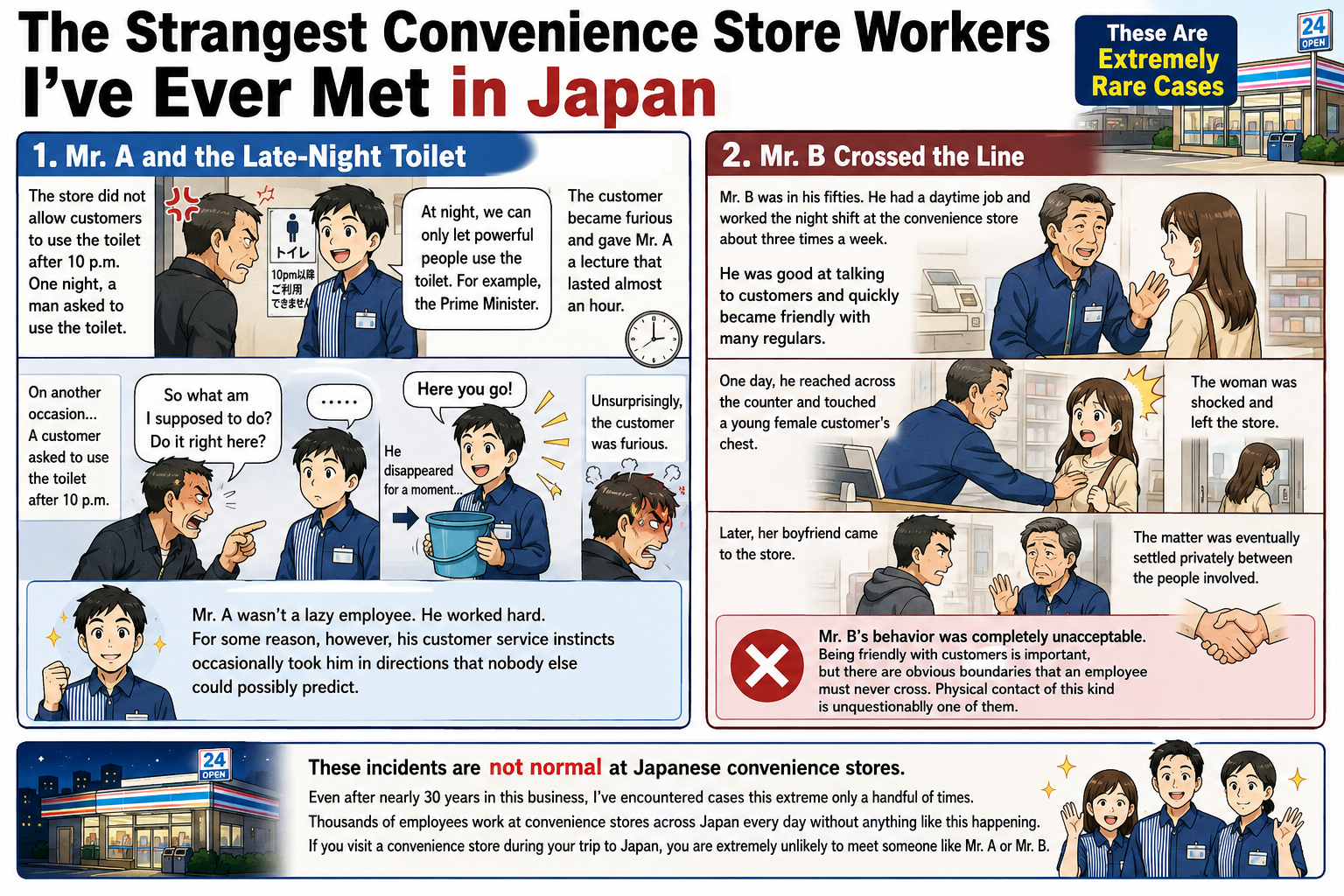
👉 The Strangest Convenience Store Workers I’ve Ever Met in Japan
Start with Part 1 and meet two more unforgettable people from my years working in Japanese convenience stores.
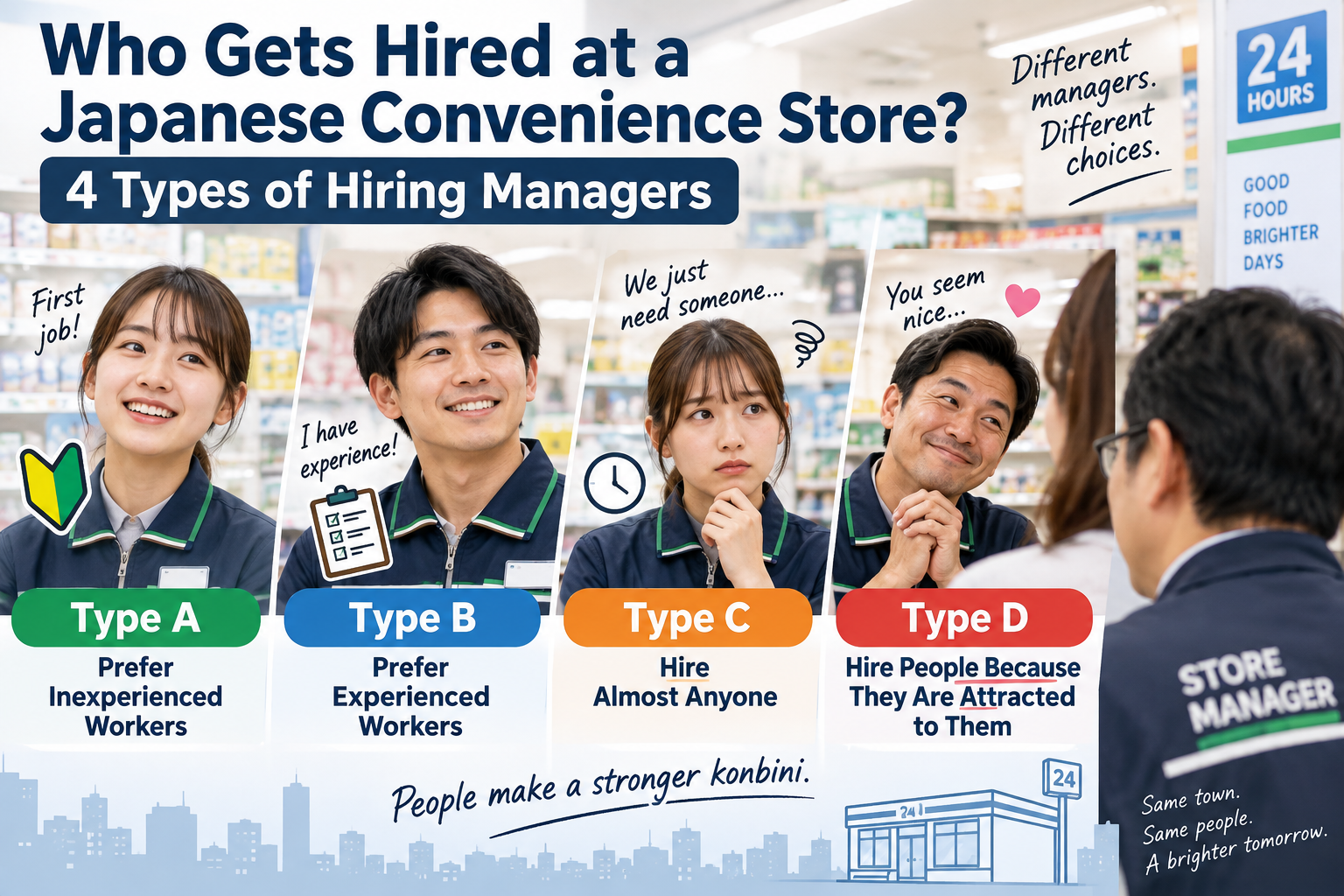
👉 What Does a Convenience Store Manager Actually Do? (Part 2) — Hiring Staff
Learn how convenience store managers choose new employees—and why a short interview doesn’t always tell you everything.
👉 What Does a Convenience Store Manager Actually Do? (Part 3) — Training Staff
Discover how new convenience store employees are trained and why some parts of the job can be surprisingly difficult to teach.
👉 What Do Convenience Store Register Staff Actually Do?
See what convenience store cashiers actually do and why working at the register requires more judgment than it may seem.
👉 Dream Chasers Working at Japanese Convenience Stores
Meet some of the many different kinds of people who work behind the counter at Japanese convenience stores.
コメント