Hello everyone.
This is Part 2 of my story about what can happen when a part-time worker gains too much power in a convenience store.
In Part 1, I explained how a capable part-time worker can gradually become an unofficial manager when responsibility and authority are poorly balanced.
Today, I’d like to tell you about one particular part-time worker.
Let’s call him A.
A Was Actually a Very Good Worker
A was a capable and responsible young man.
He worked hard, understood convenience-store operations well, and could be trusted with important tasks.
Because of this, the company gradually gave him more responsibility.
Eventually, they gave him a particularly important job:
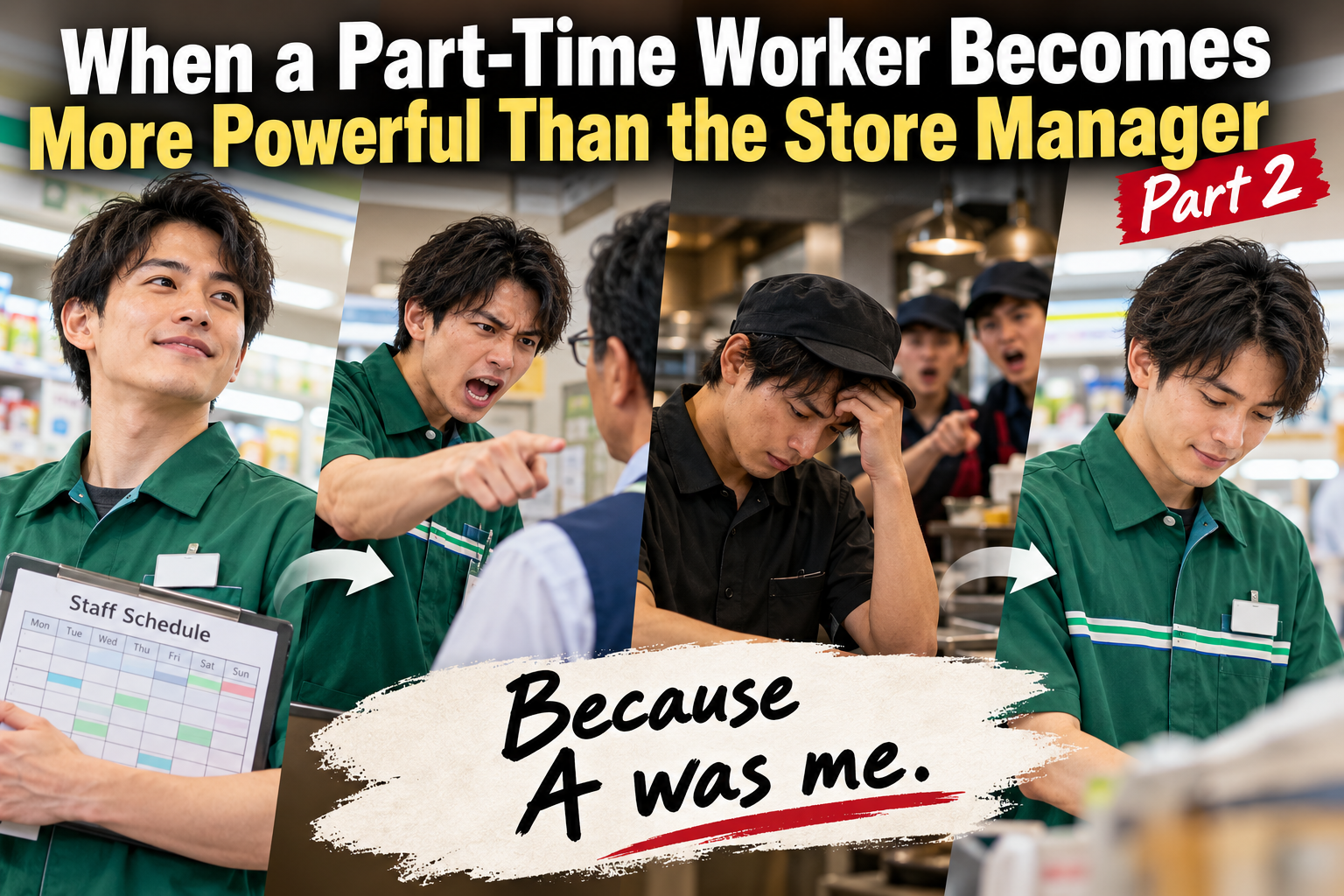
Creating the staff schedule.
At first, this might not sound so unusual.
Experienced part-time workers sometimes help with scheduling.
But there was something strange about this particular situation.
A wasn’t only scheduling his fellow part-time workers.
He was also scheduling the store manager.
Looking back, I think that was a serious mistake.
A part-time employee was effectively deciding not only when his coworkers worked, but also when his own boss worked.
Scheduling Means Power
A work schedule may look like a simple administrative task, but it can give someone considerable influence.
For a part-time worker, the number of scheduled hours directly affects their income.
Imagine that another part-time employee disagrees with the person who controls the schedule.
They might start wondering:
“What if my hours get reduced next month?”
Even if A never explicitly threatened anyone, the power imbalance was already there.
Gradually, his coworkers stopped challenging him.
Even the store manager became careful about dealing with him.
And A misunderstood what was happening.
He began to think:
“People listen to me because I’m important.”
In reality, some people were simply afraid of creating trouble with the person who controlled their working hours.
But A could no longer see the difference.
He Started Believing He Was Above the Manager
The more people avoided confronting him, the more confident he became.
Eventually, even the store manager hesitated to challenge him.
That made the situation worse.
A gradually stopped seeing himself as just another part-time worker.
He began behaving as though he were above the other employees.
Eventually, he even started shouting at the store manager.
By that point, the relationship between authority and position had completely broken down.
The manager had the official title.
But A had much of the practical power.
And because nobody had corrected the situation early enough, A had begun to mistake that power for proof of his own superiority.
Then something happened that completely changed his perspective.
A Left the Convenience Store Industry
Eventually, A started looking for a full-time job.
By then, he was extremely confident.
He thought:
“I’ve been successful in a convenience store. I can succeed anywhere.”
So he found a job in the restaurant industry.
He was appointed as an assistant manager.
There was one major problem.
He received very little training before taking the position.
Suddenly, everything was reversed.
Now He Was the Inexperienced Employee
At the convenience store, A had been the experienced worker everyone depended on.
At his new workplace, he was the inexperienced one.
He didn’t know the operation well enough.
He couldn’t perform at the level expected of an assistant manager.
And some of the younger part-time employees became frustrated with him.
They shouted at him.
Day after day, the man who had once shouted at his own store manager was now being shouted at by younger part-time workers.
For the first time, A experienced the situation from the other side.
And he couldn’t handle it.
Eventually, he quit.
Then He Finally Understood
Leaving that job was painful.
But it also forced A to think about what had happened.
For the first time, he began to understand how badly he had treated other people at the convenience store.
He realized that being highly skilled in one workplace did not automatically mean that he would be highly skilled everywhere.
He also realized that having power did not mean that he had the right to look down on other people.
So he made a decision.
He returned to the convenience-store industry.
But this time, he wanted to start again as an ordinary part-time worker.
He decided to work hard, stay humble, and rebuild himself from the beginning.
And he changed.
Sometimes Failure Is a Very Good Teacher
Of course, simply failing doesn’t automatically make someone a better person.
A could have blamed the restaurant.
He could have blamed the younger employees.
He could have blamed the lack of training.
And to be fair, some of those things really were problems.
But ultimately, he also looked at himself.
He admitted that his own behavior had been wrong.
That was probably the most important part of the story.
I believe being able to recognize your own mistakes is one of the most valuable abilities a person can have.
Sometimes we need confidence.
But sometimes we also need someone—or something—to show us that we’re not as great as we think we are.
Being too easy on ourselves can prevent us from growing.
What Happened to A?
Fortunately, this story has a good ending.
A is doing fine today.
After that experience, he became much better at looking at himself objectively.
He learned how to maintain a reasonable relationship with both managers and junior employees.
He still works hard.
But he no longer mistakes responsibility for status or authority for personal superiority.
How can I be so sure about what A thought, what he learned, and what happened to him afterward?
That’s easy.
Because A was me.
That’s all for today.
Thank you for reading.
Related Articles
👉 「When a Part-Time Worker Becomes More Powerful Than the Store Manager — Part 1」
Start with Part 1 to understand how responsibility and authority can become dangerously unbalanced inside a convenience store.
👉 「Who Gets Hired at a Japanese Convenience Store? 4 Types of Hiring Managers」
Learn how different management styles can shape employees—and sometimes the entire workplace.
👉 What Does a Convenience Store Manager Actually Do? (Part 3) — Training Staff
Discover why training and developing employees is one of the most important responsibilities of a convenience store manager.
👉 The Dark Side of Convenience Store Management in Japan — A True Story From 25 Years Ago
Read another true story about authority, workplace relationships, and the darker side of convenience-store management
👉 Dream Chasers Working at Japanese Convenience Stores
Meet some of the different people who work at Japanese convenience stores and the paths they take beyond the store.

コメント