Hello everyone.
Today, I’d like to talk about something that has quietly disappeared from many Japanese convenience stores:
👉 magazines.
If you visit Japan today, you may notice something surprising:
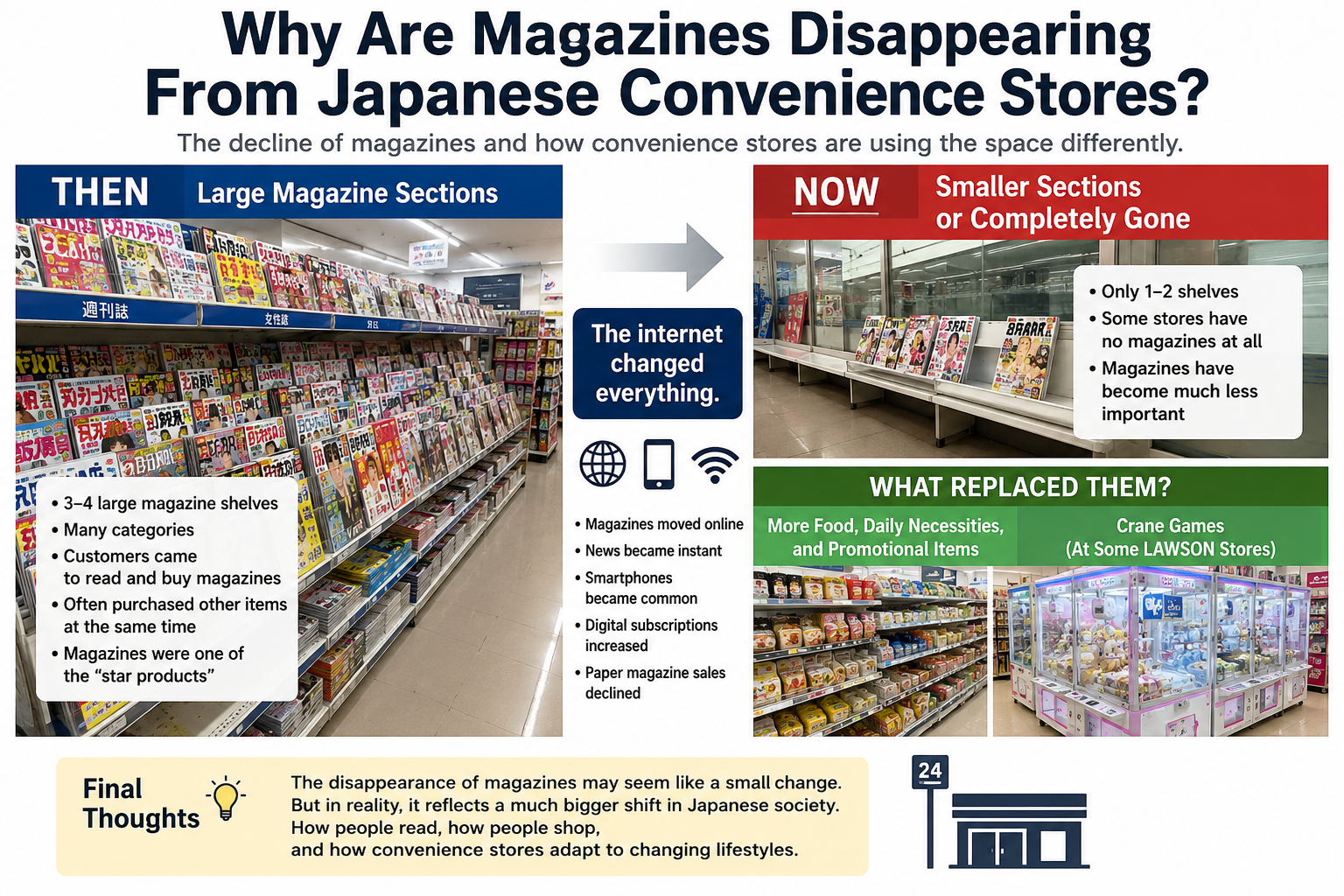
👉 many convenience stores now have very small magazine sections.
Some stores:
👉 no longer sell magazines at all.
However:
👉 this was not always the case.
In fact:
👉 magazines used to be one of the major products of Japanese convenience stores.
When Magazines Were Extremely Important
Years ago:
👉 magazines played a huge role in convenience store business.
Many customers came to convenience stores specifically to:
- read magazines,
- buy magazines,
- and then purchase other products at the same time.
For example:
someone might buy:
- a weekly magazine,
- coffee,
- snacks,
- or cigarettes.
In retail terms:
👉 magazines often increased additional purchases.
From a store manager’s perspective:
👉 magazines were surprisingly valuable products.
In some locations:
👉 customers regularly visited stores just to check the newest issue of their favorite magazine.
At that time:
👉 magazine sections were much larger than they are today.
Many stores had:
👉 three or four large magazine shelves
filled with many different categories such as:
- fashion,
- sports,
- business,
- manga,
- cars,
- travel,
- and weekly news magazines.
For many customers:
👉 convenience stores felt almost like mini bookstores.
So What Happened?
The answer is actually quite simple:
👉 the internet changed everything.
Over time:
- magazines moved online,
- news became instant,
- smartphones became common,
- and digital subscriptions increased.
As a result:
👉 paper magazine sales gradually declined.
And convenience stores adapted.
Today:
👉 magazine sections have become much smaller.
Many stores now have:
👉 only one or two shelves.
Some stores:
👉 have removed magazines completely.
What Replaced the Magazine Shelves?
This is where things become interesting.
When magazines disappeared:
👉 stores suddenly had extra space.
And convenience stores:
👉 hate wasting space.
So many stores replaced former magazine areas with:
- more food products,
- frozen foods,
- daily necessities,
- or seasonal promotional items.
However:
👉 recently, I noticed something unusual.
At several LAWSON stores in Tokyo:
👉 former magazine areas had been replaced with crane games (claw machines).
At first:
👉 I assumed this was simply the decision of an individual store owner.
However:
👉 after seeing it at multiple locations, I began wondering whether this might be part of a larger company experiment.
From a business perspective:
👉 this actually makes sense.
Convenience stores constantly test new ways to use limited space more efficiently.
If crane games attract customers and generate profit from unused floor space:
👉 other convenience store chains may eventually experiment with similar ideas as well.
Honestly:
👉 as someone with many years of convenience store experience, I find this very interesting.
Will this trend spread?
Or disappear quickly?
At this point:
👉 I honestly do not know.
But it is something I will continue watching with great interest.
Final Thoughts
The disappearance of magazines may seem like a small change.
But in reality:
👉 it reflects a much bigger shift in Japanese society.
How people read.
How people shop.
And how convenience stores adapt to changing lifestyles.
Japanese convenience stores are constantly evolving.
And sometimes:
👉 the disappearance of one product quietly tells a much bigger story.
See you next time.
Related Articles
Why Japanese Convenience Stores Are So Efficient
→ Learn how Japanese convenience stores evolved into one of the world’s most efficient retail systems.
Why Japanese Convenience Stores Always Feel One Season Ahead
→ Discover why Japanese convenience stores always seem to stay one season ahead.
Why Every Japanese Convenience Store Suddenly Sells the Same Product
→ Explore how manufacturers and convenience stores work together to shape what appears on store shelves.
コメント