Hello everyone.
Today, I’d like to talk about something many people love:
👉 beer.
If you have ever looked at the beer section in a Japanese convenience store, you may have wondered:
👉 “Why are the prices so different?”
Some cans are expensive, while others are surprisingly cheap — even though they all look similar.
Today, I’ll explain the differences using the typical prices of 350ml cans sold at Japanese convenience stores.
In Japan, these drinks are generally divided into four categories.
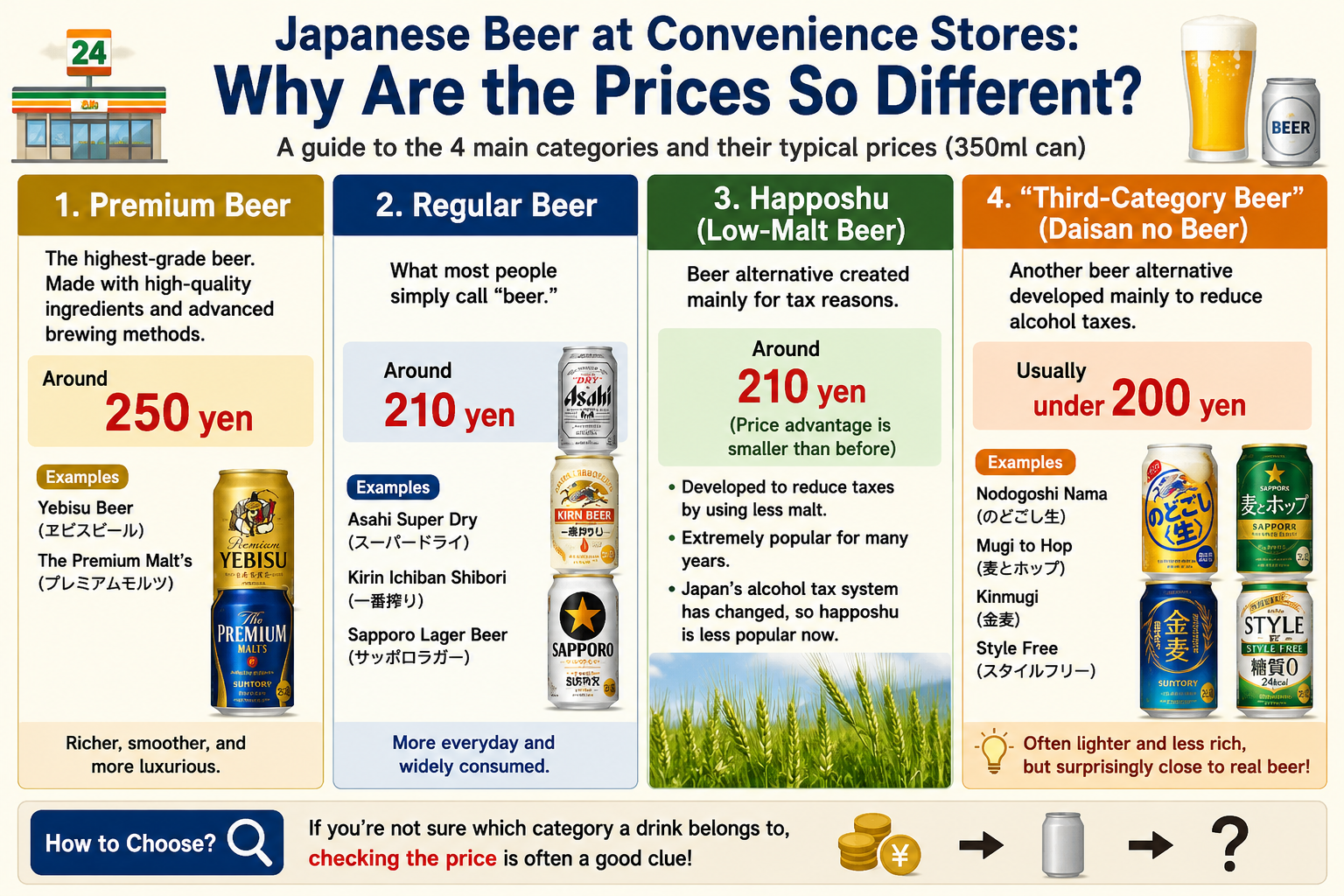
1. Premium Beer
This is the highest-grade category of Japanese beer.
Premium beers are made with higher-quality ingredients and more carefully controlled brewing methods.
At convenience stores, a 350ml can usually costs around:
👉 250 yen
Popular examples include:
- Yebisu Beer (ヱビスビール)
- The Premium Malt’s (プレミアムモルツ)
These beers are often richer, smoother, and slightly more luxurious than ordinary beer.
2. Regular Beer
This is what most people would simply call “beer.”
At convenience stores, a 350ml can usually costs around:
👉 210 yen
Popular examples include:
- Asahi Super Dry (スーパードライ)
- Kirin Ichiban Shibori (一番搾り)
- Sapporo Lager Beer (サッポロラガー)
Compared to premium beer, these products are more everyday and widely consumed.
3. Happoshu (Low-Malt Beer)
Happoshu is a beer alternative created mainly for tax reasons.
For many years in Japan, alcohol taxes changed depending on the amount of malt used in the drink.
To reduce taxes and lower prices, Japanese companies developed happoshu using different ingredient balances and lower malt content.
Because it was cheaper than regular beer, happoshu became extremely popular for many years.
However:
👉 Japan’s alcohol tax system has gradually changed in recent years.
Because of this, happoshu has lost much of its price advantage and is less popular than before.
4. “Third-Category Beer” (Daisan no Beer)
This is perhaps the most uniquely Japanese category.
Like happoshu, it was developed mainly to reduce alcohol taxes.
Because Japanese alcohol taxes traditionally became higher when drinks contained large amounts of malt, companies spent years developing beer alternatives using different ingredients.
These products became unofficially known as:
👉 “Third-category beer” (第三のビール)
Some products use ingredients such as:
- soy protein
- peas
- other alternative materials
Popular examples include:
- Nodogoshi Nama (のどごし生)
- Mugi to Hop (麦とホップ)
- Kinmugi (金麦)
- Style Free (スタイルフリー)
The price is usually:
👉 under 200 yen
Personally, I think many of these products taste surprisingly close to real beer.
They are often slightly lighter and less rich, but if someone served one to you without explanation, you might simply think:
👉 “Oh, this is just another type of beer.”
Final Thoughts
Japanese convenience stores sell a huge variety of beer products, and the pricing can seem confusing at first.
However, once you understand the tax history behind them, the differences make much more sense.
So if you are unsure which category a drink belongs to:
👉 checking the price is often a good clue.
Thank you for reading, and see you next time!
Related Articles
- Japanese Alcohol at Convenience Stores (Part 1)
An introduction to Japanese alcoholic drinks commonly sold at convenience stores. - Convenience Store vs Supermarket in Japan — Which Should You Use?
Why supermarkets and convenience stores are better for different kinds of shopping in Japan. - Why Every Japanese Convenience Store Suddenly Sells the Same Product
How seasonal promotions and limited-time products influence convenience store sales in Japan.
コメント