Hello everyone.
Today, I’d like to talk about something that may surprise visitors to Japan.
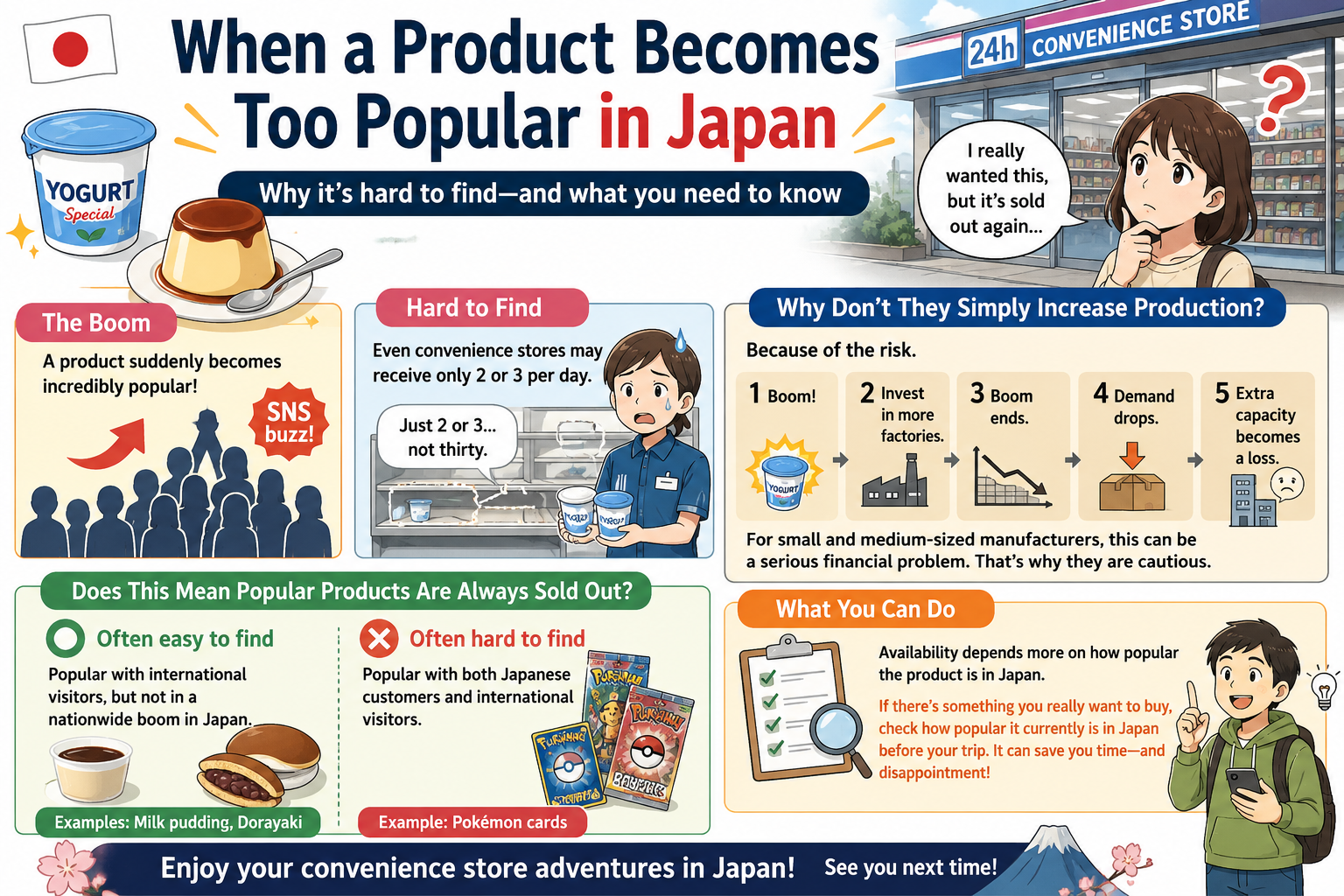
Have you ever seen a snack, drink, or dessert suddenly become incredibly popular, only to be almost forgotten a year later?
In Japan, we often call this kind of phenomenon a “boom.”
And when a product becomes part of a nationwide boom, something interesting often happens: it becomes extremely difficult to find.
The same thing happens at convenience stores.
For example, imagine that a certain yogurt suddenly becomes a huge hit across Japan.
You might expect convenience stores to receive dozens of cups every day.
In reality, a store may receive only two or three.
Not thirty.
Just two or three.
Why Is the Supply So Limited?
The reason is simple.
The manufacturer never expected such enormous demand.
Factories are usually designed to produce enough products for normal levels of demand. If something suddenly becomes a nationwide sensation, production cannot always increase at the same speed.
This leads to an obvious question:
Why doesn’t the manufacturer simply expand production?
The answer is risk.
Imagine what could happen:
- A product suddenly becomes extremely popular.
- The manufacturer invests heavily in new equipment or expands its factory.
- A year later, the boom ends.
- Demand suddenly falls.
- The company is left with production capacity it no longer needs.
For a large company, this may be manageable.
For a small or medium-sized manufacturer, however, making a major investment because of a temporary boom can create a serious financial problem.
That is why manufacturers are often cautious about dramatically increasing production just because a product has suddenly become popular.
The boom may disappear before the investment pays off.
Does This Mean Popular Products Are Always Sold Out?
Fortunately, no.
There is an important difference between products that are popular with international visitors and products that are currently booming in Japan.
For example, Japanese desserts such as milk pudding and dorayaki are popular with many international visitors. However, they are usually relatively easy to find because they are not necessarily experiencing a nationwide boom among Japanese consumers.
On the other hand, something like Pokémon cards can be extremely popular with both Japanese customers and international visitors.
When that happens, finding them can be much more difficult.
So if you cannot find something at a Japanese convenience store, it does not necessarily mean the store is poorly stocked.
Sometimes, the product is simply too popular.
In the end, availability often depends more on how popular the product currently is in Japan than on how popular it is with tourists.
If there is something you absolutely want to buy during your trip, it may be worth checking its current popularity in Japan before you arrive.
It could save you a lot of time—and disappointment.
I hope you enjoy your convenience store adventures in Japan.
See you next time!
Related Articles
👉 Why Japanese Convenience Stores Always Feel One Season Ahead
Learn how Japanese convenience stores predict demand and adjust their products according to the season.
👉 What Does a Convenience Store Manager Actually Do? (Part 1) — Why Product Ordering Is So Difficult
Discover how convenience store managers decide what products to order—and how difficult it can be when demand suddenly changes.
👉 Why Every Japanese Convenience Store Suddenly Sells the Same Product
Learn how promotions can suddenly increase demand for certain products at Japanese convenience stores.
👉 Why Are Magazines Disappearing From Japanese Convenience Stores?
See how convenience stores constantly change their limited shelf space as customer demand evolves.
👉 Why Has Chewing Gum Almost Disappeared from Japanese Convenience Stores?
Discover what happens when consumer demand shifts and one product category gradually loses shelf space.
コメント