Hello everyone.
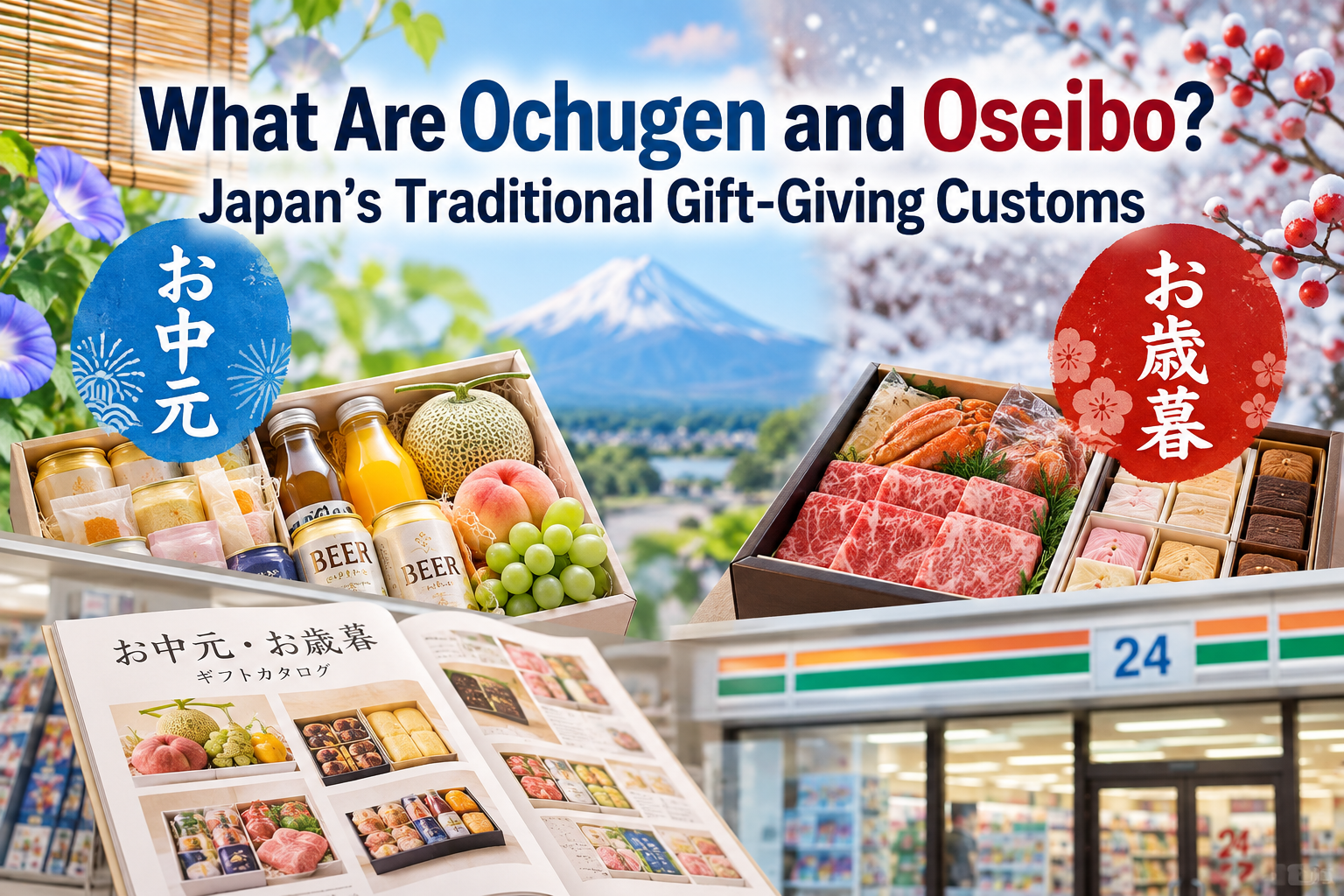
Today, I’d like to introduce two traditional Japanese gift-giving customs: ochugen and oseibo.
If you visit Japan at certain times of the year, you may see these words in department stores, supermarkets, online shops, and even convenience stores.
Both traditions are still alive today, although they seem to be less common than they once were.
So, what exactly are ochugen and oseibo?
What Is Ochugen?
Ochugen is a traditional summer gift.
People send gifts to those who have helped or supported them, such as relatives, business contacts, teachers, or other important people in their lives.
The basic message behind the gift is something like:
“Thank you for everything you do for me, and I hope you stay healthy during the hot summer.”
The traditional timing varies depending on the region.
In the Tokyo area, ochugen gifts are generally sent around early to mid-July. In some other parts of Japan, the season comes later and may extend into August.
Popular gifts include beer, juice, coffee, sweets, fruit, cooking oil, and other food and drink sets.
Many of these products are packaged in special gift boxes.
What Is Oseibo?
Oseibo is similar to ochugen, but it is an end-of-year tradition.
Oseibo gifts are usually sent in December, often from early in the month until around December 20.
The message is simple:
“Thank you for everything you’ve done for me this year.”
Traditionally, oseibo has sometimes been regarded as a slightly more important or substantial gift-giving occasion than ochugen because it expresses gratitude for the entire year.
Popular gifts include sweets, alcohol, meat, seafood, coffee, cooking oil, and other gift sets.
So, in simple terms:
Ochugen = Thank you in summer.
Oseibo = Thank you at the end of the year.
You Can Even Order Them at Convenience Stores
This may surprise some visitors to Japan.
Convenience stores have also handled ochugen and oseibo gifts.
Customers can look through a catalog in the store, choose a gift, place an order, and have it delivered directly to the recipient.
Depending on the convenience store chain and the year, the catalogs may include products offered in cooperation with department stores, food manufacturers, gift companies, and other suppliers.
In other words, you don’t necessarily have to go to a department store to send a traditional Japanese seasonal gift.
You may be able to order one at your local convenience store.
However, after many years of working in convenience stores, I have noticed something.
Not many customers seem to use this service anymore.
Why?
Why Don’t Many People Order Them at Convenience Stores?
There are probably several reasons.
One simple reason is that customers usually choose the gift from a catalog.
They cannot always see the actual product before ordering it.
At a department store, customers may be able to see displays or examples of the products and ask specialized staff for advice.
And today, there is another powerful competitor:
online shopping.
It is now extremely easy to compare hundreds of gifts, prices, brands, and delivery options without leaving home.
But I think there is an even bigger reason.
Japanese society itself has changed.
A Tradition That Is Gradually Changing
In the past, it was more common for people to send ochugen or oseibo gifts to their bosses, business partners, relatives, and others with whom they had an ongoing relationship.
Today, this kind of formal gift-giving appears to be less common in many workplaces.
Some companies also restrict or prohibit employees from accepting gifts from business partners because of compliance rules, conflict-of-interest policies, or concerns about inappropriate business relationships.
Family relationships have changed as well.
In the past, extended families often had more regular contact, and seasonal gifts were one way of maintaining those relationships.
Today, many people have less frequent contact with distant relatives.
As those relationships change, the social role of ochugen and oseibo may also become smaller.
Are Ochugen and Oseibo Disappearing?
Not yet.
Department stores, supermarkets, online retailers, and some convenience stores still offer seasonal gift services, and many people continue to send ochugen and oseibo.
However, compared with the past, these customs seem to be becoming less central to everyday Japanese life.
Perhaps they will never completely disappear.
Instead, they may simply change.
People may send gifts to fewer people, choose less formal gifts, or use online services instead of visiting a department store or convenience store.
The Most Important Part May Remain
Personally, I like the basic idea behind these traditions.
Of course, you don’t need to buy someone a gift to show your appreciation.
But taking the time to tell someone,
“Thank you for everything you’ve done for me.”
is something worth keeping.
The traditional forms of ochugen and oseibo may gradually become less common.
But I hope the idea behind them—the habit of expressing gratitude to the people who have helped us—doesn’t disappear.
Thank you for reading!
Related Articles
👉 Why Every Japanese Convenience Store Suddenly Sells the Same Product
Discover how Japanese convenience stores use seasonal events and special promotions throughout the year.
👉 Convenience Store Events in Japan: Setsubun
Learn about another traditional Japanese custom that has become closely connected with modern convenience-store culture.
👉 November 11 Is Pocky Day in Japan
See how seasonal events and special days influence the products and promotions you find in Japanese convenience stores.
👉 How to Send Luggage in Japan: An Easy Guide to Yamato Takkyubin Delivery Slips
Learn how Japan’s convenience stores also serve as convenient locations for sending packages and deliveries.
👉 Is Japan Really a “Manual-Based Society”? — A Convenience Store Perspective
Explore another side of Japanese culture and how social customs and rules influence everyday life.

コメント