Hello everyone.
Today, I’d like to introduce three popular traditional Japanese sweets: dango, daifuku, and manju.
If you’re visiting Japan for the first time, they may look quite similar.
They’re usually small and round, and many varieties are served with anko, the sweet red bean paste commonly used in Japanese sweets.
But dango, daifuku, and manju are actually quite different, especially when it comes to their texture and how they’re made.
So, how can you tell them apart?
Let’s take a look.
First, What About Mochi?
Before we start, there’s one important thing to understand.
People sometimes use the word mochi very broadly when talking about Japanese rice-based sweets, but dango and daifuku aren’t exactly the same thing.
Traditional mochi is made by steaming and pounding glutinous rice until it becomes soft, sticky, and stretchy.
Daifuku has a soft, stretchy mochi outer layer, usually wrapped around a sweet filling.
Dango, on the other hand, is generally made by mixing rice flour with water and then boiling or steaming the dough.
Manju is different from both. Its outer layer is usually made from a flour-based dough.
That’s the basic difference.
Now let’s look at each one.
1. Dango
Let’s start with dango.
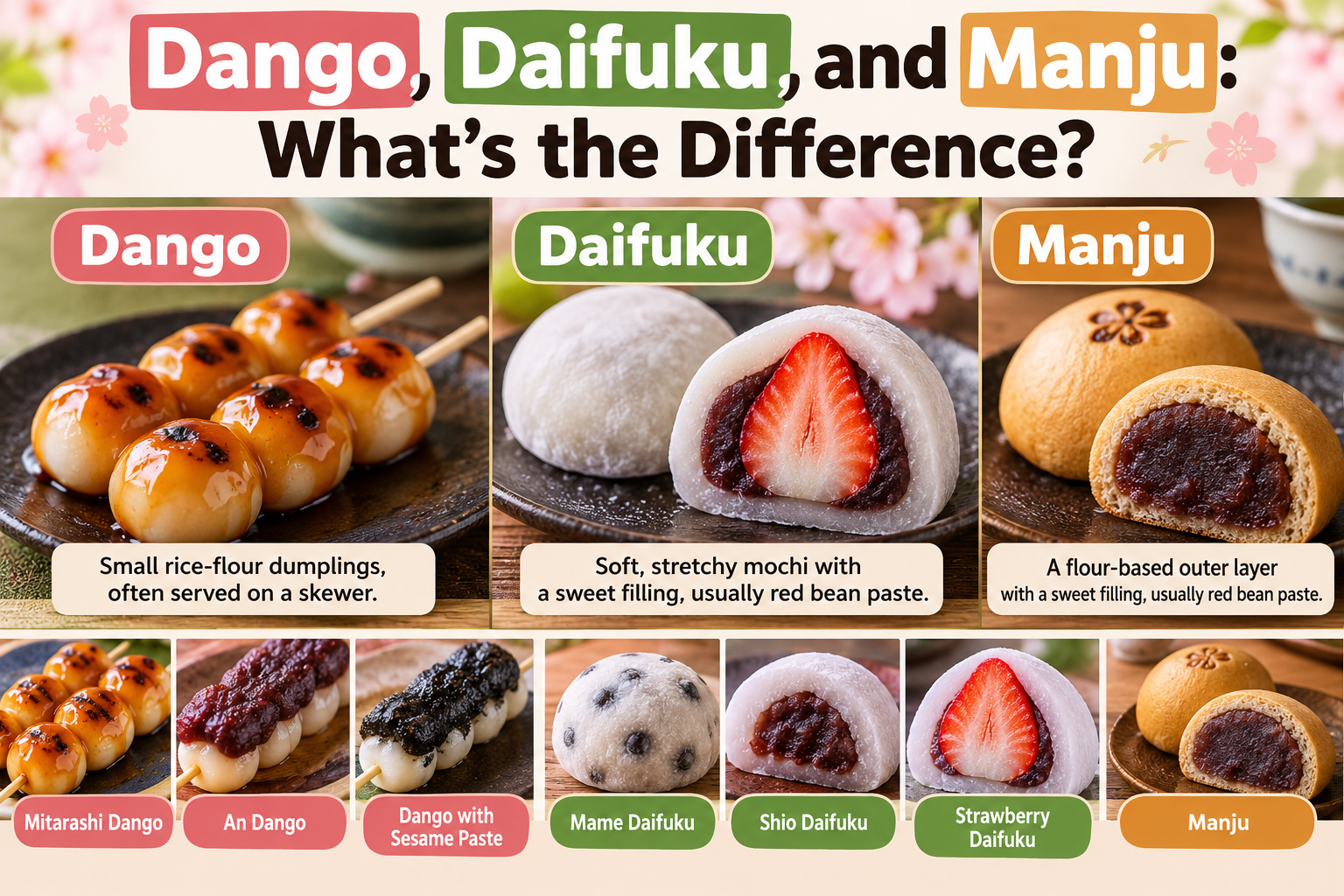
Dango are small rice-flour dumplings, and several pieces are often served together on a wooden skewer.
At Japanese convenience stores, you’ll commonly find a few different varieties.
Mitarashi Dango
This is probably one of the most popular types of dango in Japan.
The dango are covered with a thick, glossy sauce made mainly from soy sauce and sugar.
The interesting thing about mitarashi dango is the combination of sweet and salty flavors.
If you’ve never tried it before, the taste may surprise you.
But somehow, it works!
An Dango
An dango is topped with sweet red bean paste.
If you like anko, this is one of the simplest and most traditional ways to enjoy it with dango.
Dango with Sesame Paste
You may also find dango covered with a sweet sesame-based paste or sauce.
Sesame has a rich and distinctive flavor, so this version tastes quite different from mitarashi dango or an dango.
If you see these varieties at a convenience store, they’re all worth trying.
2. Manju
Next is manju.
One easy way to understand manju is to think of it as a small Japanese sweet bun.
The outer layer is usually made from a flour-based dough, while the inside typically contains sweet red bean paste.
Compared with daifuku, the outside is much less stretchy and has a texture closer to a soft steamed cake or bun.
So if you’re looking at manju and daifuku and aren’t sure which is which, take a look at the outer layer.
Daifuku looks soft, smooth, and stretchy.
Manju usually looks more like a small steamed cake or bun.
There are actually many different kinds of manju throughout Japan, including regional specialties, although the selection at an ordinary convenience store may be fairly limited.
3. Daifuku
Finally, we have daifuku.
Daifuku is one of Japan’s best-known traditional sweets.
It has a soft, stretchy mochi outer layer wrapped around a sweet filling, usually red bean paste.
But today, you’ll find many different varieties.
Mame Daifuku
Mame daifuku contains beans in the outer mochi layer.
The combination of soft mochi, beans, and sweet red bean paste gives it a distinctive texture.
Shio Daifuku
Shio means “salt” in Japanese.
A small amount of salt is used to create a contrast with the sweetness of the red bean paste.
Adding salt to a sweet may sound unusual, but it can actually make the sweetness stand out even more.
It’s a simple but surprisingly effective combination.
And Then There’s Strawberry Daifuku
One of the most interesting varieties is ichigo daifuku, or strawberry daifuku.
For Japanese people, this isn’t unusual anymore. It’s already a very popular sweet.
But if you’ve never seen one before, the combination may surprise you.
A whole fresh strawberry is wrapped together with sweet red bean paste inside a soft layer of mochi.
Some modern versions, including ones sold at convenience stores, also contain whipped cream.
The combination is excellent:
soft mochi + sweet red bean paste + fresh strawberry
The slightly tart freshness of the strawberry works surprisingly well with the sweetness of the anko and the soft texture of the mochi.
Strawberry daifuku is particularly common during strawberry season, especially from winter into spring.
If you see one in a Japanese convenience store, I definitely recommend giving it a try.
So, What’s the Difference?
Here’s the easiest way to remember the difference:
Dango: Small rice-flour dumplings, often served on a skewer with a sweet or sweet-and-salty topping.
Daifuku: Soft, stretchy mochi wrapped around a sweet filling, usually red bean paste.
Manju: A flour-based outer layer with a sweet filling, usually red bean paste.
They may look similar at first, but once you’ve tried all three, you’ll realize that their textures are completely different.
And that’s part of the fun of exploring Japanese sweets.
So next time you visit a Japanese convenience store, take a look at the traditional sweets section.
Instead of simply choosing something that looks familiar, why not try dango, daifuku, and manju and compare them for yourself?
You might discover a new favorite Japanese sweet.
Thank you for reading!
Related Articles
👉 Why Dorayaki Is So Popular in Japan (The Real Reason)
Discover another classic Japanese sweet filled with anko and commonly found at convenience stores.
👉 What Are Tsukimi Dango?
Learn about tsukimi dango, the traditional rice dumplings connected with Japan’s autumn moon-viewing season.
👉 The Green Tea at Japanese Convenience Stores Is Not Matcha
Learn the difference between traditional matcha and the bottled green tea commonly sold at Japanese convenience stores.
👉 Why This Pudding Is So Popular Among Foreign Customers in Japan
Looking for another Japanese dessert? Discover a popular creamy pudding commonly found at convenience stores.
👉 Why Japanese Convenience Stores Always Feel One Season Ahead
Learn how the seasons influence what Japanese convenience stores put on their shelves.

コメント