Hello everyone.
Japanese convenience stores have become famous around the world for their high-quality products and incredible convenience.
As someone who has spent many years working in the convenience store industry, I’m genuinely happy to see this recognition.
I believe this success was built through the long-term efforts of:
- convenience store headquarters
- franchise owners
- store staff
all working together over many years.
However, at the same time, I also feel that some parts of the industry are still trapped in older ways of thinking.
Today, I’d like to talk about one example of that.
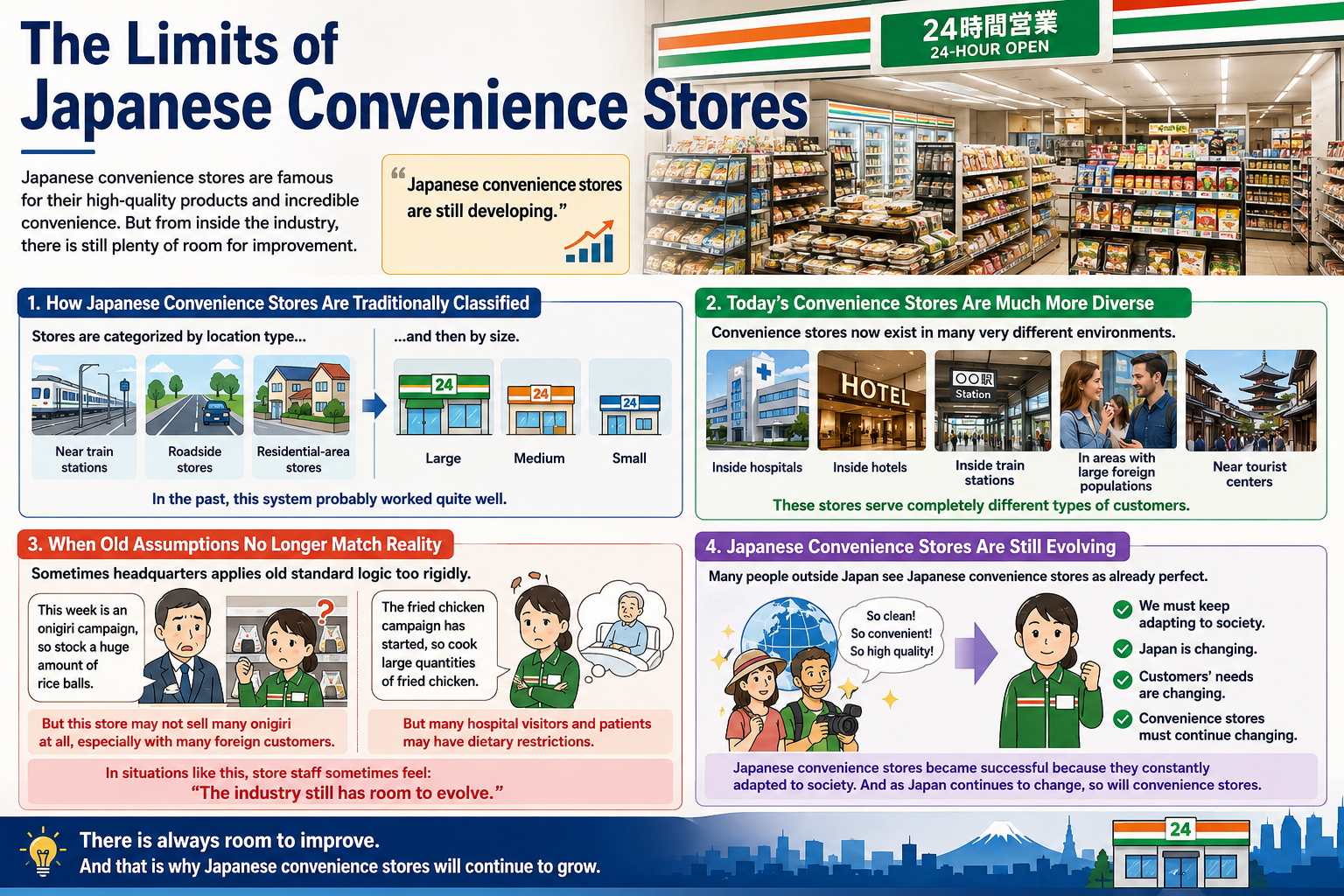
How Japanese Convenience Stores Are Traditionally Classified
In Japan, convenience stores have traditionally been categorized by location type, such as:
- stores near train stations
- roadside stores
- residential-area stores
Then, each store is further classified by size:
- large
- medium
- small
As a result, many stores have historically been managed using roughly nine standard operating patterns.
In the past, this system probably worked quite well.
But modern Japan is changing rapidly.
Today’s Convenience Stores Are Much More Diverse
Today, convenience stores exist in many completely different environments, for example:
- inside hospitals
- inside hotels
- inside train stations
- in areas with large foreign populations
- near major tourist destinations
These stores serve very different types of customers.
As a result, the traditional classification system is no longer always sufficient.
When Old Assumptions No Longer Match Reality
Sometimes convenience store headquarters still applies older standard logic too rigidly.
For example, a store with many foreign customers may receive instructions like:
👉 “This week is an onigiri campaign, so stock a huge amount of rice balls.”
But in reality, that particular location may not sell many onigiri at all.
Or a convenience store inside a hospital may receive instructions such as:
👉 “The fried chicken campaign has started, so prepare large quantities of fried chicken.”
Even though many hospital visitors and patients may have dietary restrictions or different needs.
When situations like this happen, store staff sometimes feel:
👉 “The industry still has room to evolve.”
Japanese Convenience Stores Are Still Evolving
Many people outside Japan see Japanese convenience stores as already perfect.
But from inside the industry, I believe there is still plenty of room for improvement.
Japanese convenience stores became successful because they constantly adapted to changes in society.
And as Japan itself continues to change, convenience stores will also need to continue changing.
In that sense:
👉 Japanese convenience stores are still developing.
Related Articles
- What Is a Directly Managed Convenience Store in Japan?
How headquarters-operated stores are used for experiments, training, and operational testing in Japan. - The Future of Convenience Store Owners in Japan
The growing challenges facing convenience store owners in a rapidly changing Japan. - Is Japan Really a “Manual-Based Society”? — A Convenience Store Perspective
Why real convenience store operations often depend more on flexibility and experience than manuals alone.
コメント