Hello everyone.
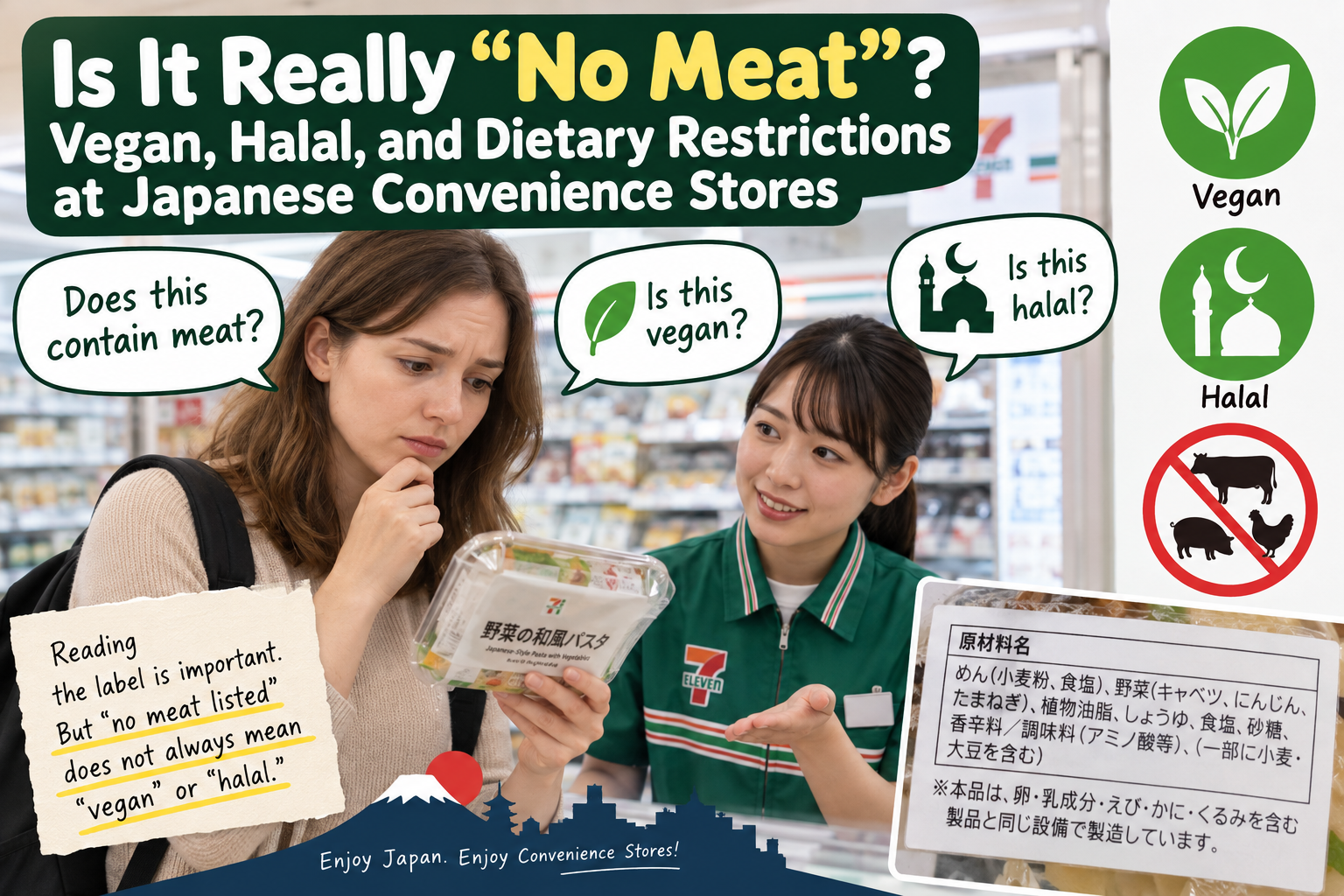
Today, I’d like to talk about something I’m often asked by international customers at Japanese convenience stores:
“Does this contain meat?”
“Is this vegan?”
“Is this halal?”
These are very important questions for people who avoid certain foods for religious, ethical, or personal reasons.
But there is something you should know when shopping at a Japanese convenience store.
Can We Really Say “100% No Meat”?
The short answer is:
Not always.
You may find a convenience-store product that does not appear to contain meat when you check the ingredient list.
However, that does not necessarily mean that a convenience-store employee can confidently tell you:
“Yes, this is 100% vegan.”
or
“Yes, this is definitely halal.”
Why?
Because “I don’t see meat in the ingredient list” and “this product meets vegan or halal standards” are not the same thing.
A product may contain seasonings, extracts, flavorings, or other ingredients whose origins are not obvious to an ordinary customer—or to a convenience-store employee.
There may also be questions about how the food was manufactured or processed.
For people who follow strict dietary or religious rules, these details can be extremely important.
What About Warnings on Japanese Food Packages?
You may also notice warnings on some Japanese food packages saying that the product was manufactured in a facility that also handles certain allergens.
These warnings are mainly intended to provide information about possible allergen cross-contact during manufacturing.
They should not automatically be interpreted as meaning that a product is or is not vegan or halal.
This is another reason why simply looking at one part of the package may not be enough to determine whether a product meets someone’s specific dietary requirements.
Convenience-Store Employees Cannot Guarantee It
This is the most important point.
Convenience-store employees are not food-certification experts.
We can read the ingredient label with you.
We can show you the information written on the package.
We may also be able to help you find products with clearer labeling.
But unless the manufacturer provides clear information or the product has appropriate certification, we should be careful about saying:
“This is definitely vegan.”
“This is definitely halal.”
“This is 100% safe for your dietary requirements.”
In other words:
We can tell you what the label says. But we cannot always tell you whether a product meets your personal religious or dietary standards.
For customers with strict requirements, that distinction is very important.
What Should Strict Vegans or Muslim Travelers Do?
If you need to follow dietary rules strictly, I would not recommend relying entirely on ordinary convenience-store food without checking the product carefully.
Instead, look for options such as:
- halal-certified products
- clearly labeled vegan products
- specialty halal shops
- vegan or vegetarian restaurants and stores
- products for which the manufacturer provides clear dietary information
Japan has gradually become more accommodating to different dietary needs, especially as the number of international visitors has increased.
However, compared with the enormous variety of products sold in Japanese convenience stores, clearly certified halal or vegan options can still be difficult to identify.
Japanese Convenience Stores Still Have Work to Do
Personally, I think this is an area where Japanese convenience stores can improve.
Convenience stores are an important part of everyday life in Japan, and they are also extremely useful for international travelers.
Ideally, customers should be able to walk into a store and quickly identify products suitable for vegans, vegetarians, Muslims, and people with other dietary requirements.
Clearer labels and more certified products would make shopping much easier.
Customer Demand Can Make a Difference
Convenience stores have changed enormously over the years in response to changing customer needs.
Dietary diversity may be one of the next areas where they need to change.
If you would like to see more clearly labeled vegan or halal products, you can also send your feedback directly to convenience-store companies.
A few requests may not make much difference.
But when enough customers ask for the same thing, companies have a stronger reason to develop and sell those products.
So if this issue matters to you, make your voice heard.
And until labeling and product choices improve, remember:
“No meat listed” does not necessarily mean “vegan” or “halal.”
When in doubt, check the label carefully, look for appropriate certification, and contact the manufacturer if you need a definite answer.
See you next time!
Related Articles
👉 Advice for Vegan Visitors Using Japanese Convenience Stores
A practical guide for vegan travelers looking for food at Japanese convenience stores and other places in Japan.
👉 Best Japanese Cup Noodles for Beginners: What Should You Try in Japan?
Learn how to choose Japanese cup noodles and what international visitors should check before buying them.
👉 Don’t Add Hot Water! Some Japanese Convenience Store Ramen Only Needs a Microwave
Discover the ready-to-eat noodles and soups sold at Japanese convenience stores and what to expect from them.
👉 Convenience Store vs Supermarket in Japan — Which Should You Use?
Learn when a convenience store is useful and when a supermarket may offer a better selection for your needs.
👉 The Limits of Japanese Convenience Stores
Japanese convenience stores are incredibly useful, but they cannot provide everything. Here’s where their limitations begin.
コメント